
Trump-Backed World Liberty’s Staking Shakeup: The Game-Changer That Could Skyrocket Your Crypto Rewards—Are You Ready to Play?

You ever wonder what happens when the Trump family throws their weight behind a DeFi platform? Well, World Liberty Financial just shook the boat with a governance proposal that’s as bold as it is intriguing. Picture this: if you want to have your say and cast votes with your WLFI tokens, you’ll have to lock those tokens up—no quick flips allowed. And not just that, they’re sweetening the pot with staking rewards to reward folks who actually get off the sidelines and participate actively. It’s a compelling mix of commitment and incentive, designed to keep the game tight and the power spread out. Whether you’re a casual holder or thinking about going Node or even Super Node—yeah, those tiers come with some serious perks and access—the new system is all about tying governance power to long-term stakes and pushing demand for their USD1 stablecoin. It’s a fascinating push toward decentralizing without letting a few whales run the show. I’m thinking, does this approach signal a seismic shift in how DeFi projects might balance influence and responsibility? Buckle up—this one’s going to be worth watching. LEARN MORE
World Liberty Financial, a DeFi platform backed by the Trump family, has put forward a governance proposal that would require holders of unlocked WLFI tokens to stake them to vote, while offering staking rewards to those who actively participate in governance.
Under the plan introduced on February 26, WLFI holders must lock their tokens for at least 180 days to take part in governance voting.
Participants who cast at least 2 governance votes during their lock-up period would receive an estimated 2% annual return paid from the project’s treasury.
Voting power would be measured by both stake size and remaining lock-up duration using a non-linear formula to limit concentration among the largest holders. The system also links staking to deposit incentives on USD1, World Liberty’s flagship stablecoin.
The proposal also establishes Node and Super Node tiers for larger stakers, offering additional incentives such as access to licensed market makers for 1:1 USD1 stablecoin conversions and prioritized partnership engagement.
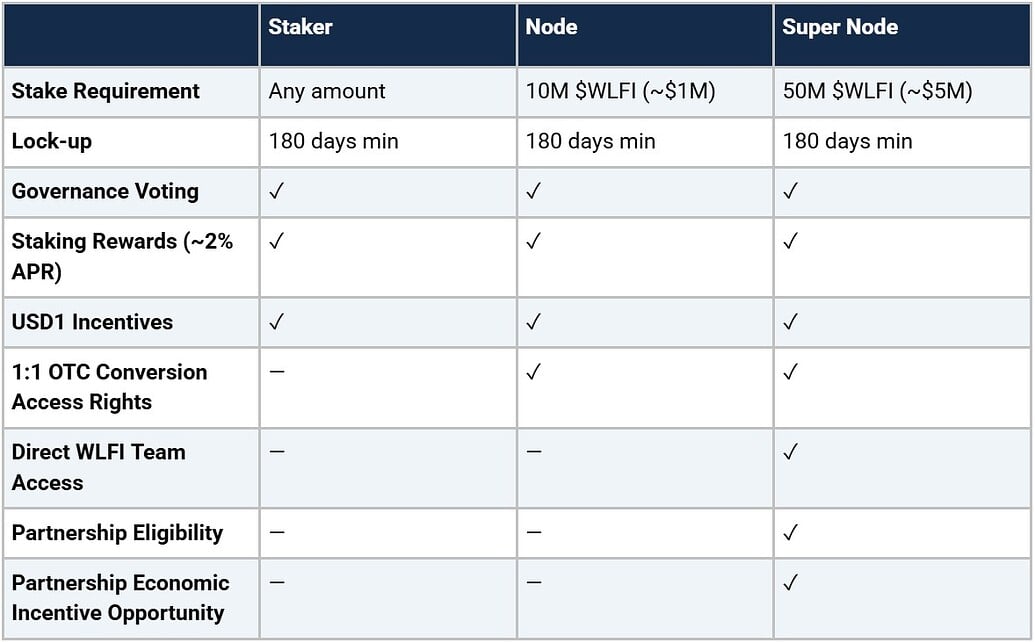
To become a “Node,” users must stake at least 10 million WLFI, valued at roughly $1 million at current prices.
These participants would gain access to licensed market makers facilitating 1:1 conversions of supported stablecoins such as USDT and USDC into USD1, as well as USD1 off-ramps into US dollars.
The move would redirect arbitrage profits from institutional market makers to committed token holders, while strengthening demand for USD1 and tying governance power to long-term capital commitments.
To become a “Super Node,” participants must lock up a minimum of 50 million WLFI. In return, holders would receive priority access to partnership discussions with the platform’s leadership, though commercial agreements remain subject to separate review.
The proposal will be put to a seven-day vote and must secure participation from at least one billion eligible tokens to be valid.
Staking-based governance models have gained traction across decentralized finance projects as developers seek mechanisms to align long-term incentives without relying on centralized oversight.

Fujifilm Instax Mini Instant Film, 20 Sheets – White Daylight ISO 800 for Instax Mini 13, 12, 11, 41 Cameras –Bundeld with The Tudak Store Microfiber Cleaning Cloth
$32.95 (as of October 24, 2026 03:34 GMT +00:00 - More infoProduct prices and availability are accurate as of the date/time indicated and are subject to change. Any price and availability information displayed on [relevant Amazon Site(s), as applicable] at the time of purchase will apply to the purchase of this product.)
Apple EarPods Headphones with USB-C Plug, Wired Ear Buds with Built-in Remote to Control Music, Phone Calls, and Volume
$19.00 (as of October 24, 2026 03:23 GMT +00:00 - More infoProduct prices and availability are accurate as of the date/time indicated and are subject to change. Any price and availability information displayed on [relevant Amazon Site(s), as applicable] at the time of purchase will apply to the purchase of this product.)
ARM & HAMMER Cloud Control Platinum- Improved Packaging Clumping Cat Litter, 34 lb
$32.16 (as of October 24, 2026 03:23 GMT +00:00 - More infoProduct prices and availability are accurate as of the date/time indicated and are subject to change. Any price and availability information displayed on [relevant Amazon Site(s), as applicable] at the time of purchase will apply to the purchase of this product.)
HAOYUYAN Wireless Earbuds, Sports Bluetooth Headphones, 80Hrs Playtime Ear Buds with LED Power Display, Noise Canceling Headset, IPX7 Waterproof Earphones for Workout/Running(Black)
$23.98 (as of October 24, 2026 03:34 GMT +00:00 - More infoProduct prices and availability are accurate as of the date/time indicated and are subject to change. Any price and availability information displayed on [relevant Amazon Site(s), as applicable] at the time of purchase will apply to the purchase of this product.)













Post Comment