
Is Bitcoin’s Slide Below $70K a Canary in the Coal Mine, or the Calm Before an Unstoppable Surge Beyond $100K?
Bitcoin was cruising near $74,000 just last week, standing tall as if ready to prove it’s the ultimate safe haven amid rising global tensions. But oh, how swiftly the tides turned. Now, after a shaky week and a drop to around $69,173, cracks in that armor are showing. Investors, once hopeful that Bitcoin could be the calm within the storm, are suddenly eyeing its notorious volatility with a hint of skepticism—especially as the Strait of Hormuz tensions send oil prices soaring. So, is Bitcoin losing its safe-asset shine, or is this just another plot twist in the grand crypto drama? As the market debates whether it’s gearing up for a big leap or bracing for a tumble, one thing’s clear: understanding Bitcoin’s next move feels a bit like trying to read tea leaves during a storm. LEARN MORE
During the week ending 21st of March, Bitcoin looked strong and was changing hands near the $74,000 price level. Rising global tensions also pushed the idea that it could act as a safe asset, but that idea has weakened this week.
Bitcoin has now fallen to around $69,173, down over 2% in a day and nearly 4% in a week. As tensions around the Strait of Hormuz push oil prices up, investors are now questioning Bitcoin’s volatility.
Polymarket predicts Bitcoin’s next move
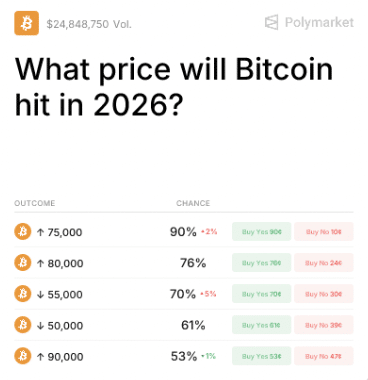
In fact, a recent post by Polymarket has caught attention, with bettors starting to predict,
Bitcoin is now more likely to crash below $45,000 than to reclaim $100,000 this year.

However, a closer look at the data suggests the opposite. There is a strong consensus that Bitcoin [BTC] could trade in the $75,000–$80,000 range, with high confidence among traders reflected in these probabilities.
In fact, lower levels like $55,000 and $50,000 are seen as strong support. Still, the $90,000 level remains low and uncertain, showing the market agrees on moderate growth but is divided on a move beyond $90K.
What’s behind this drop?
Zooming out, Bitcoin’s recent drop makes more sense when you look at the political twists over the past 24 hours.
Just a day ago, Polymarket traders were expecting tensions to ease after U.S. President Donald Trump hinted at slowing down the Iran conflict.
However, that optimism faded quickly.

As soon as the White House shifted its tone and issued more serious threats, Bitcoin reacted sharply, dropping and even slipping below the $68,000 level.
At the same time, this drop may not just be about war news.
Community backs Bitcoin
Some analysts believe this is part of a normal market cycle. After Bitcoin halving events, big corrections, often around 30%, are common as over-leveraged traders get wiped out.
Rather than a crash, this acts as a reset, clearing short-term speculation and building a stronger base for the next rally.
The analyst further added,
Calling for a crash to $45k drastically underestimates the massive, silent buy walls Wall Street has already stacked at the $55k threshold.
Echoing similar sentiments, another X user said,

Bitcoin’s metrics stand firm amidst “Extreme Fear”
Even though Bitcoin’s price is moving up and down a lot, its deeper data shows strength. Bitcoin dominance is around 58.76%, which means more money is moving into Bitcoin compared to altcoins during uncertain times.
However, at the same time, the Crypto Fear & Greed Index sitting in the “Extreme Fear” zone raises questions that something is cooking.

The market appears to be following a familiar pattern. Retail investors tend to enter at higher prices due to FOMO, like in 2017, 2021, and recently near $74,000.

However, right now, retail activity is low, suggesting smaller investors are stepping back, a phase that historically aligns with quiet accumulation by larger players.
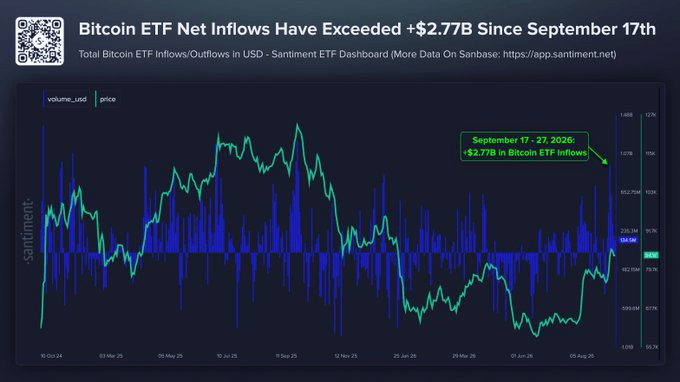
Meanwhile, on the institutional side, Bitcoin ETFs have seen recent outflows, $163.5 million on the 18th of March, $90.2 million on the 19th of March, and $52 million on the 20th of March.
However, these outflows are steadily decreasing, indicating that selling pressure from institutions may be slowing, potentially pointing toward market stabilization.
What to expect?
All in all, right now, Bitcoin’s data is giving mixed signals, making the situation unclear.
Overall, Bitcoin is stuck between positive factors like strong dominance and slowing ETF outflows, and negative factors like global tensions and uncertain investor behavior.
Therefore, until Bitcoin clearly moves above $74,000 or drops and stabilizes near $65,000, the market will likely remain uncertain.
Final Summary
- Bitcoin’s recent drop is not just random; it reflects how strongly global political events are influencing market behavior.
- Despite short-term fear, key indicators like dominance and slowing ETF outflows suggest underlying strength.

Pur Luv Chicken Jerky Dog Treats,100% Real Chicken Breast, 16 Ounces | 3-ingredient jerky: whole-muscle chicken breast, 12g protein/treat; no dyes, fillers or artificial flavors
$14.09 (as of September 29, 2026 03:06 GMT +00:00 - More infoProduct prices and availability are accurate as of the date/time indicated and are subject to change. Any price and availability information displayed on [relevant Amazon Site(s), as applicable] at the time of purchase will apply to the purchase of this product.)
OURA Ring 5 Sizing Kit - Size Before You Buy | Unique Sizing, Not Standard Ring Sizing - Receive Amazon Credit for Oura Ring 5 Purchase
$10.00 (as of September 29, 2026 03:17 GMT +00:00 - More infoProduct prices and availability are accurate as of the date/time indicated and are subject to change. Any price and availability information displayed on [relevant Amazon Site(s), as applicable] at the time of purchase will apply to the purchase of this product.)
Apple AirPods 5 Wireless Earbuds | Bluetooth Headphones, Active Noise Cancellation, Personalized Spatial Audio, Live Translation, USB-C Charging Case, H2 Chip
$129.00 (as of September 29, 2026 03:17 GMT +00:00 - More infoProduct prices and availability are accurate as of the date/time indicated and are subject to change. Any price and availability information displayed on [relevant Amazon Site(s), as applicable] at the time of purchase will apply to the purchase of this product.)
Purina Fancy Feast Grilled Seafood Wet Cat Food, 3 oz Cans, 24-Pack | Variety Pack, crafted with real seafood in savory gravy. Made with no Artificial Colors or Preservatives.
$22.86 (as of September 29, 2026 03:06 GMT +00:00 - More infoProduct prices and availability are accurate as of the date/time indicated and are subject to change. Any price and availability information displayed on [relevant Amazon Site(s), as applicable] at the time of purchase will apply to the purchase of this product.)













Post Comment