MiniMax Group’s Jaw-Dropping 400% Surge Sparks Eyes on Shanghai STAR Market—Is the Next Big Play Unfolding?
Ever wonder how a company can rocket from a four-year startup to a $33.7 billion giant in just a handful of months? MiniMax Group, a Shanghai-based generative AI firm, is precisely that kind of disruptor, blazing a trail through the financial world by kicking off its listing on Shanghai’s STAR Market. Imagine buying shares at IPO and watching them quintuple — that’s exactly what early investors in MiniMax experienced, turning modest bets into hefty windfalls almost overnight. This move isn’t just about swelling stock prices or impressive numbers; it taps into a broader shift in China’s tech landscape, where innovators like MiniMax are rewriting the playbook on growth, regulation, and cross-border investments. As the company eyes a dual A+H listing, the stakes — and questions — only get higher: What does this mean for investors navigating the tricky waters of dual-listed shares? And how will MiniMax’s meteoric rise reshape the global AI arena? Buckle up — this isn’t your typical IPO story. LEARN MORE
MiniMax Group, the Shanghai-based generative AI company, has formally kicked off the process to list on Shanghai’s STAR Market. The company signed a mentorship agreement with CITIC Securities on May 29 and submitted its filing to the Shanghai office of the China Securities Regulatory Commission.
If successful, MiniMax would land a dual A+H listing structure, pairing its existing Hong Kong shares with a new mainland China offering.
From IPO to powerhouse in five months
The company raised approximately $619 million in its Hong Kong IPO at HK$165 per share. By May 29, those shares were trading at HK$840.
That’s roughly a 400% gain. In English: if you bought $10,000 worth of MiniMax at IPO, you’d be sitting on about $50,000 five months later.
The surge has pushed MiniMax’s market capitalization to approximately HK$264 billion, or about $33.7 billion. For context, that puts the company in the same valuation neighborhood as some well-established US tech firms, despite being founded just four years ago in January 2022.
Revenue has kept pace with the stock price enthusiasm. MiniMax’s post-IPO revenue more than doubled year-over-year, reaching $79 million in 2025. The growth has been driven by AI-native applications, including video generation tools.
Founded by Yan Junjie, the company specializes in large language models and generative AI. It competes directly with other Chinese LLM developers like Zhipu AI, which is also pursuing its own A-share listing.
Why the STAR Market matters
Shanghai’s STAR Market was specifically designed for technology-focused companies, launched in 2019 to give homegrown tech firms a domestic venue that doesn’t require the profitability track record demanded by traditional exchanges.
For MiniMax, listing there opens the door to mainland Chinese investors who may not have access to Hong Kong-listed shares. The CSRC filing represents the first formal step in what will be a multi-stage review process before shares can actually begin trading.
A broader trend in Chinese AI
MiniMax isn’t the only Chinese AI company eyeing public markets. Zhipu AI, another large language model developer, is pursuing a similar A-share listing path.
What this means for investors
At a $33.7 billion market cap on $79 million in annual revenue, MiniMax is trading at a revenue multiple north of 400x.
On the risk side, dual-listed shares can create pricing complexities. A+H listed companies in China frequently trade at different valuations on each exchange, sometimes with significant premiums or discounts between the two.
There’s also the regulatory dimension. MiniMax will need to satisfy CSRC requirements around financial disclosure, corporate governance, and technology IP ownership.
Bolux Dog Harness, No-Pull Reflective Dog Vest, Breathable Adjustable Pet Harness with Handle for Outdoor Walking - No More Pulling, Tugging or Choking (Black, S)
$16.98 (as of September 21, 2026 03:10 GMT +00:00 - More infoProduct prices and availability are accurate as of the date/time indicated and are subject to change. Any price and availability information displayed on [relevant Amazon Site(s), as applicable] at the time of purchase will apply to the purchase of this product.)
Earth Rated Dog Poop Bags on Refill Rolls, 270 Bags, Lavender | Guaranteed Leak Proof and Extra Thick Waste Bag Refill Rolls
$14.99 (as of September 21, 2026 03:04 GMT +00:00 - More infoProduct prices and availability are accurate as of the date/time indicated and are subject to change. Any price and availability information displayed on [relevant Amazon Site(s), as applicable] at the time of purchase will apply to the purchase of this product.)
FlavCity Vanilla All in One Protein Shake Powder - On the Go Meal Alternative + Collagen Peptides, Reishi & Cordyceps - Focus, Skin, Hair & Joint Support - 100% Grass Fed Whey, 20 Servings
$59.98 (as of September 21, 2026 03:22 GMT +00:00 - More infoProduct prices and availability are accurate as of the date/time indicated and are subject to change. Any price and availability information displayed on [relevant Amazon Site(s), as applicable] at the time of purchase will apply to the purchase of this product.)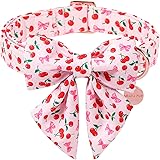
UP URARA PUP Spring and Summer Dog Collar with Bow Tie, Cherry Bowtie Collar Adjustable for Girl Boy Dog, Spring Pink Bow Collar for Dogs, M
$16.99 (as of September 21, 2026 03:10 GMT +00:00 - More infoProduct prices and availability are accurate as of the date/time indicated and are subject to change. Any price and availability information displayed on [relevant Amazon Site(s), as applicable] at the time of purchase will apply to the purchase of this product.)








Post Comment