
Unlocking the S&P 500’s Secret Rhythm: How Elliott Wave Analysis Could Reveal the Next Market Twist Before Everyone Else Does
Ever get that feeling the market’s got a secret it’s itching to spill—like it’s playing hard to get, but you just know a big move’s brewing? Back on June 3, when the S&P 500 was chilling near $7,570, the Elliott Wave Principle, teamed up with market breadth, boldly suggested a sizable decline could be looming, potentially dragging on for months. Fast-forward a couple of weeks, and we saw the index dip to $7,237 before bouncing back to $7,456—proof the waves are rolling just like the script predicted. Now, eyes are set on the next drop, somewhere between $6,840 and $7,075, hinging on that Fibonacci magic, assuming the index stays shy of $7,598. What’s fascinating—and frankly, exciting—is watching these patterns unfold with such precision. It begs the question: in a sea of noise and chaos, can the Elliott Wave Principle really give us a crystal ball moment? Let’s dive into how this age-old method keeps proving its worth in today’s wild market waters. LEARN MORE
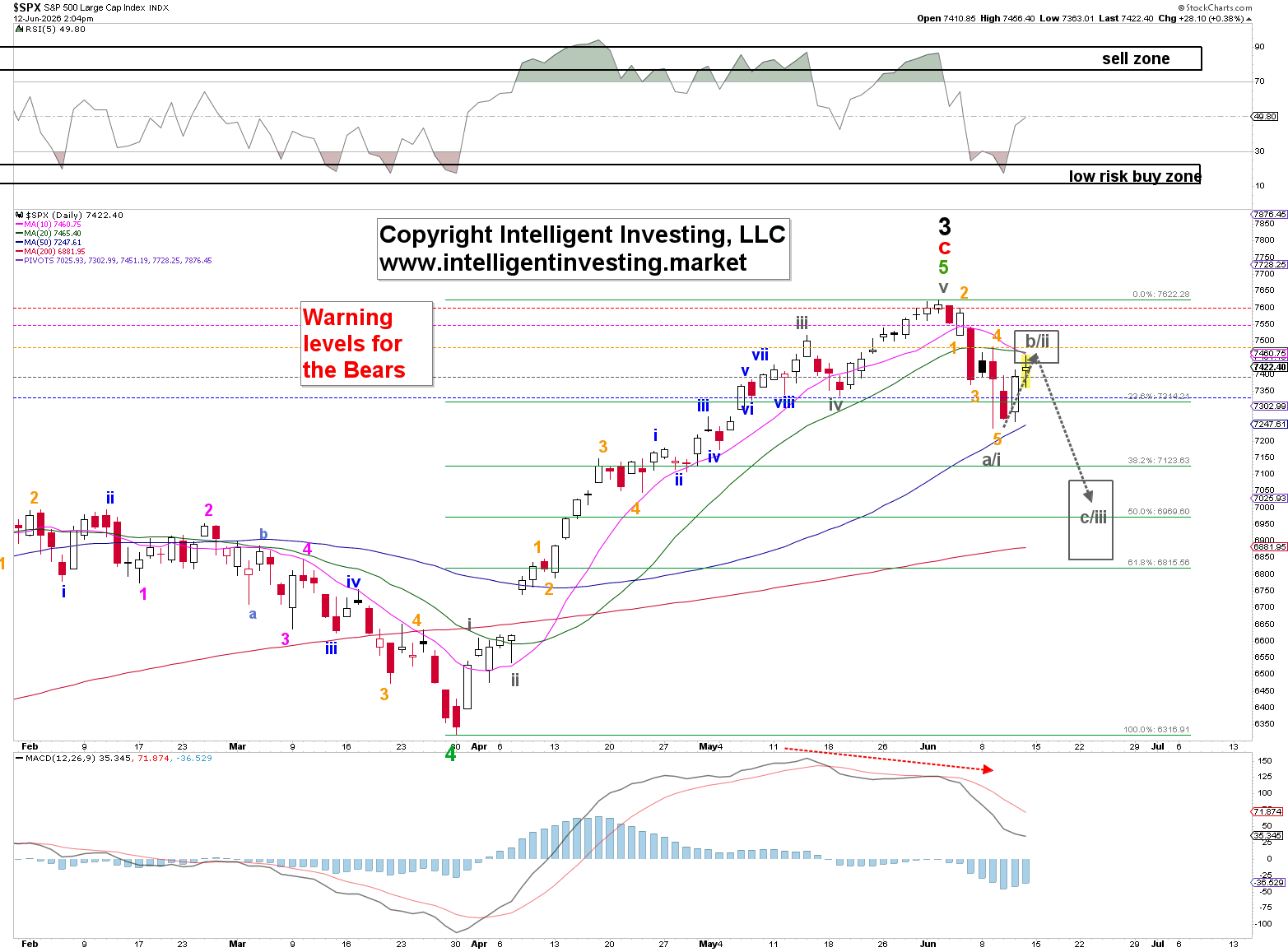
In the June 3 update, when the S&P 500 (SPX) was trading at around $7,570, it was shown, using the Elliott Wave Principle combined with market breadth, that “the weight of the evidence points toward a large-degree decline that could last several months.”
Fast-forward to today: the index fell to $7,237 on Tuesday and has since rallied to $7,456. So far, so good. We now expect the next leg lower to $6,840-7,075, depending on the Fibonacci relationship: (gray) c/iii = 1.618x a/i to c/iii = a/i. This assumes the index holds below $7,598. See Figure 1 below.
Figure 1. Short-term Elliott Wave count with technical indicators for the SP500
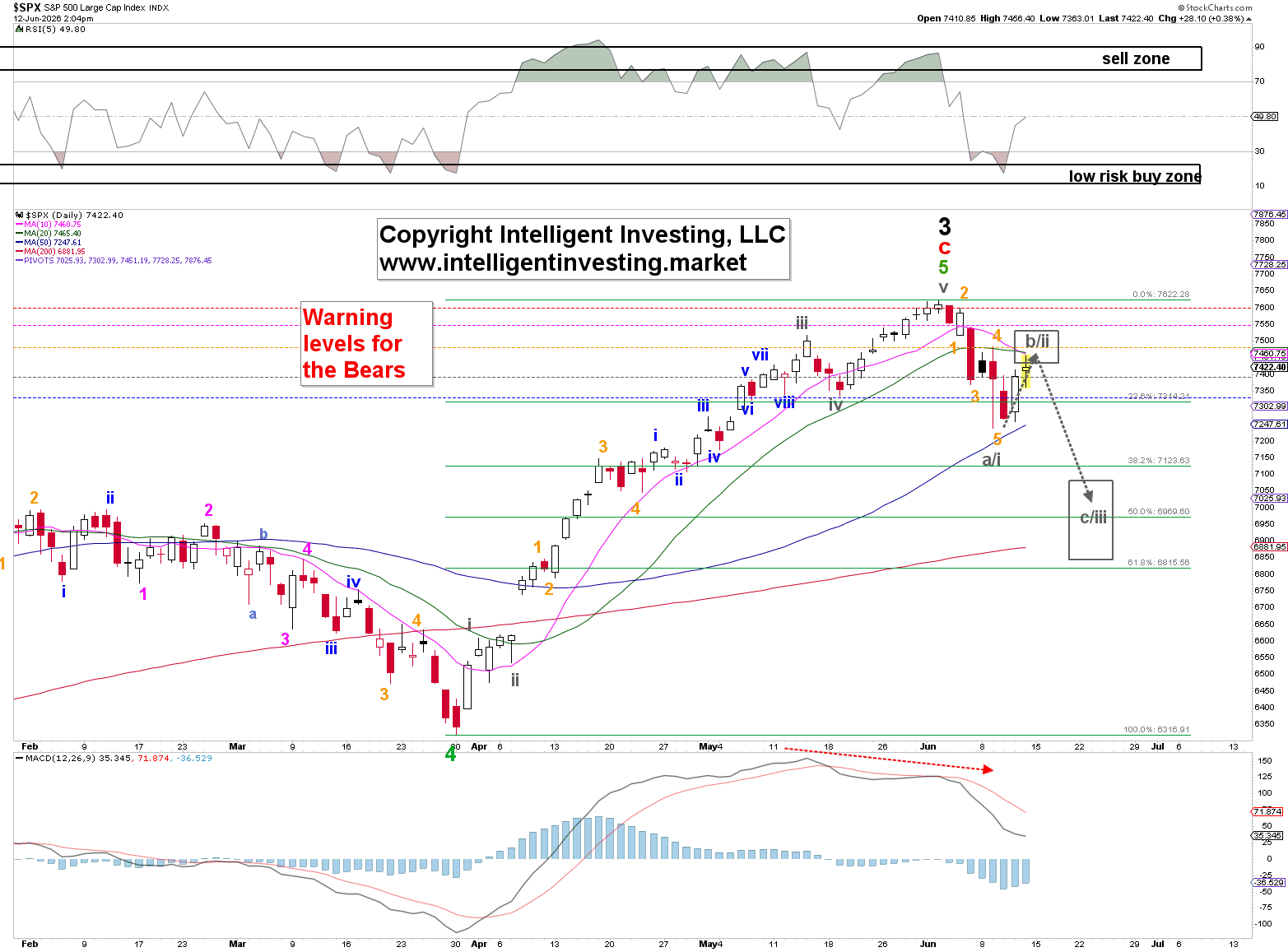
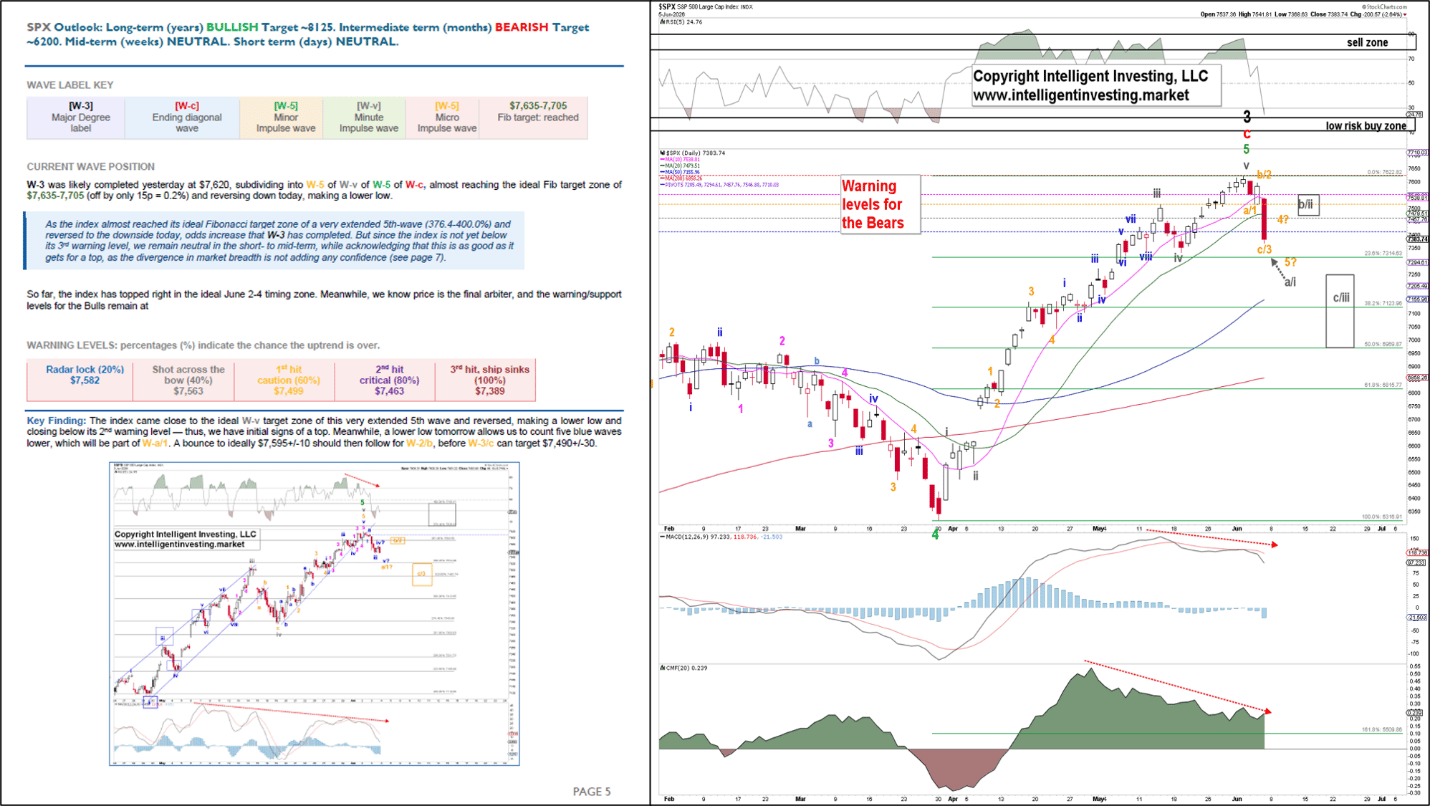
With the intermediate-term picture in place, I wanted to share how the index has been correctly tracked over the past weeks to demonstrate the EWP’s accuracy and reliability. Specifically, in Wednesday’s June 3 Newsletter, it was forecasted that
“A lower low tomorrow allows us to count five blue waves lower, which will be part of W-a/1. A bounce to ideally $7,595+/-10 should then follow for W-2/b, before W-3/c can target $7,490+/-30.”
The index opened lower on June 4 at $7,516, rallied to $7,598 that same day, and then dropped to $7,368 on June 5. The latter target was slightly below expectations, as the index moved beyond the more common 161.80% extension for a 3rd/C-wave. However, direction is far more important than a 1.2% small miss in magnitude. Thus, so far, that’s three for three. See Figure 2 below.
Figure 2. June 3 Newsletter Forecast vs Actual Market Performance by June 5
With three waves lower, it remained uncertain whether a 4th wave up and a 5th wave lower would develop. Regardless, “After three waves lower, always expect at least three waves back up.” The index gave us three waves up, with an up day on June 8 and a reversal on June 9, thereby completing five (orange) waves lower: see Figure 1.
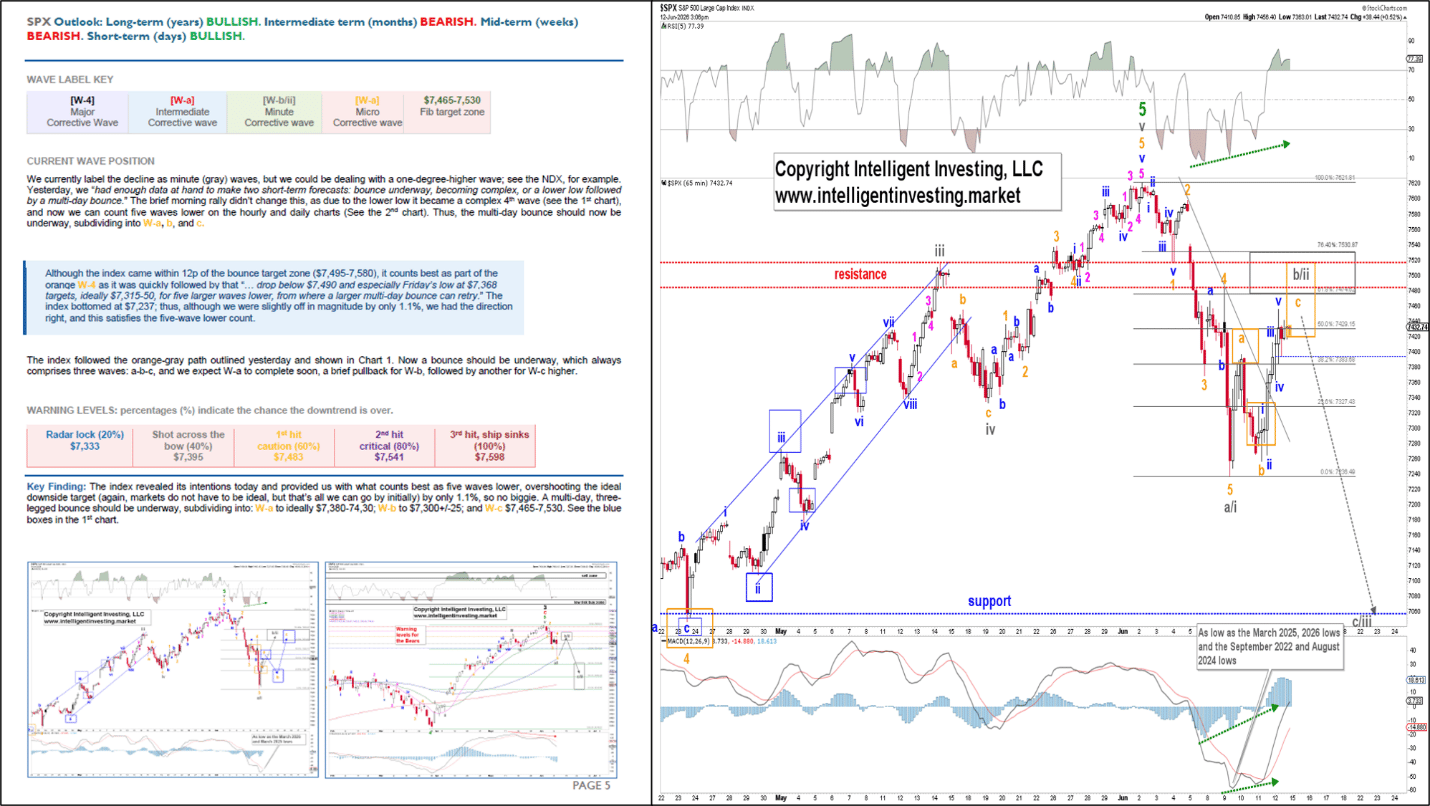
With five (orange) waves lower on the books, our lives were made easier again, as we know from the EWP that a three-wave bounce – gray W-b/ii – must be expected, followed by another leg lower: gray W-c/iii. So, in the June 9 Newsletter, see Figure 3 below, a multi-day a-b-c corrective bounce was expected with these precise targets:
→ (Orange) W-a to $7,380-7,430 (reached $7,396 on Wednesday)
→ (Orange) W-b to $7,300 +/-25 (reached $7,257 on Thursday)
→ (Orange) W-c targeting $7,465-7,530 (reached $7,456 so far; today’s high)
So far, the textbook three-wave corrective bounce unfolded right into the zones we outlined. Again, that’s three for three.
Figure 2. June 9 Newsletter Forecast vs Actual Market Performance by June 12
The point is that, when used correctly, the EWP allows us to look around several corners at once, providing remarkable foresight and a clear advantage. In addition, the EWP proves that financial markets exhibit predictable patterns, allowing us to participate with greater confidence. While there will always be periods of uncertainty, such as the “would a 4th wave up and a 5th wave lower develop?” question, once we do get five waves lower, the next several moves are highly predictable with uncanny precision.
Of course, there will be times when an analyst is wrong, but expecting perfection in an imperfect world is a recipe for (portfolio) disaster. However, one simply course-corrects by reassessing price action. When the index follows well-defined EWP patterns, as it does now, the next big-to-small moves are relatively straightforward, giving market participants an edge and a plethora of low-risk/high-reward entry and exit levels, i.e., the target zones.

Pure Life Purified Bottled Water - 15 Pack, 16.9 Fl Oz | Still Drinking Water Enhanced with Minerals for a Crisp Taste
$4.95 (as of October 12, 2026 03:09 GMT +00:00 - More infoProduct prices and availability are accurate as of the date/time indicated and are subject to change. Any price and availability information displayed on [relevant Amazon Site(s), as applicable] at the time of purchase will apply to the purchase of this product.)
Active Noise Cancelling Ear Buds Wireless Bluetooth Headphones 80H Playtime Display Charging Case 50dB ANC Over Ear Hooks Earbuds with Hi-Res Sound & Clear Calls for Sports Running Gym Workout Black
$89.96 (as of October 12, 2026 03:32 GMT +00:00 - More infoProduct prices and availability are accurate as of the date/time indicated and are subject to change. Any price and availability information displayed on [relevant Amazon Site(s), as applicable] at the time of purchase will apply to the purchase of this product.)
Beats Studio Pro Premium Wireless Over-Ear Headphones- Up to 40-Hour Battery Life, Active Noise Cancelling, Great for Travel & Commuting, USB-C Lossless Audio, Apple & Android Compatible -Black
$199.95 (as of October 12, 2026 03:21 GMT +00:00 - More infoProduct prices and availability are accurate as of the date/time indicated and are subject to change. Any price and availability information displayed on [relevant Amazon Site(s), as applicable] at the time of purchase will apply to the purchase of this product.)
Blue Buffalo Health Bars Pumpkin & Cinnamon Dog Biscuits, 16 oz | Oven-Baked, Crunchy Texture, No Chicken By-Product, Corn, Wheat, or Soy
$4.98 (as of October 12, 2026 03:11 GMT +00:00 - More infoProduct prices and availability are accurate as of the date/time indicated and are subject to change. Any price and availability information displayed on [relevant Amazon Site(s), as applicable] at the time of purchase will apply to the purchase of this product.)














Post Comment