How This Woman’s Journey Through The Odyssey Reveals the Secret to Unstoppable Strength and Grit You Need to Know
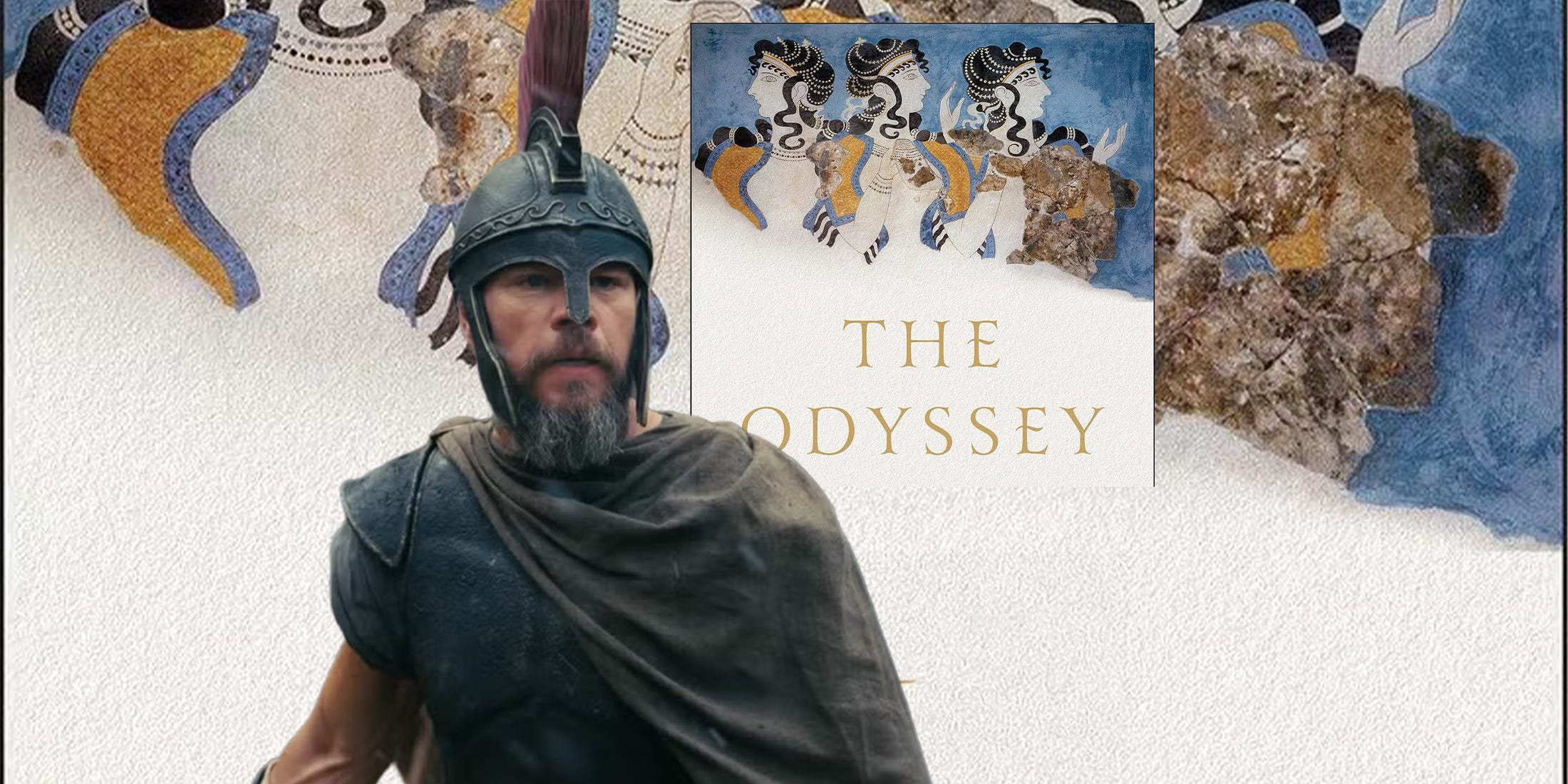
Ever wonder what compels a filmmaker like Christopher Nolan to dive headfirst into an ancient Greek epic as sprawling as The Odyssey? It’s not just the cyclops or the sea monsters—it’s the magnetic pull of a “complicated man” whose cleverness and cunning transcend millennia. Nolan didn’t just stumble upon any version; he was inspired by Emily Wilson, the classics professor who dared to reinvent Homer’s 12,109-line poem for our times. Her rendition isn’t just a translation—it’s a reawakening, sparking debates, stirring emotions, and proving that old stories still pack a punch when retold with sharp strategy and heart. As Nolan’s epic film fuels newfound interest, Wilson shares what it means to journey through The Odyssey—not just as a tale of myth, but as a mirror reflecting our own tangled, evolving selves. Curious about how a thousand-year-old narrative still resonates today? Let’s embark on this adventure together. LEARN MORE
 9 min read
When Christopher Nolan was asked what captivated him about The Odyssey enough to make a film out of the ancient Greek epic, he cited a relatively modern author. “I think it’s the Emily Wilson translation that begins, ‘Tell me about a complicated man,’ ” the filmmaker told Empire magazine last November. “The genius of the character, the cleverness, the inventiveness of him, that was a huge part of what interested me. He’s not just a soldier. He’s an amazing strategist, a very wily person.”
All of those things could be said of Emily Wilson herself. The classics professor from the University of Pennsylvania crafted a new adaptation of Homer’s 12,109-line poem in 2017—an effort that required strategy, wiles, cleverness, and inventiveness. Given that adaptation naturally means interpretation, Wilson also became an unwitting soldier in the battles that ensued over how she retold the story.
But—people were debating and engaging with a text that was thousands of years old. Something there must have resonated, and Wilson was credited with making the old story relevant again.
She expected that it might sell only a few thousand copies, given how many other English-language adaptations were out there, dating back to George Chapman’s from the early 1600s. But surprisingly, her take on The Odyssey became a blockbuster among booksellers, long before Nolan decided to make his blockbuster for the screen.
Nolan’s film has only galvanized more sales, although he penned his script based off many interpretations of Homer’s tale, weaving in parts of Virgil’s The Aeneid and Aeschylus’s Agamemnon as well. Wilson told Esquire she has never spoken to Nolan—but she hopes to someday.
She told us what she’d love to ask him, but it’s clear she has a lot to say about The Odyssey herself and what that long-ago story has to teach us about ourselves right now.

ESQUIRE: One of the things that people praise about your book is that it makes The Odyssey feel accessible.
EMILY WILSON: I have definitely heard many, many versions of that. Their perception was that this was going to be hard. I mean, it is hard once you get deep into analyzing it and thinking it through, but it’s not hard on the level of the sentence, the paragraph, the engagement of the story.
This was never meant to be rarefied work for scholars. It was mass entertainment.
I’m trying to convey that quality of the original because the Homeric poems are obviously designed for oral performance out loud for audiences, many of whom may have been illiterate. It’s not designed as the kind of poetry that you need to stop and look words up in the footnotes. It’s designed to be propulsive, gripping entertainment with this amazing musicality and rhythm to the language.
Do you have a favorite part of this story?
I’m constantly just thinking, “Wow, this is so good. This is the best bit.” But then the next day I realize, “Oh, no, this is the best bit.” So it’s a constant process for me. One of many possible examples is I love the complex depiction of “What is a homecoming? What is a nostos, a journey home from war?”
Is there a part of that element you find particularly beautiful?
The geographical homecoming happens halfway through the poem. Odysseus, of course, has so many recognition scenes and reunion scenes with these characters back on Ithaca. The fact that Athena disguises Ithaca so that it’s covered in fog… He doesn’t recognize his own homeland when he comes back to it. I find that so moving and also so powerful.
The boy in me loves book nine, when Odysseus starts telling all of his adventure stories, beginning with the excursion into the cave and the battle with the giant cyclops.
The eye sizzling on the stake. Love that!

Emily Wilson, a classics professor from the University of Pennsylvania, was the first woman to translate The Odyssey into English.
Yes! That’s for the kid in me. But I’ll be 50 soon, and the person I am now really loves the quiet, secret conversation with his wife Penelope when Odysseus gets home. She’s waiting for him every day but doesn’t recognize him when he finally arrives. I realized reading your book: He went away, but he actually never comes back. He is a different person then. When I look back at faraway times in my own life, that feels like a different person to me too. It’s the notion of becoming a stranger to yourself.
The Odyssey is a poem all about time. It’s all about time and memory. That is what Odysseus’ journey back to Ithaca is. It’s not just about changing where he is. It’s also about: Can he be the self he was 20 years ago? I would argue that the poem shows us that going back in time or manipulating time is impossible for almost everyone. And yet if you have an Olympian deity on your side, maybe you can kind of get there.
So I’m not a C-minus student with my interpretation, professor?
I love what you said about your own experience of being very different now from ten years ago or 20 years ago. I certainly feel that before the pandemic I was a different person. Who was I before I had kids? It was a different person. But The Odyssey points out that even within a particular moment of your life, some people can be different in different contexts. Who am I now, talking to you, versus who am I when I’m talking to my dog? I might be a different person.
We can be different people not just from our old selves but in the present?
Odysseus is absolutely exceptional in his ability to be different for different people in different contexts. One of his superpowers is his multiplicity. He’s able to be someone different when he’s recognized by Eurycleia, the enslaved nurse, versus who he is when he’s recognized by his dog, which was another of my possible top lists of best scenes in The Odyssey—ever.
Is this why the story has resonated for, what is it, 3,200 years?
It depends whether we’re counting from The Odyssey as we have it or the myths, which, for sure, are definitely much older. It’s just so emotionally powerful. We’ve already talked about time, memory, identity, but it’s also about these deep themes of community. Who belongs where? It has the theme of outsiders and insiders—and the responsibilities of hosts and the responsibilities of guests. What it means to be a stranger. All of those I find really moving themes, and The Odyssey is so good on all of it.
Now the new Christopher Nolan film is on the way. Do you have plans to see it?
I’m going to see it next week. I’m very excited. Norton, who published my translations of Homer, are doing a screening in New York. So I’m going to go for that. It’s a day or two before it is hitting the cinemas. Many people have already seen it.
But you have not seen it already, right?
I haven’t yet seen it. I’m counting the days, counting the hours.
Nolan has cited your book, but from what I gather, you two never had a conversation?
We’ve never had a conversation, no. I’d be very glad to talk to him if he wants to give me a call.
What would you like to talk about if you could?
I would be really interested to hear more about his relationship with The Odyssey in terms of how often he’s read it and in what context. I’ll also be interested to watch out for themes that Christopher Nolan has always been interested in. His films are often about time and memory and a man on a quest to get back to a beloved woman. And then there are themes about complicated male heroes who are very often in some kind of rivalry with another man or other men. Themes of technology and cleverness and its discontents. All of those things are Odyssey themes but also Nolan themes.
I’ve seen Nolan reference your opening line about “the complicated man.” The conclusion to that stanza is “Find the beginning.” What I find interesting about “a complicated man” and “find the beginning” is the notion of trying get back to when things weren’t so complicated. When things felt simpler.
I love that close reading. In some ways, I absolutely see what you’re saying. That search for “Where can I start this story?” is also an acknowledgment that there are many possible starting points. Therefore it may be difficult or perhaps impossible to recover a simpler time or a simple protagonist. Maybe it’s not there, if you have to search for it like that.
When you were doing your translation, what were you working from? What are you looking at in terms of original text?
I didn’t do a whole reedition of the Greek text because that’s a whole other project. So I worked primarily with the Oxford classical text. I look at other editions occasionally. Standard scholarly editions of the Homeric poems, as for other ancient texts, are based on both medieval manuscripts and also fragments of papyri, which are the earliest evidence about the text. But those are still centuries later than the actual production of the poems.

The Odyssey director Christopher Nolan has specifically cited Emily Wilson’s translation of the epic poem as inspiration for his film.
Where did they come from?
They were edited by scholars for the first time around the time of the Library of Alexandria, so in the Hellenistic period in the third and second centuries BCE. All modern editions are, in a sense, looking back to the editions that were collated by those scholars in that period.
The Odyssey was not just recorded in a very different language from English, but it comes from such a long time ago that it’s an entirely different way of thinking. How did you have to adapt your own mindset to create your version of the story?
Obviously I’ve been working on this poem for many, many years, and working on a translation is a way of trying to address that question, versus trying to study the poems as a scholar, as a critic, as a teacher. Of course, they all overlap with each other. … Hm, I’m not sure where to start with it.
Find the beginning, Emily. Find the beginning!
[Laughs.] Find the beginning, okay, yes. It’s about acknowledging the strangeness. You emphasize just how long ago this culture is. As a translator, one of the big things I needed to do was to immerse the reader in this very, very strange world. You can be aware of, wow, this is a world where slavery is completely normalized. Animal sacrifice? Completely normal. Goddesses popping up in the middle of everything? Totally normal. Yet you can have these moments of shock along with the startlingly familiar. Look at the intimacy of the son and the mother having an argument or the man sitting on the beach crying because he’s so homesick.
Doesn’t this story predate morality? The Odyssey feels like a story from a much more primitive, Darwinian time, where the strong prevail.
I would challenge that. The Odyssey is actually really interested in social norms. The Iliad is also. It’s absolutely a time before written laws, of course. And it’s a time before the structures of the city-state, as they evolved a little bit later in Greek history.
And before religion?
It’s a time with very extensive religious practices and religious beliefs. But of course the gods aren’t the guarantors of morality in quite the way as modern Christianity.
They weren’t giving down tablets with commandments, right?
[Laughs.] Yeah, exactly. But The Odyssey is really interested in particular norms and what happens when they’re violated. That’s presented as really, really mattering—and also being of great interest to Zeus.
Are there particular events in society, in culture, in history, that send us back to this narrative? What tends to be happening in the world when people get interested again in The Odyssey?
There’s been this real interest in The Odyssey and The Iliad throughout the last four centuries of modernity. It’s partly about the way that the world has opened up over the last few centuries, but even more in the 21st century. We’re in a time of globalization, of new technologies, of new kinds of movement of peoples from one place to another. It’s not surprising that there’s renewed interest in this poem that was about those things.
Was that happening too, back when the story originated thousands of years ago?
The eighth century BCE was preoccupied by those themes. It was a time when Greek speakers were migrating and colonizing in all kinds of places all around the Mediterranean world, beyond the Greek mainland. Our moment of globalization was, in a way, foreshadowed by that time in Archaic Greece.
Sounds like we look to this story because we still have the same questions.
The Odyssey is really engaged with this question of same and other. Of hospitality. Of the stranger. What does it mean to have multiple identities, multiple different places, and to endure over time—or to change?

Amazon Echo Show 5 (newest model), Smart display, Designed for Alexa+, 2x the bass and clearer sound, Charcoal
$99.99 (as of September 20, 2026 03:10 GMT +00:00 - More infoProduct prices and availability are accurate as of the date/time indicated and are subject to change. Any price and availability information displayed on [relevant Amazon Site(s), as applicable] at the time of purchase will apply to the purchase of this product.)
Smiry Dog Door Mat for Muddy Paws, Absorbent Non Slip Dirt Trapper, 30x20 | Grey and Black, Quick Dry Washable Chenille Mat for Mud Dogs, Entry Rug for Indoor and Outdoor
$9.99 (as of September 20, 2026 03:10 GMT +00:00 - More infoProduct prices and availability are accurate as of the date/time indicated and are subject to change. Any price and availability information displayed on [relevant Amazon Site(s), as applicable] at the time of purchase will apply to the purchase of this product.)
Roku Streaming Stick HD with Voice Remote | Compact 4K Streaming Device for TV with Roku Voice Remote & Long-Range Wi-Fi - Free & Live Local News, Sports
$38.99 (as of September 20, 2026 03:12 GMT +00:00 - More infoProduct prices and availability are accurate as of the date/time indicated and are subject to change. Any price and availability information displayed on [relevant Amazon Site(s), as applicable] at the time of purchase will apply to the purchase of this product.)
Airheads Full-Size Candy Bars, Assorted Taffy Variety Pack, 60 Count Box | Individually Wrapped Bulk Candy, Assorted Fruit Flavors, Artificially Flavored
$9.84 (as of September 20, 2026 03:22 GMT +00:00 - More infoProduct prices and availability are accurate as of the date/time indicated and are subject to change. Any price and availability information displayed on [relevant Amazon Site(s), as applicable] at the time of purchase will apply to the purchase of this product.)











Post Comment