
How Losing Every Dollar of Profit Can Ignite Your Greatest Comeback Yet—Are You Ready to Win Big Again?
Ever stared at a stock chart and felt your stomach do a somersault? That’s precisely what happened with my sizeable stake in the State Street® SPDR® MSCI USA Small Cap Value Weighted UCITS ETF, ticker USSC. Imagine watching roughly a third of your seven-figure portfolio take a nosedive — a 40% profit just vanishing into thin air after a political rollercoaster shook the markets. It’s enough to test the mettle of any investor, and honestly, it made me ask: how do you cope when the numbers on your screen start looking like a horror flick? Having weathered these storms more times than I can count, I find the pain of loss in diversified ETFs somehow different from the nail-biting unpredictability of individual stocks. But even with a thousand tiny, “ugly” stocks bundled in one fund, the emotional tug remains profound. This experience sharpened my resolve and reshaped my thinking on risk, resilience, and the bittersweet dance with market uncertainty. Buckle up as I peel back the layers of this journey — and maybe help you make peace with your own portfolio’s “sucky” moments. LEARN MORE
img#mv-trellis-img-1::before{padding-top:65.33203125%; }img#mv-trellis-img-1{display:block;}img#mv-trellis-img-2::before{padding-top:24.043715846995%; }img#mv-trellis-img-2{display:block;}
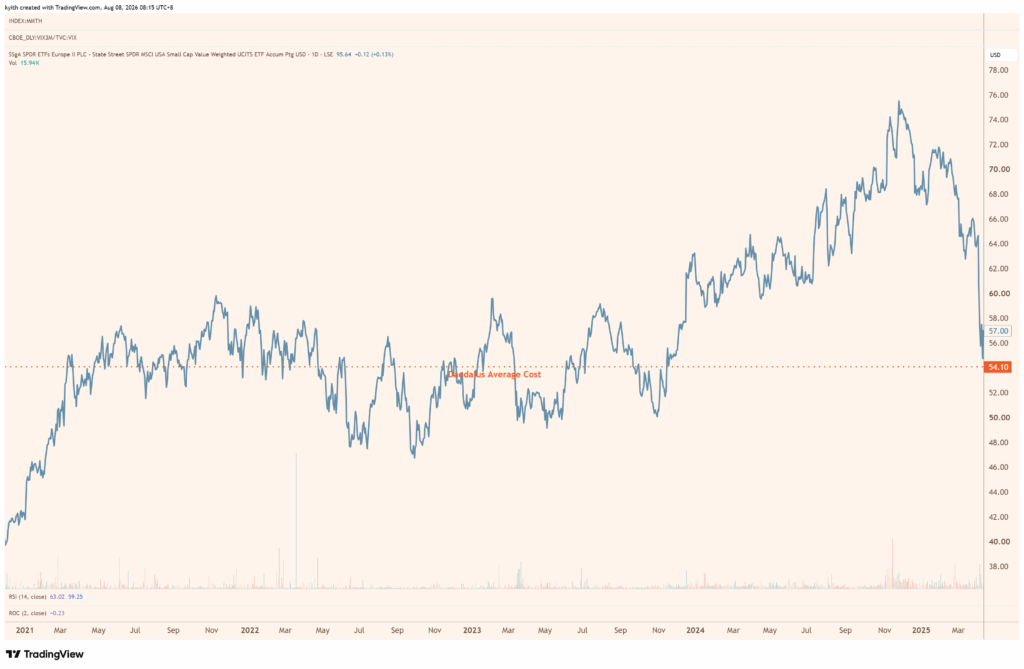
The chart below is the State Street® SPDR® MSCI USA Small Cap Value Weighted UCITS ETF (ticker USSC):

If you see where the orange line is, you would be able to see the average cost of my position. USSC used to be 30-33% of my seven-figure portfolio. (I reallocated it to AVGS).
This chart ends at one of the lowest points after Liberation day in 2025. We went through an emotional period where Trump was elected end of 2024, and USSC sees a massive spike before correcting from Nov 2024 all the way into Liberation day.
I basically see a 40% cumulative profit evaporated in my eyes.
I am sure some of you went through these kind of experience. How do you feel when that happens to you?
After investing long enough, I went through this numerous times. The feeling is different during my individual stock investing days. I know that the markets can go through periods where systematic events (like what happen in this episode) can bring down the market. However, it is often mixed with the uncertainty that this company XYZ may be going down because the market deems it will be hit significantly harder than the rest.
Unless I am very convicted, I would usually be plagued with indecision whether to hold, buy more or sell.
Is it the same if I held 1,300 little, ugly stocks like in a USSC?
It was much easier for a few reasons:
- I went into my USSC position during a period where there was so much uncertainty over when the recession will come. Small caps in a way would do significantly worse in recession. Still, I put my position in. I basically resigned my fate that I may have to take a 40% drawdown from my average cost when I put my positions in 2023.
- To reached a stage where I can accept a 40% drawdown potentially, I understood that recessions, one-time systematic events, basically uncertainty is part and parcel if I am crafting an income portfolio for the next 60 years. You avoid one, you are going to get another. Like it or not that is going to happen.
- I mentally walk myself through again why having these allocations to not just USSC but the whole portfolio is an optimal way to setup a passive, low effort income portfolio. Whatever will happen in the future may be different from the past but would result in similar fashion. There will be the recovery. Why does the market recover? What’s the kind of more drastic drawdown we seen in the past, that is actually factored into my income plan.
- I mentally walk myself through what are the fundamental drivers of return.
- I know that portfolio returns is part of what gives long term inflation adjusted income BUT NOT all of it. Its actually how much you withdrawal from the portfolio relative to the portfolio value. The more conservative you plan that, it overcomes poor return sequences.
At Providend we prepare clients for drawdowns but I don’t know.
As someone with significant net wealth in the markets, I don’t know how to coach people through seeing all your profits wiped out.
I hope our advisers recognize that it’s a sucky feeling. I wonder how many of them went through such a sucky feeling themselves. I am not talking about losing money but losing and feeling sucky about it. Did you ever think about selling out? Did you all-in when you felt that? Why did you all-in?
I always felt that you would understand what others go through better if you went through sucky situation before. Not everyone can have the experience especially if it is a client adviser that hasn’t invest much before. Sometimes, I wonder if we place so much emphasis on risk coaching, is it a criteria for potential associate adviser and adviser to feel the sucky feeling before in order to qualify being an ideal candidate.
But I digress.
The path of dealing with this better I feel… is a mixture of knowledge and experience.
I can have that self-talk because I am an anxious, insecure person who does not want to do stupid things with significant amount of money that I can never make back easily if I lose it. That is enough motivation to search out the truth of how to correctly see these things structurally.
Experience is feeling enough of these sucky situation, selling out and seeing your decision turn out right… and also wrong.
It is also when you feel the suck so much and sit it through.
As a person who many concludes as think-too-much, I realize that there are some lessons that you would only learn when you feel the pain and do it anyway.
But that may be the most important lesson.
You invest in risk assets, you ARE GOING TO FEEL PAIN AND SUCK.
You are going to go through uncertainty.
If there are no such things, you won’t get high returns.
The less sophisticated ones search their lives for that elusive investment that doesn’t suck but give them decent return.
I don’t know la, are there really so many investments with asymmetric returns out there? Cannot be right….
That is how I felt folks should deal with it but that is me. I do think that I have enough sucky experience and knowledge to relate to people.
But don’t ask me how to help people live with it better. I think folks just have to accept that your well optimized portfolio can suck at times.

Do Like Me on Facebook. I share some tidbits that are not on the blog post there often. You can also choose to subscribe to my content via the email below.
If you’re thinking of opening an Interactive Brokers account, my referral link is here.
As the new account holder, you’ll receive USD 1 in IBKR stock for every USD 100 you deposit, up to USD 1,000 in shares — so a USD 10,000 deposit gets you USD 100 in IBKR stock, and the bonus is capped at USD 1,000 for deposits of USD 100,000 or more. A few other things to know: the minimum deposit to qualify is USD 10,000, done within 30 days of opening, and the bonus shares are locked up for one year from the award date. The promotion is currently active, and using the link costs you nothing extra. On a separate note, if you haven’t already, it’s worth taking a look at how IBKR’s share price has performed over the past five years — the stock you receive as a bonus isn’t just a token; it’s a stake in a company that has done quite well for its shareholders.
I break down my resources according to these topics:
- All my personal notes about how my philosophy behind my own money and how I manage it.
- Building Your Wealth Foundation – If you know and apply these simple financial concepts, your long term wealth should be pretty well managed. Find out what they are
- Active Investing – For active stock investors. My deeper thoughts from my stock investing experience
- Learning about REITs – My Free “Course” on REIT Investing for Beginners and Seasoned Investors
- Dividend Stock Tracker – Track all the common 4-10% yielding dividend stocks in SG
- Free Stock Portfolio Tracking Google Sheets that many love
- Retirement Planning, Financial Independence and Spending down money – My deep dive into how much you need to achieve these, and the different ways you can be financially free
- Providend – Where I work and do research. Fee-Only Advisory. No Commissions. Financial Independence Advisers and Retirement Specialists. No charge for the first meeting to understand how it works

Kyith is the Owner and Sole Writer behind Investment Moats. Readers tune in to Investment Moats to learn and build stronger, firmer wealth foundations, how to have a Passive investment strategy, know more about investing in REITs and the nuts and bolts of Active Investing.
Readers also follow Kyith to learn how to plan well for Financial Security and Financial Independence.
Kyith worked as an IT operations engineer from 2004 to 2019. Currently, he works as a Senior Solutions Specialist in Fee-only Wealth Advisory Firm Providend. All opinions on Investment Moats are his own and does not represent the views of Providend.
You can view Kyith’s current portfolio here, which uses his Free Google Stock Portfolio Tracker.
His investment broker of choice is Interactive Brokers, which allows him to invest in securities from different exchanges all over the world, at very low commission rates, without custodian fees, near spot currency rates.
You can read more about Kyith here.
Dog Allergy Relief Chews - Anti-Itch Skin & Coat Supplement with Omega 3 | Itchy Skin Relief Treatment with Fish Oil - Itching & Paw Licking Support - Dry Skin & Hot Spots Treats - Made in USA, 180Ct
$22.99 (as of September 26, 2026 03:11 GMT +00:00 - More infoProduct prices and availability are accurate as of the date/time indicated and are subject to change. Any price and availability information displayed on [relevant Amazon Site(s), as applicable] at the time of purchase will apply to the purchase of this product.)
Premier Protein 30g High Protein Shake, Chocolate, 12 Pack | 160 Calories, 24 Vitamins & Minerals, No Added Sugar, Supports Muscle Health, Gluten-Free, 11 oz
$23.97 (as of September 26, 2026 03:05 GMT +00:00 - More infoProduct prices and availability are accurate as of the date/time indicated and are subject to change. Any price and availability information displayed on [relevant Amazon Site(s), as applicable] at the time of purchase will apply to the purchase of this product.)
Good 'n' Fun Kabobs Long-Lasting Dog Treat Made With Real Protein, 24 oz | Premium Chicken, Pork and Beef Hide Chew, Supports Dental Health and Mental Stimulation, For Adult Dogs
$17.97 (as of September 26, 2026 03:05 GMT +00:00 - More infoProduct prices and availability are accurate as of the date/time indicated and are subject to change. Any price and availability information displayed on [relevant Amazon Site(s), as applicable] at the time of purchase will apply to the purchase of this product.)
OURA Ring 5 Sizing Kit - Size Before You Buy | Unique Sizing, Not Standard Ring Sizing - Receive Amazon Credit for Oura Ring 5 Purchase
$10.00 (as of September 26, 2026 03:16 GMT +00:00 - More infoProduct prices and availability are accurate as of the date/time indicated and are subject to change. Any price and availability information displayed on [relevant Amazon Site(s), as applicable] at the time of purchase will apply to the purchase of this product.)






Post Comment