
Seiko’s First-Ever Watch Reborn: The Vintage Masterpiece That’s Shaking Up Timekeeping Today!
Ever wonder if a design can truly stand the test of time—like, over a century and then some? In 1913, a year when men still hadn’t quite warmed up to wristwatches and the world was busy marveling at the first functional zipper and Charlie Chaplin’s silent antics, Seiko’s Kintaro Hattori was quietly making history in Japan with the Laurel—the country’s very first wristwatch. Now, fast forward 113 years, and Seiko isn’t just dusting off an old blueprint; they’re reimagining it with a blend of respect, craft, and modern tech that begs the question: can a watch design from another era still feel fresh, relevant, and damn handsome today? Spoiler alert: the answer might surprise you. LEARN MORE
 2 min read
The year is 1913. The first functional zipper has only just been invented, Charlie Chaplin’s first film won’t come out for another year, and wristwatches won’t really take off among men until the First World War. Over in Japan, though, Seiko founder Kintaro Hattori is already ahead of the game.
That same year, his company produced the Laurel: Japan’s first wristwatch, complete with a white enamel dial, spindly blue hands, and a bright-red 12 at the top. Fast-forward 113 years and Seiko has decided to revisit it.
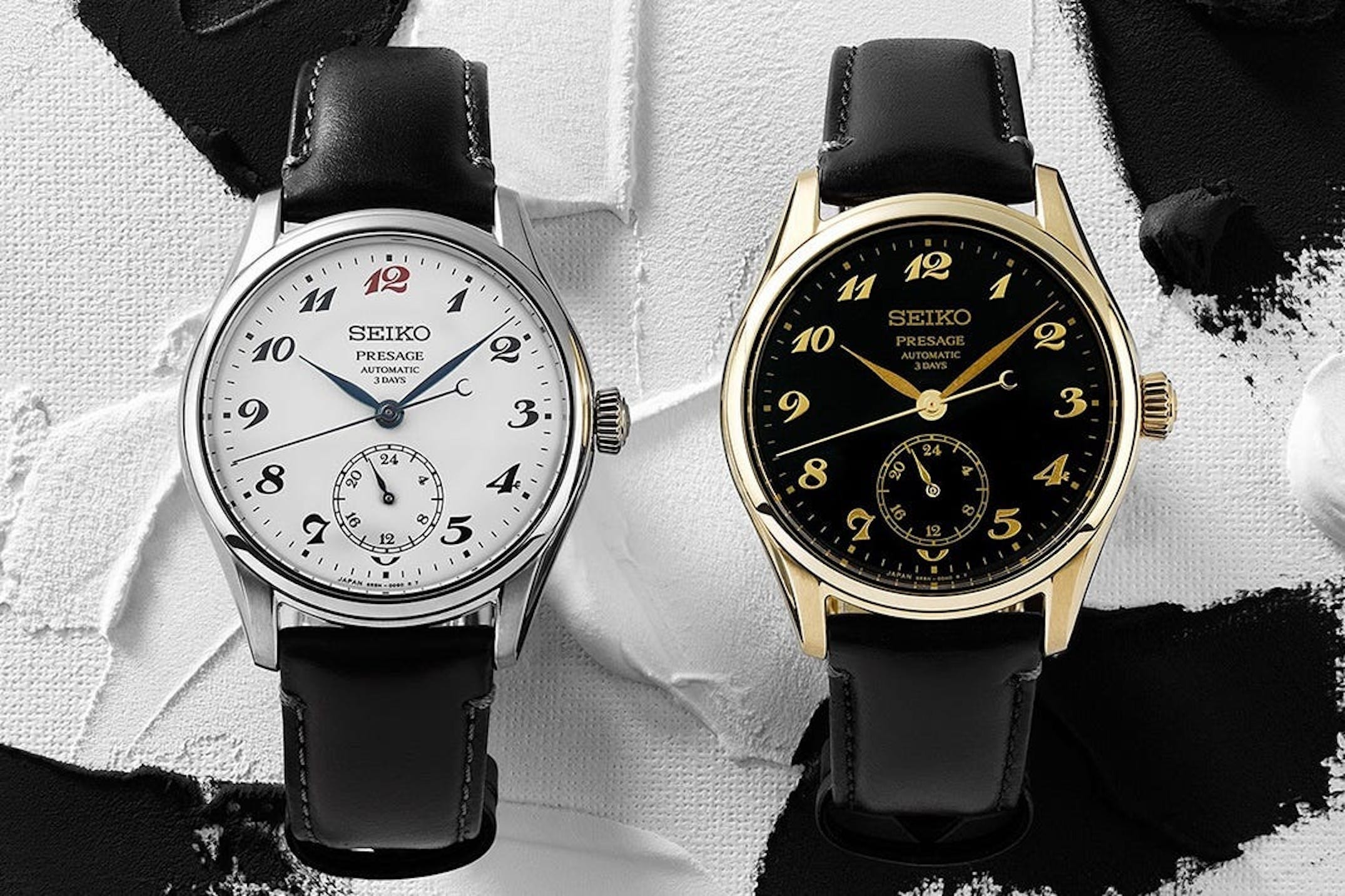
The result is a pair of new Presage Classic Series “Craftsmanship” watches that borrow some of the Laurel’s best bits without going for a full 1913 reenactment. These are the new Presage Classic Series “Craftsmanship” Enamel (HCC005) and Urushi Lacquer (HCC006), priced at $1,400 and $1,650, respectively.
The HCC005 is the closest of the two to the original. Its white enamel dial brings back the blue hands, Arabic numerals, and, crucially, that little red 12. The HCC006 goes in a slightly dressier direction, pairing a black urushi lacquer dial with gold details and a yellow-gold-colored case.

There’s some serious craft involved in those dials too. The glossy white dial is made from enamel fired at high temperatures, while the deep black one uses urushi, a traditional Japanese lacquer applied and polished by hand to create its finish. Both techniques are overseen by master craftsmen who have spent decades perfecting them.
Thankfully, what’s going on inside has moved on a little since 1913. Both watches measure 39.6mm across and are powered by Seiko’s automatic 6R5H movement, with a 72-hour power reserve. There’s a dual-curved sapphire crystal up top, an exhibition case back underneath, and an oil-tanned leather strap to keep things suitably old-school.

You’ll also spot a sub-dial at six o’clock, although it isn’t actually counting the seconds. Instead, it’s a 24-hour indicator linked to the main time—essentially a rather handsome way of telling you whether it’s morning or night.

And unlike with plenty of heritage revivals, you won’t have to enter a ballot, set three alarms, or start trawl resale sites to get hold of one. Neither version is a limited edition.
Turns out 113 years is a pretty good test of whether a watch design has aged well.
Purina ONE Lamb and Rice Formula Dry Dog Food for Digestive Support | Dog food with real lamb as first ingredient, Microbiome Balanced and prebiotic fiber, supports digestive health
$48.98 (as of October 22, 2026 03:13 GMT +00:00 - More infoProduct prices and availability are accurate as of the date/time indicated and are subject to change. Any price and availability information displayed on [relevant Amazon Site(s), as applicable] at the time of purchase will apply to the purchase of this product.)
Amazon Echo Dot (newest model) - Vibrant sounding speaker, Designed for Alexa+, Great for bedrooms, dining rooms and offices, Charcoal
$79.99 (as of October 22, 2026 03:23 GMT +00:00 - More infoProduct prices and availability are accurate as of the date/time indicated and are subject to change. Any price and availability information displayed on [relevant Amazon Site(s), as applicable] at the time of purchase will apply to the purchase of this product.)
Pur Luv Dog Treats, Chicken Jerky Dog Treat with Real Chicken Breast, 16 oz | High protein and low fat, Limited ingredient recipe, No artificial flavors or preservatives, Satisfies instinct to chew
$14.99 (as of October 22, 2026 03:13 GMT +00:00 - More infoProduct prices and availability are accurate as of the date/time indicated and are subject to change. Any price and availability information displayed on [relevant Amazon Site(s), as applicable] at the time of purchase will apply to the purchase of this product.)
Milk-Bone Original Biscuits Large Dog Treats, 10 Lb.
$14.98 (as of October 22, 2026 03:13 GMT +00:00 - More infoProduct prices and availability are accurate as of the date/time indicated and are subject to change. Any price and availability information displayed on [relevant Amazon Site(s), as applicable] at the time of purchase will apply to the purchase of this product.)














Post Comment