Indonesia’s On-Chain Economy Is About to Blow Up—Here’s Why Investors Should Pay Attention NOW
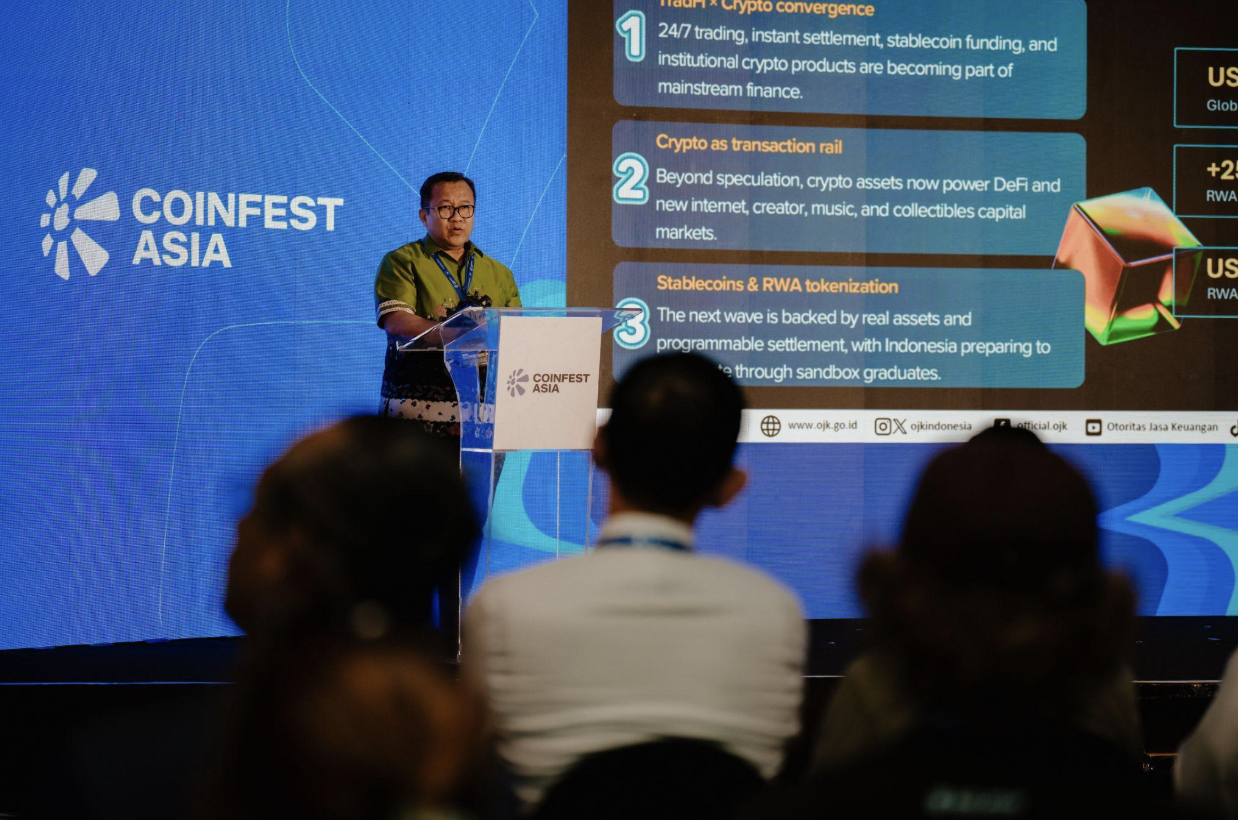
What if the future of Indonesia’s economy wasn’t just digital—but explicitly on-chain? Imagine a nation where blockchain isn’t just a buzzword tossed around crypto trading floors, but a fundamental backbone of financial life itself—fueling everything from transactions to DeFi, stablecoins to asset tokenization. That’s exactly what Indonesia’s Financial Services Authority (OJK) is boldly declaring as they set the stage for an on-chain revolution. Adi Budiarso, the man steering this innovation, made it clear at Coinfest Asia 2026: “Indonesia’s on-chain economy is coming.” And with 22.69 million crypto consumers and soaring transaction values, the momentum can’t be ignored. But this isn’t just about enthusiasm for tech; it’s about reshaping the entire financial ecosystem—elevating crypto firms to formal financial institutions, introducing unified investor IDs, regulating stablecoins beyond mere speculation, and ushering in real-world asset tokenization. The question isn’t if Indonesia will embrace this future — it’s how fast and how deeply this transformation will ripple through Asia’s burgeoning digital asset space. Ready to dive in? The blockchain train’s pulling out of Bali—are you onboard? LEARN MORE
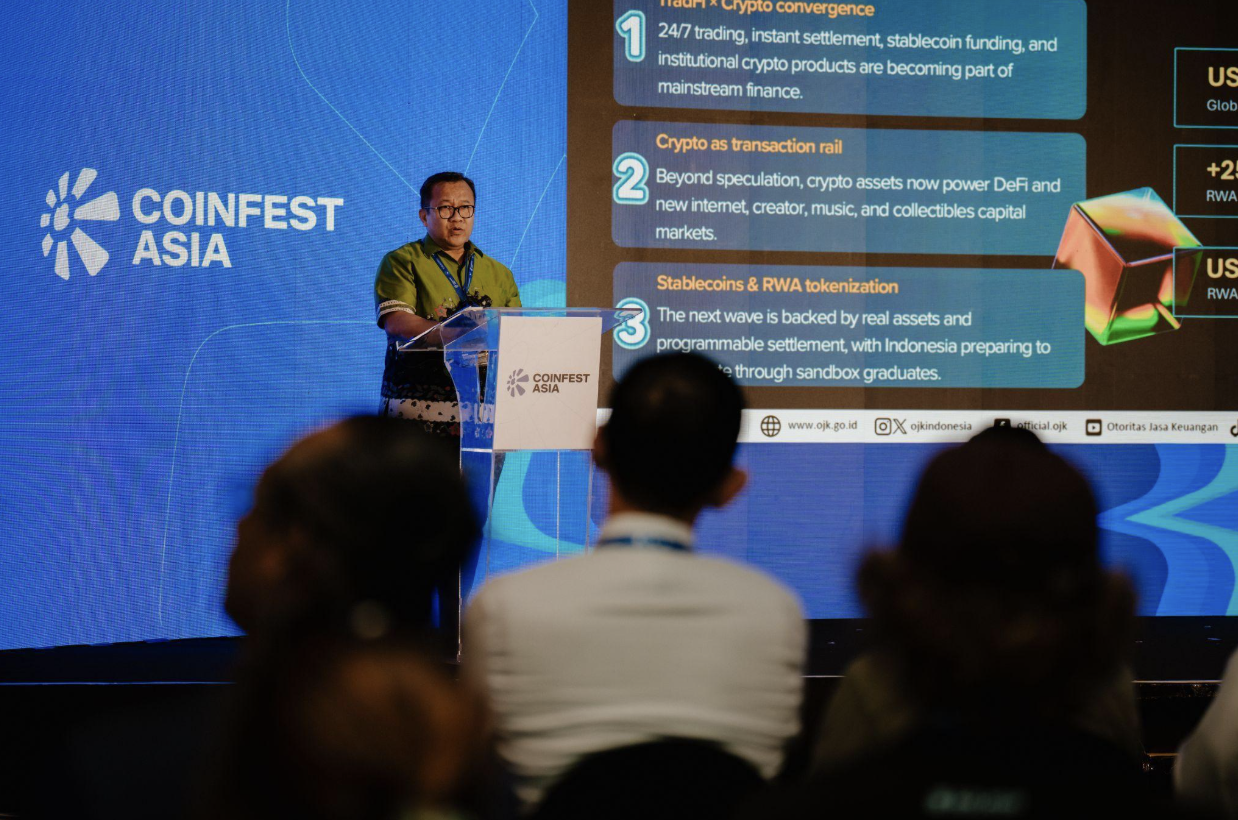
Indonesia’s Financial Services Authority (OJK) says the country’s on-chain economy is coming, as the regulator moves to expand the role of digital assets beyond crypto trading and deeper into the national financial system.
Adi Budiarso, OJK’s Chief Executive for Financial Sector Technology Innovation, Digital Financial Assets and Crypto Assets Supervision, outlined the direction during a keynote at Coinfest Asia 2026, the World’s Crypto Festival, a major crypto industry gathering in Asia held in Bali on Aug. 20–21.
“Today, at this Coinfest Asia Forum, I wish to declare that Indonesia’s on-chain economy is coming,” Adi said.
The push comes as OJK sees crypto assets taking on a broader role in the financial system. Adi said blockchain is increasingly being used not only for investment, but also for transactions, decentralized finance (DeFi), stablecoins and asset tokenization.
“Crypto assets are no longer merely speculative investment instruments; they have become the engine and rail for DeFi transactions,” he said.
That shift is unfolding alongside the continued expansion of Indonesia’s domestic crypto market. OJK recorded 22.69 million crypto asset consumers as of June 2026, up from 22.40 million a month earlier, while transaction value reached IDR 28.58 trillion, rising 24.2% from May.
The market infrastructure has also continued to develop, with 26 licensed digital financial asset traders, two exchanges, two clearing institutions and two custodians operating in the ecosystem.
As crypto moves closer to the broader financial system, OJK is expanding its regulatory focus beyond trading activity to the institutions, market infrastructure and financial products developing around digital assets.
Four OJK Priorities for Indonesia’s On-Chain Economy
Following revisions to Indonesia’s Financial Sector Development and Strengthening Law, known as the P2SK Law, OJK is advancing four priorities for the country’s digital asset sector.
They include strengthening the regulatory status of crypto asset service providers, restructuring trading infrastructure and investor identification, setting rules for stablecoins, and finalizing regulations for real-world asset (RWA) tokenization.
1. Crypto Providers to Become Financial Services Institutions
The first priority concerns the status of crypto asset service providers, which OJK plans to recognize as part of the financial services industry.
Adi said the change would bring governance standards for crypto businesses closer to those applied to conventional financial institutions, including banks and capital market firms.
“This is not merely a label; it does represent an elevation for the industry class,” Adi said.
2. OJK Plans Single Investor ID for Crypto Investors
OJK is also preparing a Single Investor Identification (SID) system for crypto investors as part of a broader restructuring of digital asset trading infrastructure.
The SID system is already used in Indonesia’s capital markets to assign investors a unique identification number. Adi said applying a similar mechanism to crypto would bring the sector closer to capital market standards.
“This will align the crypto ecosystem with the capital market, enhancing credibility, promoting transparency and efficiency at the same time,” he said.
3. Stablecoins to Be Treated as Transactional Instruments
Stablecoins are another part of OJK’s regulatory agenda. The authority plans to regulate them as transactional instruments, but not as payment tools, while coordinating with Bank Indonesia within the two institutions’ respective mandates.
The move comes as the stablecoin market continues to expand globally. Data presented by OJK showed global stablecoin supply rising from around US$200 billion in early 2025 to between $317 billion and $320 billion in early 2026.
“Stablecoins are positioned as transactional instruments, not payment tools,” Adi said.
Several stablecoin business models in Indonesia have also passed OJK’s regulatory sandbox and are preparing to move to the next stage.
4. OJK Finalizing RWA Tokenization Rules
OJK is also finalizing regulations for real-world asset tokenization, which allows real-world assets or their underlying economic rights to be represented digitally using blockchain technology.
The global RWA market has expanded rapidly. According to data presented by OJK, the market grew by around 256.7% between the first quarter of 2025 and the first quarter of 2026, with its value moving toward approximately US$33.5 billion by mid-2026.
In Indonesia, models developed through OJK’s sandbox include the tokenization of gold, government securities (SBN) and property economic rights.
Adi said OJK is drafting a broader regulatory framework to support the next stage of development.
“We are drafting a comprehensive OJK regulation to ensure scalability and security,” he said.
He also said RWA tokenization could help expand access to capital for small and medium-sized enterprises while broadening access to financial opportunities.
Indonesia Eyes a Larger Role as an Asian Crypto Hub
Alongside the regulatory roadmap, Adi said Indonesia wants to take a larger role in the development of Asia’s digital asset industry.
“We are fully committed to establishing Indonesia as Asia’s crypto hub, a center for innovation, investment and crypto transactions in this region,” he said.
OJK has also linked the development of digital assets to Indonesia’s broader economic agenda under the 2025–2029 National Medium-Term Development Plan, which targets economic growth of 8% by 2029.
Adi said economic and financial stability, digital transformation and deeper financial markets are among the factors needed to support that target, while technologies such as tokenization could help broaden access to financing and investment.
He also called on regulators, industry participants, academics, media, and consumers to take part in developing Indonesia’s digital asset ecosystem.
“Our future will be on-chain soon, and this is the thing that we build together,” Adi said.
Disclaimer: This is an Event Partner post and should not be treated as news/advice.

Pur Luv Chicken Jerky Dog Treats, Made with 100% Real Chicken Breast, 16 Ounces, Healthy, Easily Digestible, Long-Lasting, High Protein, Satisfies Dog's Urge to Chew
$14.09 (as of September 2, 2026 03:00 GMT +00:00 - More infoProduct prices and availability are accurate as of the date/time indicated and are subject to change. Any price and availability information displayed on [relevant Amazon Site(s), as applicable] at the time of purchase will apply to the purchase of this product.)
Blink Outdoor 4 – Wireless smart security camera, two-year battery life, two-way talk. Required Sync Module not included – Add-on camera
$37.99 (as of September 2, 2026 03:08 GMT +00:00 - More infoProduct prices and availability are accurate as of the date/time indicated and are subject to change. Any price and availability information displayed on [relevant Amazon Site(s), as applicable] at the time of purchase will apply to the purchase of this product.)
Cat Deterrent & Repellent Spray Anti-Scratch Training Aid, 4OZ 2 Pack | Furniture Protector for Sofa, Bed, Kitchen, Courtyard, Indoor & Outdoor Use, Pee Stopper, Non-Toxic & Safe
$25.99 (as of September 2, 2026 03:06 GMT +00:00 - More infoProduct prices and availability are accurate as of the date/time indicated and are subject to change. Any price and availability information displayed on [relevant Amazon Site(s), as applicable] at the time of purchase will apply to the purchase of this product.)
Pedigree Dentastix Large Breed Dental Dog Treats, Variety, 51 Count | Original, Beef & Fresh Flavors, triple action dental care, reduces tartar, cleans teeth, freshens breath, for dogs 40+ lbs
$23.98 (as of September 2, 2026 03:00 GMT +00:00 - More infoProduct prices and availability are accurate as of the date/time indicated and are subject to change. Any price and availability information displayed on [relevant Amazon Site(s), as applicable] at the time of purchase will apply to the purchase of this product.)














Post Comment