Is Your Body Younger or Older Than You Think? The Surprising Truth Behind Katy Perry’s Age Test Revealed!
Ever wondered if your body’s really keeping pace with the years on your birth certificate? It’s kinda wild—these biological age tests have taken off from dusty research labs straight into celeb Instagrams and, yep, into your inbox with at-home kits. Even Katy Perry’s shared hers, claiming a biological age of 33. But before you rush to compare your digits, let’s unpack what these tests are actually telling us—and what might just be smoke and mirrors. Spoiler: It’s not a crystal ball for your lifespan, but more like a snapshot of how your body’s aging compared to your peers. Sound intriguing? Let’s dive in and sift the science from the hype. LEARN MORE
Biological age tests have jumped from research labs into direct-to-consumer kits and celebrity Instagram feeds. Katy Perry has told followers her biological age is 33. Here is what the science actually supports, and what it does not.
What is biological age and how is it different from chronological age?
Biological age estimates how quickly your body is aging relative to peers born the same year, while chronological age just counts calendar time. A test that puts a 60-year-old at 55 is saying that person’s body resembles the average 55-year-old’s.
The underlying concept is not fringe. “Biological age is real. There’s a difference between your chronological age and your biology, that’s for sure, and we can measure it by various means,” David Furman, a professor at the Buck Institute for Research on Aging, told Forbes.
How do biological age tests actually work?
Most aging clocks read DNA methylation, a chemical process in which methyl groups attach to DNA over time and alter the cytosine base, one of the four letters of DNA. The distribution of those tags is used to estimate biological age.
Steve Horvath pioneered the approach and developed the GrimAge test. “You can use methylation to measure time in all cells that contain DNA,” he told NPR. A higher proportion of methylated DNA at certain sites points to accelerated biological age.
Horvath spent more than 10 years as a UCLA professor working on the biomarker. “We spent over 10 years trying to understand what factors accelerate your epigenetic clock,” he told NPR. Smoking, poor diet, inactivity and “pretty much any lifestyle factor that is bad for you” push the clock forward, his research found.
What do biological age test results tell you?
You get a number, not a lifespan. Different clocks measure different biology, so each captures one slice of aging.
- GrimAge, which reads DNA methylation in blood and predicts higher risk of cognitive decline. It is named after the Grim Reaper.
- iAge, which tracks chronic inflammation and predicts greater vulnerability to heart disease and frailty.
- GlycanAge, which measures biomarkers reflecting immune function.
- Microbiome clocks, which estimate aging of the gut.
Luigi Ferrucci, a geriatrician and scientific director at the National Institute on Aging, urged restraint. “At this point, if you want to do it, it must be based on curiosity,” he told NPR.
How accurate are biological age tests?
Results can swing considerably, and no test predicts how long you will live. Estimates shift within a day, and physical activity can move them, so researchers suggest retaking a test at the same time of day for a fair comparison.
A 2025 study found professional German soccer players tested right after a match looked biologically far younger, possibly from physiological changes tied to intense exertion. Their numbers returned to baseline a few hours later.
The underlying process cannot be halted. “Aging is something that happens to all of us. Even if we optimize everything, it’s [only] the rate of change which is modifiable,” Bradley Elliott, a researcher at the University of Westminster and trustee of the British Society for Research on Ageing, told Forbes.
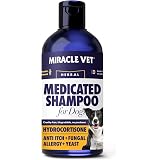
Miracle Vet Medicated Dog Shampoo for Itchy Skin Relief - Antifungal for Dog Allergy Relief, Yeast Infection, Hot Spot & Dry Skin Anti-Itch Treatment Wash - Hydrocortisone 8 fl oz
$14.99 (as of September 15, 2026 03:09 GMT +00:00 - More infoProduct prices and availability are accurate as of the date/time indicated and are subject to change. Any price and availability information displayed on [relevant Amazon Site(s), as applicable] at the time of purchase will apply to the purchase of this product.)
Temptations Classic Crunchy and Soft Cat Treats, Tasty Chicken, 30 oz | Under 2 calories per treat, crunchy outside & soft inside, resealable tub, 100% complete & balanced, snack, meal or topper
$14.97 (as of September 15, 2026 03:03 GMT +00:00 - More infoProduct prices and availability are accurate as of the date/time indicated and are subject to change. Any price and availability information displayed on [relevant Amazon Site(s), as applicable] at the time of purchase will apply to the purchase of this product.)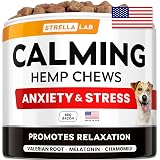
STRELLALAB Hemp Calming Chews for Dogs - Stress, Anxiety Relief Treats | Advanced Relaxing Support Supplement w/ Melatonin - Separation, Barking, Fireworks & Travel - All Breeds, Sleep Aid (120Ct)
$19.90 (as of September 15, 2026 03:09 GMT +00:00 - More infoProduct prices and availability are accurate as of the date/time indicated and are subject to change. Any price and availability information displayed on [relevant Amazon Site(s), as applicable] at the time of purchase will apply to the purchase of this product.)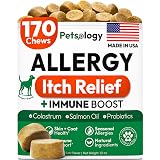
Dog Allergy Relief Chews 170 Count Anti Itch Skin & Immune Support for Dogs | Itch Relief, Omega 3 Fish Oil, Probiotics, Hot Spots & Allergies, Paw Licking, Dry Skin & Coat Supplement, Beef Liver Flavor
$16.99 (as of September 15, 2026 03:09 GMT +00:00 - More infoProduct prices and availability are accurate as of the date/time indicated and are subject to change. Any price and availability information displayed on [relevant Amazon Site(s), as applicable] at the time of purchase will apply to the purchase of this product.)










Post Comment