
Sberbank’s Crypto Push: Is Russia About to Rewrite the Rules of Digital Finance Starting December 1?
Russia’s largest bank, Sberbank, is about to shake things up in the crypto world starting December 1st — by launching its very own crypto trading platform. Now, this isn’t just another fintech fad; it’s a serious nod towards pushing institutional adoption of digital assets within the country. Imagine the ripple effect: a banking giant stepping into crypto trading officially, right after the Central Bank of Russia gave it the green light for both exchange operations and custody last month. So, what does this mean for investors and the broader financial ecosystem in Russia? Will this move open the floodgates or just nudge the market forward ever so gently? With Sberbank already juggling Bitcoin, Ethereum, and Tether tests, and a firm cap placed on retail crypto exposure, the question looms: is Russia crafting a measured dance with crypto, or setting the stage for full-blown adoption? Hold onto your hats—this could be a game changer. LEARN MORE
Russia’s largest bank, Sberbank, is set to launch crypto trading on the 1st of December, a move that could accelerate the country’s institutional adoption of digital assets.
Earlier this week, the Central Bank of Russia approved Sberbank to operate a digital asset exchange. Last month, the regulator also gave the bank the green light for crypto custody. Speaking on the development, Sberbank said,
This status will allow the bank to provide services related to organizing the circulation of digital currency on interfaces which clients already use.
This would bring the list of approved firms that can operate as digital asset exchanges to nine, including Sberbank, T-Invest and VTB. Exchanges are mandated to handle crypto conversions and trading.
However, a custody license allows the approved firm to safekeep the digital assets and track ownership.
Sberbank is reportedly conducting tests with Bitcoin [BTC], Ethereum [ETH], and Tether [USDT], but more permitted tokens could be subject to the central bank’s guidelines.
Will Russia’s crypto regulation advance adoption?
The latest wave of approvals comes just two months after Russia’s “Digital Currencies and Digital Rights” federal law went into effect on the 1st of September. This introduced licensing rules for interested players in the sector.
Towards the end of September, secondary legislation to the above law covering custodians and exchanges was approved. Applications for licenses were opened on the 5th of October, and Sberbank and eight other firms and banks got approvals.
Earlier this week, the central bank granted approvals for exchange operations to Sberbank, effectively allowing it to custody and trade crypto assets. This is a great unlock for Russia-based institutional investors who don’t want to leave the familiar banking environment they are used to.
Worth noting that even the U.S. top banks and brokerages such as Bank of America and JPMorgan Chase now offer support for crypto trading. For example, Morgan Stanley allows both direct crypto trading and ETF-related exposure.
But there are some differences between the regulatory approaches adopted by the two countries. First, the Russian approach is codified into law, but the U.S. push has been stalled via the CLARITY Act. Similarly, the U.S. has no caps on crypto investment.
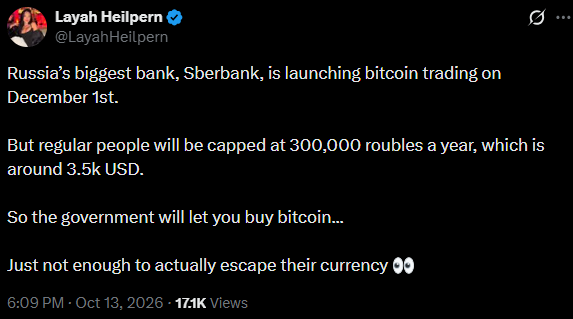
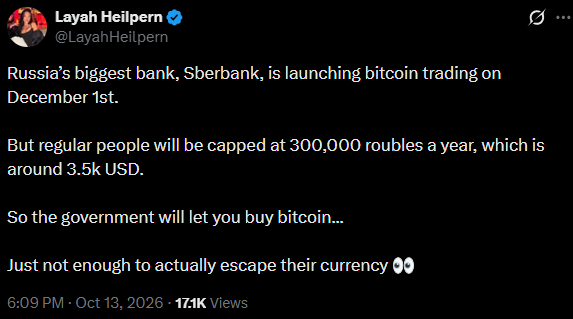
However, Russia only grants that unfettered access privilege to accredited institutional investors. For retail investors, crypto investments will be capped at 300,000 roubles per year (about $3.5K per year).
In fact, analyst Layah Heilpern questioned the cap provision,
So the government will let you buy Bitcoin…Just not enough to actually escape their currency
That said, Russia ranked 16th globally for crypto adoption in 2026, according to Chainalysis. It remains to be seen how the latest regulatory push will drive adoption.
Final Summary
- Russia’s largest bank, Sberbank, will begin crypto trading support for BTC, ETH, and USDT from December 1.
- Retail investors will be capped at $3.5K annually for crypto exposures.

Large Pet Heating Pad, Adjustable Temperature with Timer, 35" x 24" | 6 Heat Levels, 6 Timer Settings, Chew-Resistant Cord, Waterproof PVC, Indoor Heated Mat for Dogs and Cats
$36.98 (as of October 14, 2026 03:21 GMT +00:00 - More infoProduct prices and availability are accurate as of the date/time indicated and are subject to change. Any price and availability information displayed on [relevant Amazon Site(s), as applicable] at the time of purchase will apply to the purchase of this product.)
SUPERDANNY Extension Cord,Flat Plug Surge Protector Power Strip,10Ft | 8 AC & 4 USB Ports (2 USB C),Surge Protector with 1050J,Desk Charging Station for Home Office,College Dorm Room Essentials
$13.99 (as of October 14, 2026 03:21 GMT +00:00 - More infoProduct prices and availability are accurate as of the date/time indicated and are subject to change. Any price and availability information displayed on [relevant Amazon Site(s), as applicable] at the time of purchase will apply to the purchase of this product.)
Apple iPad 11-inch: A16 chip, 11-inch Model, Liquid Retina Display, 128GB, Wi-Fi 6, 12MP Front/12MP Back Camera, Touch ID, All-Day Battery Life — Blue
$424.99 (as of October 14, 2026 03:21 GMT +00:00 - More infoProduct prices and availability are accurate as of the date/time indicated and are subject to change. Any price and availability information displayed on [relevant Amazon Site(s), as applicable] at the time of purchase will apply to the purchase of this product.)
FUJIFILM instax mini 13 Instant Film Camera - Clay White
$79.95 (as of October 14, 2026 03:32 GMT +00:00 - More infoProduct prices and availability are accurate as of the date/time indicated and are subject to change. Any price and availability information displayed on [relevant Amazon Site(s), as applicable] at the time of purchase will apply to the purchase of this product.)












Post Comment