
Why Your “Passive” Buy-and-Hold Portfolio Is Secretly Sabotaging Your Wealth Growth (And What To Do About It)
Ever tried to run a “set-it-and-forget-it” portfolio and ended up refreshing your stock app every five minutes? Yeah, me too. It’s almost like the myth of a truly passive stock portfolio is just that—a myth. Watching my colleague AK71’s recent interview got me thinking: managing 10, 20, or even 50 individual stocks quietly? Not really happening. No matter how much we wish for that easy dividend stream and the “buy and hold forever” fairy tale, the reality bites. Companies don’t stick around forever, storms hit, and suddenly your portfolio’s a drama-filled soap opera. So, is your “passive” plan actually active under the hood? Spoiler alert—it probably is. Buckle up, because we’re diving into why being passive isn’t as passive as you think, and why embracing a bit of active management might be your best shot at survival and success. LEARN MORE
img#mv-trellis-img-1::before{padding-top:85.15625%; }img#mv-trellis-img-1{display:block;}img#mv-trellis-img-2::before{padding-top:62.01171875%; }img#mv-trellis-img-2{display:block;}img#mv-trellis-img-3::before{padding-top:62.01171875%; }img#mv-trellis-img-3{display:block;}
I manage to watch my old blogger colleague AK71’s interview at Fifth Person recently. I think AK comes across as having a more active management of his individual stocks portfolio than many of his followers imagine it to be.
If you manage a bunch of individual stocks, say 10, 20, or sometimes 50 of them, you cannot really get a passive portfolio.
I know a lot of you want it to be passive.
They see influencers say that if you pick all the right stocks, you can buy and hold them and never have to do anything else. In their minds, those stocks will just grow at a steady rate over the long term, and that alone makes it a passive plan.
The most common version of this is dividend stocks. The idea is that you pick the right companies, the ones that keep growing their dividends, and then you can relax.
There can be a lot of reasons why it’s really hard to be passive.
You are Pretty Poor at Keeping Your Portfolio Passive
Let’s start with the ones that involve actions, like making trades and things like that.
Do I see passive portfolios around?
Yeah, we see a lot of buy and hold portfolios at work. What kind of stocks do they own?
Very familiar past themes. That’s how I will classify them.
What you end up with is a mix of securities.
Some stocks do really well, and a lot of others don’t.
Yeah, people buy and hold and I’m not sure that’s the best idea if you never reallocate into other stocks.
A lot of the time, these people started out wanting to hold for the long term. But they don’t really know how to reallocate, or they don’t have the time to do it. They also don’t have a new set of securities to rotate into.
I think a lot of people don’t go deep enough in their analysis. So when something seems to go against their first read, whether that read was shallow or deep, they tend to feel pulled toward selling or folding.
It’s passive until your stocks don’t do well
I don’t think that’s really passiveness, though. The moment you have to evaluate the situation and make those calls, that’s already a kind of active management.
Most Companies Eventually Die, So How can You Not Do Anything?
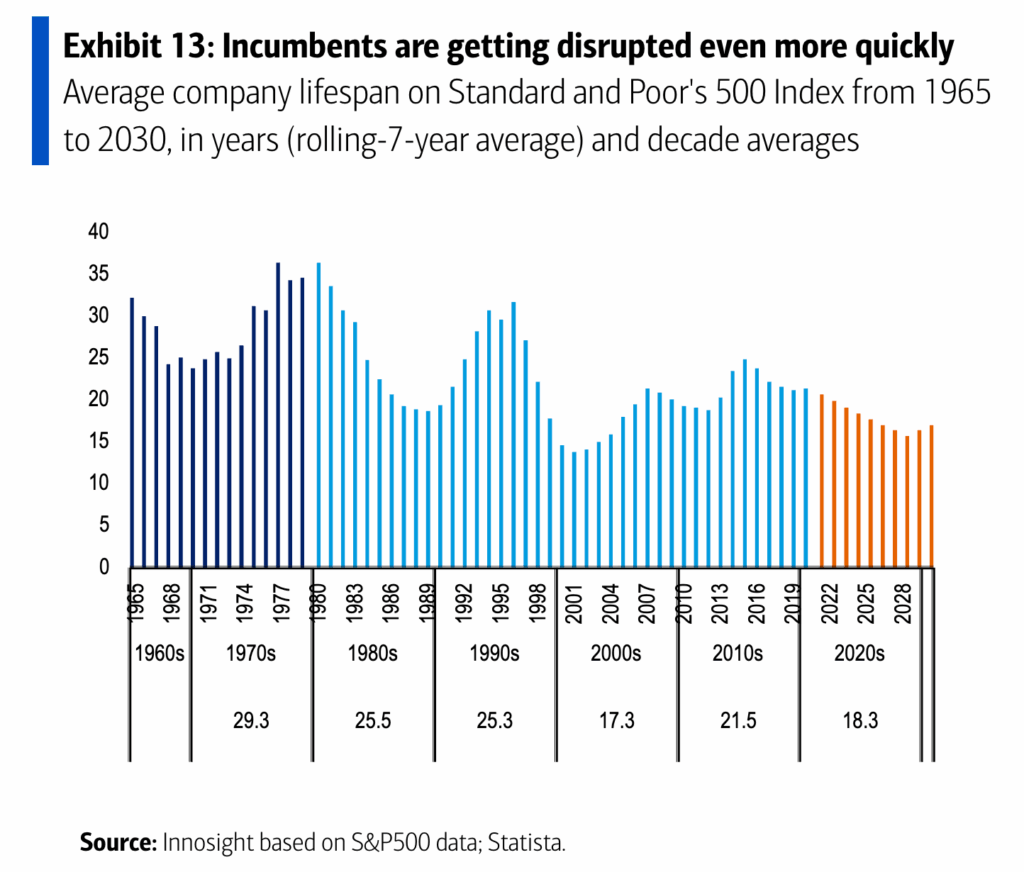
The second reason is that companies are not staying listed, or even staying in business, as long as they used to.
I think most of us look at the market through the companies that survived, and we assume most companies do the same. We forget about survivorship bias.

This chart shows the average lifespan of the large cap companies in the US. You can see that even the oldest lasted most 30 years and it’s getting shorter and shorter.
When we think about what to invest in, we think of the DBSs and Louis Vuitton, which have lasted a long time, and we assume every company is like that.
But if you look at the whole picture, there will be plenty of companies you would tell yourself not to buy because they look wobbly. You might want to think about what share of companies fall into that group compared to the ones that last.
If you feel you have to pick and choose from a basket of stocks, then I guess there’s a good chance many of them won’t do well over time. And if they don’t do well, I’m not sure how buying and holding forever would work?
Professional portfolio managers do some things that a lot of people overlook.
- They need to keep curating their holdings. That means thinking about what to sell, what to hold, and how much to sell of each position.
- It also means deciding what to rotate into, and knowing what your opportunity set is.
That isn’t passive. There is real activity involved. I’m not sure whether people forget this or whether they somehow leave it out of the passive portfolio they talk about.
I think it’s natural for us to keep shifting our money between stocks in a systematic way.
Even investors have their own systematic way of judging these things, whether they lean toward value, like Warren Buffett, or toward growth. That’s a natural thing to do, and for professional managers it isn’t passive at all.
If it were passive, how could they justify the salary they actually get? To them it isn’t passive, but to you, the person putting money into the fund, it is passive.
And if you do it yourself, taking on a role similar to those portfolio managers, then it isn’t passive either.
Thinking and Being Concerned Enough to Investigate is Not Passiveness
One lie people tell themselves is that being active means making some portfolio move.
To me, being active also means thinking about your portfolio and its parts. If you don’t think about it, something will happen to your portfolio anyway.
I’m not sure I’m explaining this well.
What I mean is that if you have to think about your portfolio on purpose, or else something bad will happen to it, then that isn’t really passive, even if you aren’t making any trades.
I think a lot of us would have felt that in the past. When I was a retail portfolio manager, I understood this firsthand.
- If you want to concentrate in a certain position, you have to be right about it. So you have to think it through.
- That’s true before you buy the stocks, and it’s just as true after you’ve bought them and want to add more. What gives you the conviction to add more? How do you build that conviction? I think the answer is that you have to spend enough time actually thinking about it.
- When something happens that could affect one of your stocks, you would usually need to think if the something will have significant positive or negative impact to that stock.If you already worked it out last time, that counts as being active too. And if you need more time, going into a chat group to ask what people think isn’t passive either.
I’m sure many of you have gone through all of this before.
You go to chat groups to look for opportunities, or you ask other people whether it’s a good idea to add more. Is now a good time to add, or is it the wrong time? Should you be selling instead? Do we think this event will turn out to be positive or negative?
Many of you have probably been in this spot before.
Multiply this by the number of securities that matter to you.
But you convenient label this as passive.
It’s not that you can’t live a life where you talk about stocks all the time. In my job, I have to look at investing stuff constantly, even on boring days. But there’s a difference between looking at it because it interests you and looking at it because your portfolio will suffer if you don’t.
So I chat with people about stocks a lot, and sometimes I get pretty emotional about certain ones. I might even own a few of those positions. Then I can say I’m a bit disappointed or heartbroken, because I own it and it’s not doing well. But there’s a difference in how much any of this really affects you. I think the clear line is the reason you want to grow your portfolio, or make sure it does well over time.
Usually that reason is to earn income or reach a target so you can be financially independent. If that goal matters to you and you keep thinking about it, then that kind of thinking isn’t really passive at all.
You become Active When You Felt Your Portfolio is Struggling.
People who have already done well tend to feel more relaxed about their portfolios. In a way, they feel like they’re already in the money. They’ve made 100% gains on a big part of their holdings, so they don’t feel the need to watch them closely.
Then there are those who find it very hard to take their eyes off their portfolio. I think they’re often the ones with concerns, especially when it hasn’t been doing well for a long time. I may be wrong about this, and I’d love to hear how it looks from where you sit.
This chart may probably explain some of the past you lived through:

The red line is the MSCI World ETF and the blue line is the SPDR STI ETF. The time period was end 2009 to Apr 2021.
The STI represents your experience holding mainly Singapore stocks. After 11 years or so, its made 67%. 4.7% p.a. ain’t so bad until you realize you could have been more broadly diversified and harvest 11.4% p.a. with the MSCI World ETF.
This is usually where people start to get a little wobbly.
You find yourself wondering whether you’re making the right call by sticking with Singapore stocks or should be switching. It might help to think of it less as one trade and more as a broader look at your strategic allocation. Still, it usually comes from worry when your portfolio isn’t doing very well, and that’s completely understandable.

Fast forward and look at a different time frame, sticking to the Singapore stocks would make you outperform from 110% versus 65%.
If you have stuck with your Singapore stocks you will feel more assured, and felt that your portfolio is more passive.
You might be thinking by now that a lot of the Singapore stocks have already rallied, except for the banks. Is it going back to the way things were in the 2010s and 2020s, when nothing much happened for years?
If you have that kind of concern, I get it, and it’s not a small thing to worry about.
If the market goes back that way, it could throw off your plan, whether you’re holding this as an income portfolio or an accumulating one. So it makes sense that you’re thinking about it.
There is a plane of Activeness that I am Comfortable with and a plane of Activeness that I absolutely don’t want to go Back to.
Nowadays my portfolio is more strategic. I don’t invest in many individual stocks. I invest through systematic strategies instead.
I still care about earnings per share growth and earnings yield though, but more as a basket of securities in aggregate than individual holdings.
I don’t think about the earnings yield or earnings growth of each holding. I’m not tracking all 300 or 1,000 of them to see which will survive. I know many companies won’t survive, and some will keep trying and fail on and off. A systematic strategy is built to keep collecting returns in that way. The thing I’m invested in is active, since it reallocates on a regular schedule.
I still think about some things, though.
For example, what if international markets don’t do as well as the US, or certain regions do much better? I’d like to understand why.
Long-term trends in earnings per share growth help me here, both the forecasts and the history. They show that drops in earnings per share tend to be small and that growth usually comes back. When earnings per share starts growing again, or when the market’s earnings yield looks cheap enough, staying invested for the long term should give me an attractive earnings yield. That’s especially true if I hold for 20 years and the yield is already high.
So yes, I have concerns.
I’d rather think about them now and then, and remind myself what I’ve learned about earnings per share growth across a whole basket of stocks.
That’s better than focusing on thinking about 10 or 20 single companies. Deciding what to do with a 10% position, for instance, could hold back the whole portfolio and what I put in next. Those are very active decisions with a big impact. That’s not the level of activity I want to stick with.
The best thing is that I don’t really have to take any action myself. One of the main reasons is that this whole portfolio is a strategic allocation. When I say strategic, I mean it’s a long-term allocation to systematic strategies that are spread across these regions.
I’m not saying that activity is taboo.
I think if you manage your own retail portfolio and do well, even just matching the benchmark index, you should give yourself a pat on the back. That’s a real achievement.
But I think it really comes down to whether you’re fooling yourself when you call your portfolio passive, when it’s actually much less passive than that. I’ll admit it’s hard for all of us to be honest with ourselves. There are a lot of reasons we can’t always be truthful with the people we talk to out there.
Still, I think the last line of defense is being honest with yourself about how passive this strategy really is for you.
I also think it’s just as sneaky when someone is smart and sophisticated but makes their strategy sound simpler or more passive to other people when it really isn’t.
I see plenty of people doing that these days.

Kyith is the Owner and Sole Writer behind Investment Moats. Readers tune in to Investment Moats to learn and build stronger, firmer wealth foundations, how to have a Passive investment strategy, know more about investing in REITs and the nuts and bolts of Active Investing.
Readers also follow Kyith to learn how to plan well for Financial Security and Financial Independence.
Kyith worked as an IT operations engineer from 2004 to 2019. Currently, he works as a Senior Solutions Specialist in Fee-only Wealth Advisory Firm Providend. All opinions on Investment Moats are his own and does not represent the views of Providend.
You can view Kyith’s current portfolio here, which uses his Free Google Stock Portfolio Tracker.
His investment broker of choice is Interactive Brokers, which allows him to invest in securities from different exchanges all over the world, at very low commission rates, without custodian fees, near spot currency rates.
You can read more about Kyith here.

Roku TV Remote Control (Official Manufacturer Product) | Simple Setup & Pre-Set App Shortcuts - Replacement Remote Compatible with RokuTV Models ONLY (Not Roku Players)
$9.99 (as of October 24, 2026 03:23 GMT +00:00 - More infoProduct prices and availability are accurate as of the date/time indicated and are subject to change. Any price and availability information displayed on [relevant Amazon Site(s), as applicable] at the time of purchase will apply to the purchase of this product.)
Purina Fancy Feast Grilled Seafood Wet Cat Food, 3 oz Cans, 24-Pack | Variety Pack, crafted with real seafood in savory gravy. Made with no Artificial Colors or Preservatives.
$22.86 (as of October 24, 2026 03:13 GMT +00:00 - More infoProduct prices and availability are accurate as of the date/time indicated and are subject to change. Any price and availability information displayed on [relevant Amazon Site(s), as applicable] at the time of purchase will apply to the purchase of this product.)
Milk-Bone Original Biscuits Large Dog Treats, 10 Lb.
$14.98 (as of October 24, 2026 03:13 GMT +00:00 - More infoProduct prices and availability are accurate as of the date/time indicated and are subject to change. Any price and availability information displayed on [relevant Amazon Site(s), as applicable] at the time of purchase will apply to the purchase of this product.)
Inesore 4 Pairs Replacement Ear Tips for AirPods Pro 2nd/1st (White) | (2019/2022/2023) with Noise Reduction Hole & Built-in dust Guard Screen,Silicone, with Cleaner Pen,4 Size (XS/S/M/L)
$6.98 (as of October 24, 2026 03:23 GMT +00:00 - More infoProduct prices and availability are accurate as of the date/time indicated and are subject to change. Any price and availability information displayed on [relevant Amazon Site(s), as applicable] at the time of purchase will apply to the purchase of this product.)











Post Comment