
Unlock the Retirement Mortgage Strategy That Could Free $165,000 Hidden in Your Income Portfolio—Are You Missing Out?
Ever found yourself tangled in the maze of mortgage decisions as you inch closer to a life where paychecks become a thing of the past? It’s a twisty puzzle—should you wipe out that lingering $165,000 condo loan, stash it away just in case, or simply keep it as background noise in your financial symphony? A reader recently nudged me with this very question after I shared my thoughts on a fully paid Limited Whole Life policy and his plan to funnel $50,000 into a global ETF. The conversation didn’t just stop there; it unfolded into a deep dive about how mortgages fit—or clash—with a no-work-income lifestyle and what that means for peace of mind and smart financial independence planning. So, how do you balance that mortgage knot without losing your cool or your cash flow? Let’s explore the model answer I’d give myself (and you), unpacking the complexities and revealing why sometimes the best move is simply having the option to pay off your mortgage—not necessarily doing it. Ready to rethink your mortgage and financial independence strategy? Let’s jump in. LEARN MORE
img#mv-trellis-img-1::before{padding-top:100%; }img#mv-trellis-img-1{display:block;}img#mv-trellis-img-2::before{padding-top:116.62870159453%; }img#mv-trellis-img-2{display:block;}
A long-time reader hit me up after I wrote about my fully paid up Limited Whole Life policy. You can read about this article here:
My reader shared his intention to invest the $50,000 from his paid-up policy into perhaps VALU, the Vanguard FTSE Global All-Cap UCITS ETF. I reminded him that he should consider the role of his paid-up policy and whether he has protection needs.
We had a lengthy exchange and the conversation eventually pivot to how he visualise his current setup, with a view of a no-work-income lifestyle soon.
We started talking about his $165,000 mortgage on a condo he owns in Singapore.
I was trying to give him some useful pointers but I thought its good to let readers in on how I see this “having a mortgage in a no-work-income financial independent” situation.
This is where I landed.
Let me give you my model answer for myself, but also for most people, knowing what they really want.
Before I go on, one caveat.
The right answer depends on what the loan is for. A mortgage on the home you live in is a different problem from a mortgage on an investment property.
My reader’s loan is actually on an investment property. I’ll come back to that later.
But when most people ask me about this, they mean the home they live in.
So let me give you my model answer for that.

Say there is $165,000 left on the loan of the home you live in, and you are heading towards a life without a salary.
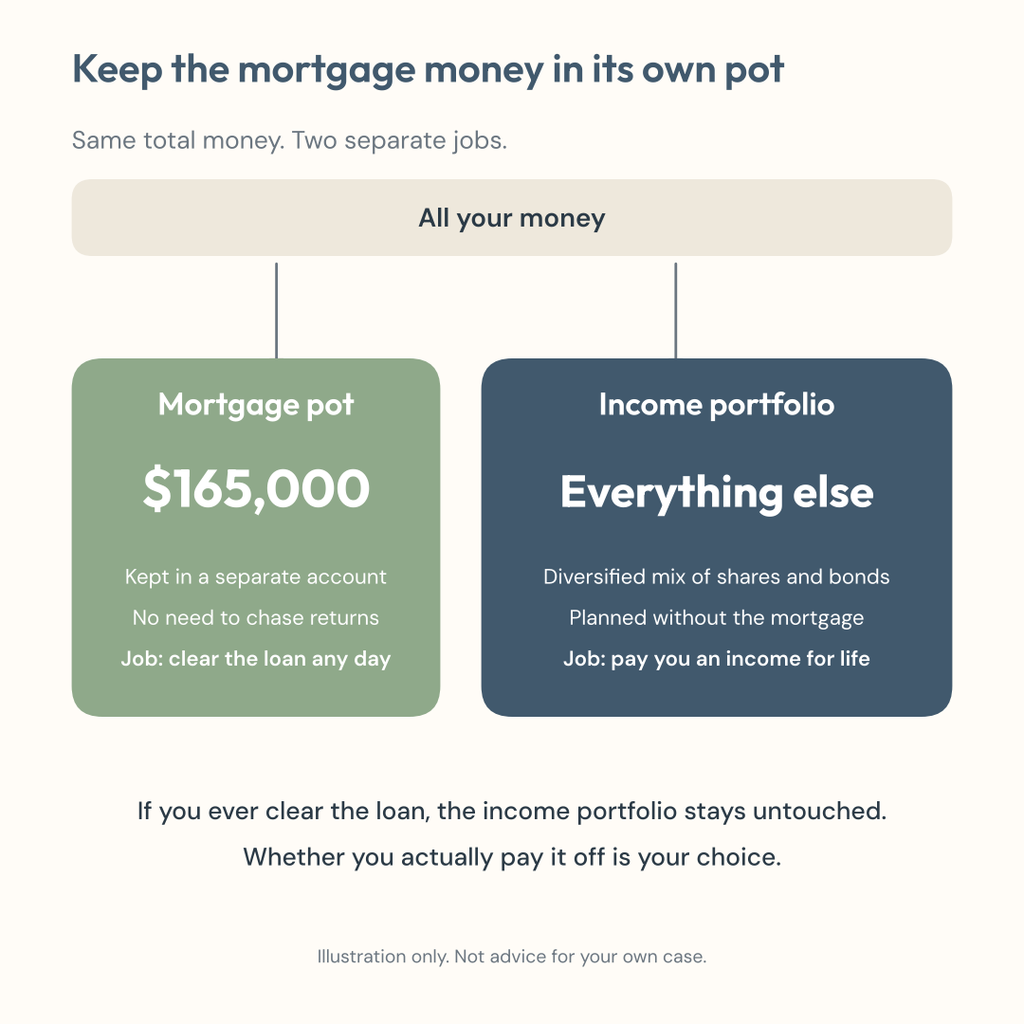
- Set that $165,000 away from the money that provides you income. Keep it in its own pool, away from the money that pays your income. A separate account is fine. Don’t worry about the return on it. Its only job is to be there, so you could clear the loan on any day you choose.
- Whether you really pay this $165,000 off is up to you. Knowing that you can is what gives you peace of mind.
- For your income portfolio, calculate how much to Fund your must-pay costs carefully. These are the costs you can’t cut even in a terrible year. For these, I use a withdrawal rate of 3%. If you want income that can last forever, like I do, use 2.5%. Keep the money in a diversified mix, with more shares if it has to last a long time.
- For your income portfolio, calculate how much to fund your flexible spending separately. Holidays, eating out, the nicer things. You can cut these when markets are bad, so 4% or 5% is reasonable.
- Add up the money needed in #3 and #4 all up. If you have enough, you are financially independent in a careful, conservative way.
Here is a made up example, just to show how it works:
- Must-pay costs of $3,000 a month, or $36,000 a year. At 2.5%, you need $1.44 million.
- Flexible spending of $1,000 a month, or $12,000 a year. At 4%, you need $300,000.
- Plus the $165,000 set aside.
- Total: about $1.9 million.
If you’re comfortable using 3% for the must-pay part, that $1.44 million becomes $1.2 million, and the total drops to about $1.67 million.

So the more careful you are, the more you need. That’s the price of sleeping well.
If you have this, you could wake up tomorrow, clear the loan, and still have enough income. Or you could keep the loan. Either way, it’s a choice, not a burden.
That’s the plan I think everyone should aspire towards.
But I know it’s not how most of us think.
And I get why.
So let me walk through the choices people usually wrestle with, and why I ended up here.
You never end this game of money/return optimisation
Most of us have spent our whole lives optimizing. Every dollar had a job. The best choice was the one with the better number.
So the first thing many people ask is this.
Should I pay off the loan, or keep the cash and earn more than the loan costs me?
Say your loan costs 1.65%. A safe high yield deposit pays 2.5% for three years. On $165,000, you earn about $1,400 a year more than you pay.
“Nice. I’m ahead!”
Then three years pass.
“Okay, what now? The deposit is ending. The loan is resetting. Can I still beat it? Which bank? Should I just pay it down?”
A mortgage doesn’t last three years.
It can run 8 years, even 15. So you keep coming back to the same table, again and again.
Will you come out ahead over 15 years?
Honestly, I don’t know. I haven’t done enough research on something this niche, and an average return won’t tell you either. Some stretches will go your way. Some won’t.
What I do know is that the game doesn’t end. You pay for it with your attention and your worry.
I call that mental load.
And I think it’s the cost most of us forget to count.
2022: the year mortgages became a lottery
I have never taken a mortgage of my own. But for about 20 years of my working life, I have been paying off my parents’ mortgage.
My loan is fixed, and it’s smaller than what many of my friends carry. When the amount is small, you don’t feel the weight as much.
So in 2022, I barely felt a thing.
But I watched a lot of people go through it.
Did you manage to reprice or refinance a few months before rates shot up? (That just means moving your loan to a new rate when the old one ends.) If you did, lucky you. If you didn’t, you were suddenly paying a lot more.
You can be the same person taking the loan but the bill is different just by timing.
It felt like a lottery.
Picture someone paying $4,000 a month. Then it becomes $6,000. That’s $2,000 more, every single month.
Is $2,000 a lot? It depends on the person. But I think the real shock wasn’t the number. We had lived with low rates for so long that nobody could imagine high ones. Some part of us hoped they would never come.
Higher rates eventually came back.
And we actually see people paying off their loans. I had heard people say they might, if rates ever went up. But only in 2022 and 2023 did I see it happen, for real.
People who had borrowed against their insurance policies felt the same squeeze.
And everyone asked me the same thing. “Kyith, how long will rates stay this high? Will they come down?”
Rates are still much higher today than back then. And the honest answer is that nobody knows where they go next.
So I would never build a retirement plan that needs rates to stay low.
Why do I keep the loan out of the income pot
People often send me their plan. It usually sounds like this:
“Kyith, I’ve reached $3 million. At 3%, that’s $90,000 a year. That covers my living costs and my mortgage. I’m financially independent!”
Hmm.
I never quite know how to say this kindly and yet succinctly enough to them.
Here’s what I see.
The money that could have cleared the loan is sitting inside the income pot. A bigger pot feels good. The income looks higher. And the hope is that the income can keep pace with the mortgage payment.
But it’s two problems tied into one knot.
Go back to that $4,000 payment. That’s $48,000 a year, more than half of the $90,000. When it jumps to $6,000, it’s $72,000. That’s 80% of the income, gone to the bank.
They were financially independent in that snapshot but when one number variable change, their whole financial independent plan wobbled.
Here’s why mortgage matters so much.
Some costs you can bend. Groceries, you can trim. A holiday, you can skip. But a mortgage? You can’t shop for a cheaper one halfway. Loans from different banks look quite alike. You can choose fixed or floating, or pay part of it down, but the bill still comes every month.
That makes mortgage usually a must-pay cost.
And whatever strategy you use, dividends or a withdrawal rate, it all comes back to one question. What income can I safely take, even in the worst years? That’s what a safe withdrawal rate tries to answer.
So the more must-pay costs you have, the more money you need behind them.
- At 3%, a $4,000 monthly payment needs $1.6 million behind it.
- At $6,000, it needs $2.4 million.
- The rate move alone added $800,000 to what you need.
“But Kyith, a mortgage ends!”
True. It’s not forever, like food.
And that is the second reason why I prefer to consider the money meant for mortgage as a separate pool.
It takes the mortgage out of your must-pay costs. The money you need gets smaller, and so does the knot.
What if the loan is on a property you don’t live in?
Now, back to my reader.
His HDB flat is fully paid. His $165,000 loan is on a small condo he bought around 2015, one of those shoebox units.
I didn’t ask him if he rented it out. But I have a feeling he’ll be the first to tell me, “Kyith, managing tenants is not as easy as you think.”
I’ve always said tenants are not everyone’s cup of tea. It means a lot more when someone who has lived it says so.
The money side is simple enough. Rent, less the usual running costs, is your cash flow. If it covers the loan, nothing comes out of your pocket.
The harder questions are about the life you want.
- If something goes wrong, is your plan to sell the property and use the money to clear the loan?
- Do you even want to own it in that stage of life?
And to judge whether it was a good investment, put all the money that went in and came out together. It boils down to one yearly return. (It’s the same XIRR idea I used in my policy article.) Then compare it with what a deposit, a bond fund or a share fund would have given you. That’s the fair test.
People like to make their Financial Independence setup more and more complicated.
Some people have more than one property. As they get close to stopping work, they sometimes sell one and buy another. Or bring two into one.
That needs cash flow planning, and not just for this year. How much down payment will the next one need? How much will the old one bring in after costs? How many years of the new loan will you be paying in retirement?
Some people get an adviser to work this out. Some prefer to do it themselves. Both are fine.
But before the next move, I’d pause and ask two simple questions.
Am I creating problems for myself?
And does this still take me towards the life I want?
I don’t think we ask that enough.
So where does this leave us?
If I had to boil it down, I’d ask you three things.
- How much peace of mind do you want, and how much mental load are you willing to carry? Beating the loan is a game with no finish line.
- Is your mortgage tangled up with the money that pays you? If it is, try to untangle it now, while things are calm.
- What’s the ideal setup for the life you want? Even if you were retrenched tomorrow. Do you want an investment property? Do you want a mortgage? Do you want to be mortgage free? Start there, and the big decisions become a lot clearer.
You don’t have to pay off your mortgage.
You just need to be able to.
This is how I think about it.

Kyith is the Owner and Sole Writer behind Investment Moats. Readers tune in to Investment Moats to learn and build stronger, firmer wealth foundations, how to have a Passive investment strategy, know more about investing in REITs and the nuts and bolts of Active Investing.
Readers also follow Kyith to learn how to plan well for Financial Security and Financial Independence.
Kyith worked as an IT operations engineer from 2004 to 2019. Currently, he works as a Senior Solutions Specialist in Fee-only Wealth Advisory Firm Providend. All opinions on Investment Moats are his own and does not represent the views of Providend.
You can view Kyith’s current portfolio here, which uses his Free Google Stock Portfolio Tracker.
His investment broker of choice is Interactive Brokers, which allows him to invest in securities from different exchanges all over the world, at very low commission rates, without custodian fees, near spot currency rates.
You can read more about Kyith here.

Blink Outdoor 4 with Free Battery Doorbell 2K+ (newest model) — Two-year battery 1080p cameras and 2K battery doorbell. Sync Module Core included — 3 Cameras + Doorbell (Black)
$65.99 (as of November 14, 2026 03:26 GMT +00:00 - More infoProduct prices and availability are accurate as of the date/time indicated and are subject to change. Any price and availability information displayed on [relevant Amazon Site(s), as applicable] at the time of purchase will apply to the purchase of this product.)
Smart Bark Collar for Large Medium Small Dogs, Rechargeable No-Bark Collar, Stop Barking Collar, 2026 Upgraded Dog Bark Collar with 3 Modes, 7 Sensitivity, Pumpkin Orange
$25.99 (as of November 14, 2026 03:26 GMT +00:00 - More infoProduct prices and availability are accurate as of the date/time indicated and are subject to change. Any price and availability information displayed on [relevant Amazon Site(s), as applicable] at the time of purchase will apply to the purchase of this product.)
BARK&SPARK No Poo Chews for Dogs - Coprophagia & Stool Eating Deterrent | Probiotics, Digestive Enzymes & Breath Aid Support - Stop Dog Poop Eating - 120 chews
$21.97 (as of November 14, 2026 03:26 GMT +00:00 - More infoProduct prices and availability are accurate as of the date/time indicated and are subject to change. Any price and availability information displayed on [relevant Amazon Site(s), as applicable] at the time of purchase will apply to the purchase of this product.)
Pet Odor Eliminator & Enzyme Deodorizer with Blue Light Nano Sprayer | 4 Enzyme Deodorizer Included, USB-C Rechargeable, Nano Atomization, Blue Light, Refillable, Handheld for Pet/Home/Car
$39.99 (as of November 14, 2026 03:26 GMT +00:00 - More infoProduct prices and availability are accurate as of the date/time indicated and are subject to change. Any price and availability information displayed on [relevant Amazon Site(s), as applicable] at the time of purchase will apply to the purchase of this product.)











Post Comment