
Crypto Regulation Chaos: How the CFTC’s Bold Move Could Rewrite the Rules Without the CLARITY Act
So, the CLARTY Act didn’t make it through the Senate this year—but don’t think the crypto game is slowing down. No sir! The Commodity Futures Trading Commission (CFTC) is stepping up its hustle, rolling out fresh advisories that could reshape how regulated derivatives trading and clearing platforms view crypto assets. Picture this: on November 23rd, the agency said, “Hey, Bitcoin, Ethereum, and payment stablecoins—you’re now part of the squad that can count towards a platform’s financial resource requirements.” Meaning Swap Execution Facilities, Designated Contract Markets, and Derivatives Clearing Organizations can now lean on these digital assets to prove they have enough funds to keep the lights on for at least a year, even when the financial seas get rough. But here’s the kicker—it’s not all sunshine and rainbows. Crypto assets can boost that 12-month coffers count but don’t expect them to cover liquidity needs, because, under GAAP rules, they’re not considered liquid cash or securities. So, the value of your Bitcoin stack might flex your financial muscles, but it won’t quite cut the mustard when you need cold, hard cash ready to settle up immediately. Plus, the advisory insists on “haircuts”—not the kind you get at the barbershop, but discounts to the asset values factoring in crypto’s infamous volatility. It’s a fascinating dance between innovation and caution. Curious about how all this shakes out for the markets and what it means for your digital asset strategy? LEARN MORE
Although the CLARTIY Act failed to pass the Senate this year, the Commodity Futures Trading Commission (CFTC) is working hard to develop new crypto market advisories.
On the 23rd of November, the agency issued a new advisory allowing certain crypto assets to be counted towards the financial resource requirements of regulated derivatives trading and clearing platforms. This includes Bitcoin [BTC], Ethereum [ETH], and payment stablecoins.
So now, Swap Execution Facilities (SEFs), Designated Contract Markets (DCMs), and Derivatives Clearing Organizations (DCOs) can use these digital assets to confirm that they have sufficient financial resources to cover at least 12 months of operating expenses.
These requirements are designed to ensure that such platforms have enough funds to continue operating and meet their financial obligations, even during times of financial stress.
Important limitations on the new advisory
However, the approval comes with an important limitation. While eligible crypto assets can contribute towards the 12-month financial resources requirement, they cannot be counted towards the separate liquidity requirement. This is because, under Generally Accepted Accounting Principles (GAAP), cryptocurrencies are not classified as cash or highly liquid securities.
In simple terms, holding Bitcoin or Ethereum may help a platform prove its financial strength, but it cannot replace the cash or highly liquid assets it needs to meet immediate payment obligations.
The advisory also requires appropriate haircuts. In other words, the platforms must discount the value of crypto assets when calculating how much they can count towards their financial resources. This would be done to account for the price volatility and risks associated with digital assets.
Expressing their opinion on the matter, CFTC’s Chairman Mike Selig said,
Pleased to see @CFTC staff continue to provide important clarity around crypto assets in US derivatives markets through today’s staff advisory.
Additional rules for a regulated crypto market
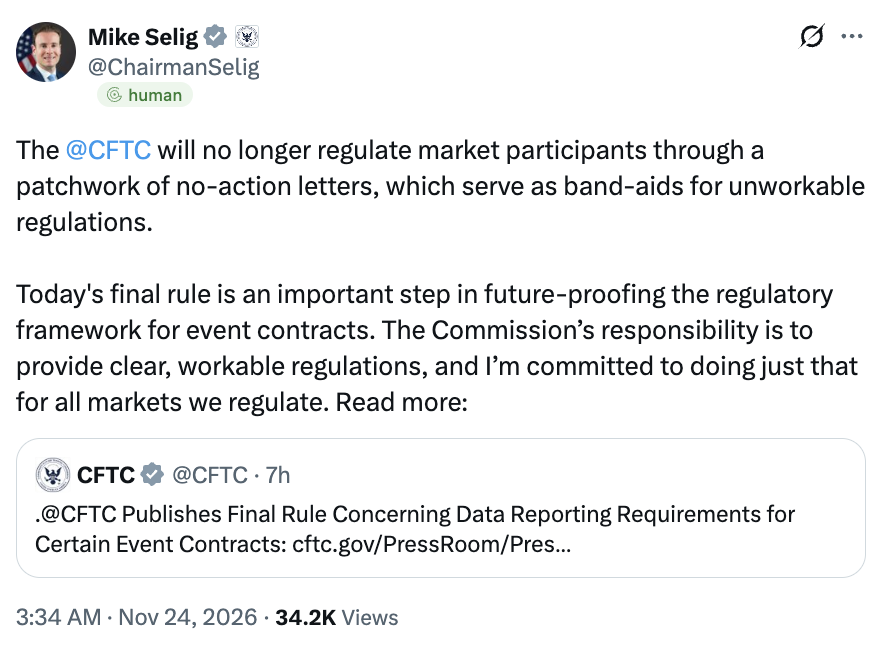
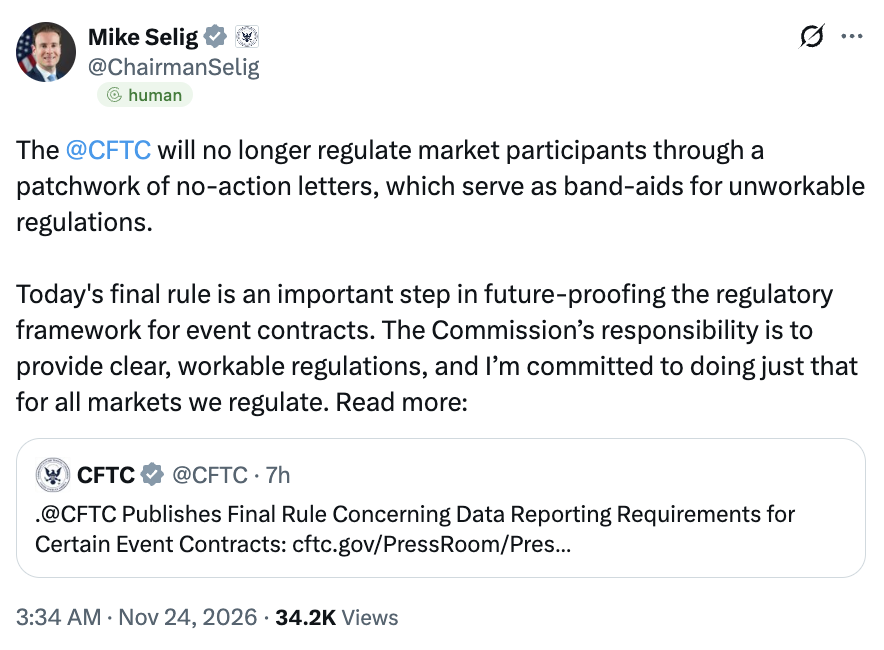
On the same day, though, the CFTC also introduced a new reporting framework for certain fully collateralized event contracts. This was done to replace the reliance on temporary regulatory exemptions and no-action letters that have been in place since 2017.
In other words, the move aims to make reporting requirements for event contracts, including prediction-market products, clearer and more consistent.
Remarking on this, Selig noted,
Not everyone is happy with CFTC’s Chairman
Yet, despite all the efforts, Senator Adam Schiff criticized the Trump-appointed CFTC Chairman over his handling of the legal battle surrounding prediction markets. Schiff claims that the chairman had previously told the Senate during his confirmation process that he would allow courts to decide whether prediction markets fall under gambling laws.
However, according to Schiff, the chairman has since acted against that commitment. Schiff believes that Selig has allegedly disregarded court orders and intervened in ongoing litigation in ways that favor the prediction-market industry.
His criticism suggests that the CFTC leadership is taking an active role in protecting prediction-market platforms rather than maintaining regulatory neutrality.
All of this coincided with the agency’s plans to use its existing authority to introduce two initiatives: Regulation Crypto Asset Transactions (CTX) and Regulation Crypto Asset Markets (CAM).
Final Summary
- The agency allowed certain crypto assets to be considered as the financial resource requirements of regulated derivatives trading and clearing platforms.
- The agency has also replaced the reliance on temporary regulatory exemptions and no-action letters that have been in place since 2017.

Blue Buffalo Health Bars Bananas & Yogurt Dog Biscuits, 16 oz | Oven-Baked, Crunchy Texture, For All Breed Sizes, No Corn, Wheat, or Soy
$3.79 (as of November 24, 2026 03:25 GMT +00:00 - More infoProduct prices and availability are accurate as of the date/time indicated and are subject to change. Any price and availability information displayed on [relevant Amazon Site(s), as applicable] at the time of purchase will apply to the purchase of this product.)
Pounce Beam "Whack-A-Mouse" Floor Projector, The Ultimate 3 AM Zoomies Cure | Interactive Cat Toy for Indoor Cats, Funny Moving Mice Light Projector & Pet Entertainment Toy for Cats
(as of November 24, 2026 03:27 GMT +00:00 - More infoProduct prices and availability are accurate as of the date/time indicated and are subject to change. Any price and availability information displayed on [relevant Amazon Site(s), as applicable] at the time of purchase will apply to the purchase of this product.)
Apple AirPods Pro 3 Wireless Earbuds with Active Noise Cancellation | Live Translation, Heart Rate Sensing, Hearing Aid Feature, Bluetooth Headphones, Spatial Audio, USB-C Charging
$149.00 (as of November 24, 2026 03:28 GMT +00:00 - More infoProduct prices and availability are accurate as of the date/time indicated and are subject to change. Any price and availability information displayed on [relevant Amazon Site(s), as applicable] at the time of purchase will apply to the purchase of this product.)
SHOKZ OpenRun Pro 2 Bone Conduction Bluetooth Sport Headphones, Black | Bundle with Reflective Strip;DualPitch premium sound;Open ear awareness; Smart Mic; IP55; 12H battery; Running/Cycling/Hiking
$124.95 (as of November 24, 2026 03:28 GMT +00:00 - More infoProduct prices and availability are accurate as of the date/time indicated and are subject to change. Any price and availability information displayed on [relevant Amazon Site(s), as applicable] at the time of purchase will apply to the purchase of this product.)













Post Comment