
Unlock the Secret Weapon This Brand Uses to Turn Ordinary Travel into a Glamorous Power Move You Can’t Miss!
Ever imagined breezing through the airport like a VIP, with zero lines, zero hassles, and none of those classic “wait, that’s not your lounge” confusions? No snippy agents, no frantic TSA rush, and definitely no customs agents ready to rain on your parade at the witching hour. Sounds like an airport utopia, right? Well, here’s where it gets juicy—PS, a renegade LA-based company, is flipping the script on airport chaos with their own luxury private terminals. They’re serving up charter-level ease and glam without the charter price tag… at least, sort of. If you thought flying commercial meant sacrificing comfort and style, think again. This isn’t just another fancy lounge; it’s a whole new way to do airports, designed to keep the flex high and the stress absurdly low. Ready to step up your travel game and dodge those terminal nightmares? Buckle up. LEARN MORE
 5 min read
Imagine a trip to the airport with no lines. No lines to check in, to drop your bag, to be told your first-class ticket is the wrong first-class ticket for the first-class lounge. Now, add to that no interpersonal friction. There are no snappy desk workers, no turbo TSA employees, and no graveyard shift customs agents that give you grief.
Airlines can only solve so many issues. These are terminal problems. PS, a Los Angeles-based company operating its own luxury private terminals, is solving them. The goal is to get you as close to the charter experience as possible, all while still flying commercial. If you ask around or sit in the common areas and eavesdrop long enough, you’ll likely hear something along the lines of “I usually fly private, but when I don’t, this is what I use.”
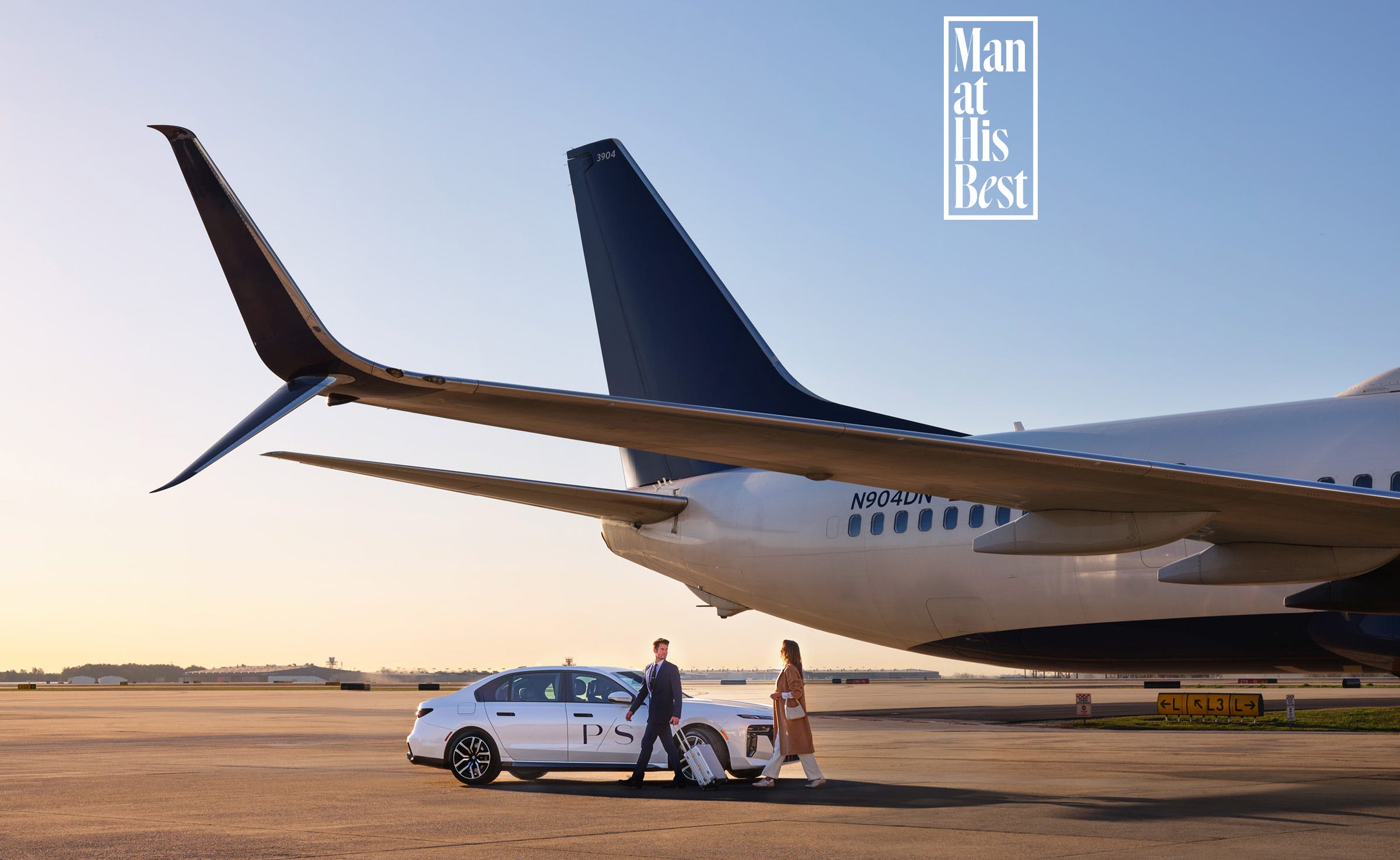
The company has locations in Atlanta, Dallas-Fort Worth, Miami, and Los Angeles, and the next order of business is expansion to the airports its clients use most—business hubs, mostly. But it started at LAX in 2017, and that’s the perfect airport for something like this. The horseshoe design and the traffic it creates, the small terminals, and the paparazzi culture do not cater to the A-list and executive frequent fliers that use it as a home airport. PS offers a way around that with on-tarmac connection from your flight to its terminal or vice versa. A chauffeur pulls you straight off the jet bridge and into a luxury fleet vehicle; that partnership is currently with BMW. If you don’t have any checked luggage, that 7 Series can (for an additional price) drive you straight to your destination within 35 miles of the airport. So if you are sitting in row one of first class, that’s about 50 steps between you and the i7 that takes you to your hotel. Or it can take you back to the PS terminal which is not a lounge, but acts as an über private lounge experience.

Each Salon, the shared lounge space within the PS terminal, is designed to match the aesthetic of the city it’s in. In Dallas-Fort Worth, that’s modern furniture with accessory antiques.
It ain’t cheap: $1,300 per head one-way for the Salon (a shared bar area), $4,950 for a private suite (essentially an airport hotel room with butler and spa service, this price is all-inclusive), and $1,650 for that PS Direct drive-you-straight-home service. There are discounts and perks if you opt for yearly membership, but this is all on top of your ticket, folks.
And it can lean comically luxurious with Champagne and caviar offered every time you enter—like before my 8 a.m. departure, to which I’m not opposed, but was caught a little off guard. There’s the jet-set marketing—tagline: The “back door” to the airport—and meant-for-the-timeline branded cocktail napkins: “You’ve arrived.”
But once you accept that PS could not afford to excuse itself from the flex-driven airport exclusivity economy, you can really admire its hospitality-inspired finishes. Its raison d’être is to get you through the airport with as little friction as possible, but it stands out in its commitment to hospitality within those confines.
For example, interior design and artwork are curated. The centerpiece artworks of each location are done in collaboration with local artists, made to fit the location they are in. The crown jewel thus far is in Miami, where PS took over the old Pan Am headquarters and flight training academy. The midcentury building is a Miami landmark, with geometric thermal walls acting as the façades and this pinkish sandy and limestone-heavy concrete throughout. Argentinian-born ceramicist Nina Surel matched this with tilework water features and a ceramic mural at the center of the property. Design like this, small and mostly unnoticed in the grand scheme of things, is what turns your mind back to a golden age of travel. It’s not credit card points and moneymaking schemes—though actually, you can buy any of the non-centerpiece artworks—just beauty for the sake of beauty.

The PS private suites function more like a daytime hotel room than a lounge.

The art in the interior courtyard of PS Miami was made to mesh with the landmark Pan-Am building the company took over.
On top of that, the food and beverage program is considered and regional. The blue corn cornbread with honey and a ricotta spread that chef Kelsey Kirwin (chefs’ names are on the menus, an indication of the atmosphere) is making at the DFW location overtook my mother’s as my all-time favorite. I would consider the signature PS martini—with (guess what) caviar-stuffed olives—worthy of a place on any hot big-city cocktail menu. And all the coffees, snacks, or water options are head and shoulders above both the general population terminals and the litany of airport lounges within them.
As far as service, yes, an agent handles your party’s check-in and keeps you abreast of delays so you don’t have to open an app—but that’s to be expected. It’s more in the interim. Servers don’t hover, they listen, and they’re backed by an extensive behind-the-scenes operation: Mention you prefer coffee, not bubbles, before a morning flight? A note is made on your profile for the next time you visit. Only ever ask for sparkling water when you fly out of LAX? They’ll know that in Atlanta. The entire operation seems to run on Guidara’s Unreasonable Hospitality, the same way all modern restaurants do. If you’re leaving Miami and mention to a business partner that you forgot to try a Cubano (on menu) and a cafecito (off menu), both will likely be delivered to your table, compliments of the house.
But every time I start to get wowed by the service details, I remember the price point and the level of clientele. That should be expected.
Standard terminals are airside, post-security, where everything (even a fancy and expensive airline lounge) is working within those confines. Since PS operates landside, with security the last stage of the terminal experience, it has the flexibility to be more hospitable to guests. For example, if you book a private suite, you can fly in, use it for a business meeting, and fly out. Or, your parents can accompany the family to departure, hang out in the suite, and squeeze every last second with the grandkids out of your visit. It is an airport experience actually designed around the ways we interact and what matters to us when we travel. That, more than the Champagne and caviar, is the definition of luxury.

Fresh Step Advanced Odor Shield Clumping Cat Litter with Gain, 18.5 lb, 2Pk | Odor Shield with Ammonia Block Technology, Low Dust, Multi Cat, Compatible with Most Automatic Litter Boxes
$28.99 (as of November 24, 2026 03:25 GMT +00:00 - More infoProduct prices and availability are accurate as of the date/time indicated and are subject to change. Any price and availability information displayed on [relevant Amazon Site(s), as applicable] at the time of purchase will apply to the purchase of this product.)
Milk-Bone Soft & Chewy Dog Treats, 25 Oz. Canister | Made with real beef & filet mignon, tender dog treats, easy to chew, for dogs of all ages and sizes
$14.48 (as of November 24, 2026 03:25 GMT +00:00 - More infoProduct prices and availability are accurate as of the date/time indicated and are subject to change. Any price and availability information displayed on [relevant Amazon Site(s), as applicable] at the time of purchase will apply to the purchase of this product.)
Lavazza Espresso Whole Bean Coffee, Medium Roast, 100% Arabica, 2.2 lb Bag
$15.99 (as of November 24, 2026 03:25 GMT +00:00 - More infoProduct prices and availability are accurate as of the date/time indicated and are subject to change. Any price and availability information displayed on [relevant Amazon Site(s), as applicable] at the time of purchase will apply to the purchase of this product.)
SHOKZ OpenRun Pro 2 Bone Conduction Bluetooth Sport Headphones, Black | Bundle with Reflective Strip;DualPitch premium sound;Open ear awareness; Smart Mic; IP55; 12H battery; Running/Cycling/Hiking
$124.95 (as of November 24, 2026 03:28 GMT +00:00 - More infoProduct prices and availability are accurate as of the date/time indicated and are subject to change. Any price and availability information displayed on [relevant Amazon Site(s), as applicable] at the time of purchase will apply to the purchase of this product.)










Post Comment