
The Surprising Link Between Fasting and Cancer Recovery: What Doctors Aren’t Telling You
When we think about feeding patients in hospitals, the intuitive answer is “more food means better recovery,” right? Well, hold onto that thought because the story is a lot more tangled than you’d expect. Back in 1974, a stark wake-up call was published that labeled “physician-induced malnutrition” as the “skeleton in the hospital closet.” Yes, it’s shocking—and frankly disturbing—that even today, patients frequently leave hospitals underfed, with as many as half suffering from malnutrition. So here’s the million-dollar question: does supplementing nutrition truly improve clinical outcomes, or could our well-meaning efforts sometimes backfire? You might think topping up calories and nutrients is a no-brainer, but 22 randomized controlled trials involving thousands of malnourished patients tell a radically different tale—plumping them up doesn’t necessarily translate into better results, and occasionally, it might even do harm. Could it be that the body’s loss of appetite during illness is less a problem, and more an ancient wisdom in disguise? Hippocrates noted over two millennia ago that fasting accompanies sickness, but only now are we beginning to decode why this age-old observation might make more sense than modern medicine gives it credit for. Prepare to reconsider everything you thought you knew about feeding the sick—sometimes, less might actually be more. LEARN MORE
What effect does supplemental feeding have on clinical outcomes?
In 1974, an influential paper was published decrying “physician-induced malnutrition” as “the skeleton in the hospital closet.” Many patients in hospitals were malnourished, which the editorial board of the Journal of the American Medical Association described as “shocking.” Even a single case is one too many, yet to this day the issue persists. If anything, people with serious illness would seem to need even more nutrition, not less, yet underfeeding remains common, involving as many as 50% of hospitalized patients. “The ethical principle of justice” requires that all patients be fed enough, given that hospital malnutrition has been associated with increased risk of disease and death. But is it cause and effect? Does eating less make you sicker, or does being sicker just make you eat less? You don’t know until you put it to the test. But would it be ethical to randomize patients to remain starved? Wouldn’t nutritional support obviously help? It turns out, no. Not one but 22 randomized controlled trials involving thousands of malnourished patients found that, sure, you can plump them up; however, there seems to be little effect on clinical outcomes. In fact, sometimes it can actually make things worse. Maybe the body is losing its appetite on purpose.
Ever since Hippocrates, fasting has been used to help treat acute and chronic diseases, based on the observation that when people get sick, they frequently lose their appetite. So, maybe that’s part of our body’s wisdom and we shouldn’t force it. But that was 2,400 years ago. What have we learned since?
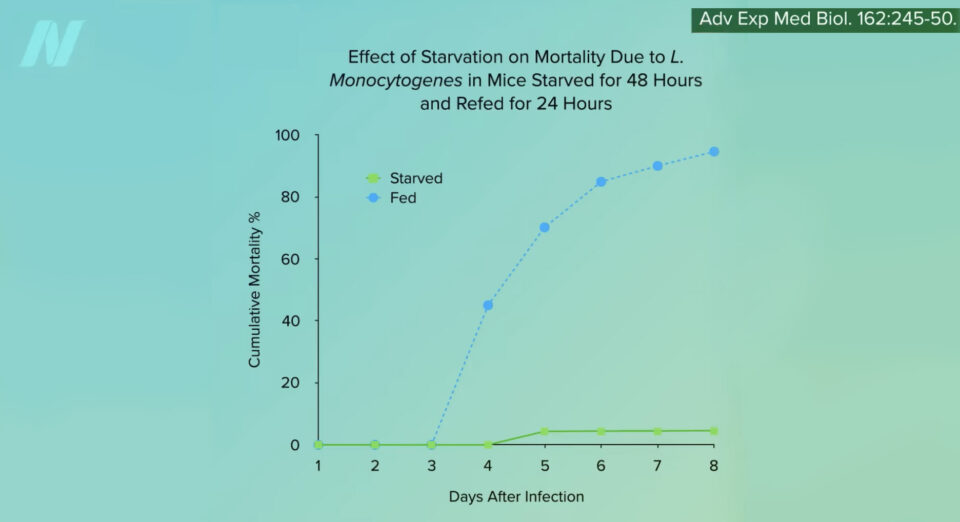
Along with fever, decreased food consumption is indeed one of the most common signs of infection, “often regarded as an undesirable manifestation of sickness,” but it’s actually an active, beneficial defense mechanism. Obviously, chronic undernutrition can impair our defenses, but data suggest that in the short-term, immune function can be enhanced by lowering food intake. Some of the data are wild: In one study, after 48 hours of starvation, about 95% of mice survived an infection if they remained starved, while about 95% died if they were refed, as you can see below and at 2:27 in my video Fasting for Cancer: What About Cachexia?.
But that was in mice. Obviously, we can’t randomize people to a fatal infection, but the study showed that the blood from starved mice was nearly eight times better at killing off the invading bacteria in a petri dish, as you can see below and at 2:41 in my video.
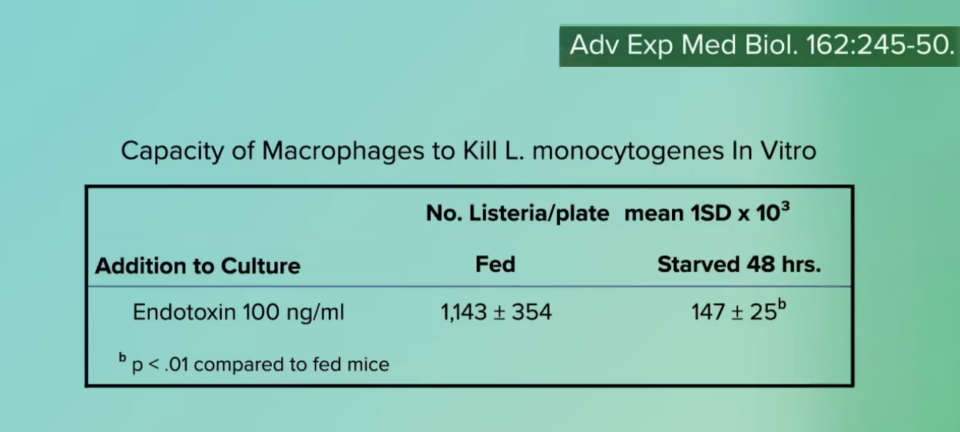
It dramatically boosted the capacity of their white blood cells to kill off the pathogens. Why can’t we just test people like that?
Indeed, we can. Researchers fasted people for two weeks on an 80-calorie-a-day diet, and their white blood cells showed the same kind of boost in bacteria-killing activity, a boost in antibody production, and a 24% average increase in natural killer cell activity. That’s especially interesting because our natural killer cells don’t just help clear infections; they also kill cancer cells. In fact, that’s how they measured natural killer cell activity—by pitting them against K562 cells, which are tumor cells (human leukemia cells). So, two weeks of fasting boosted their bloodstream’s ability to kill off cancer cells by 24%.
So, fasting is said to improve anticancer immunosurveillance—poetically described as “stimulating the appetite of the immune system for cancer.” So, why isn’t fasting used more to treat cancer? Until recently, fasting therapy has not been considered a treatment option, in part because a common therapeutic goal in palliative cancer care is to prevent weight loss and counteract the wasting syndrome known as cachexia, which is the ultimate cause of death in many cancer cases.
Tumors are voracious. They expand rapidly, needing lots of energy and protein, so cancer metabolically reprograms the body to start breaking down to feed them. It does this by triggering inflammation throughout the body. It’s not just that people lose their appetite. The key difference between weight loss from cancer cachexia and simple starvation is that cachexia cannot be reversed by feeding alone. Consider the case of a cancer patient whose weight started to drop. It’s no wonder—they were only taking in a few hundred calories a day. So, in addition to giving them about 100 grams of protein a day, researchers stuck a tube into a vein and infused up to 4,000 calories a day. But it didn’t matter. They continued to lose weight, as you can see at 4:56 in my video.
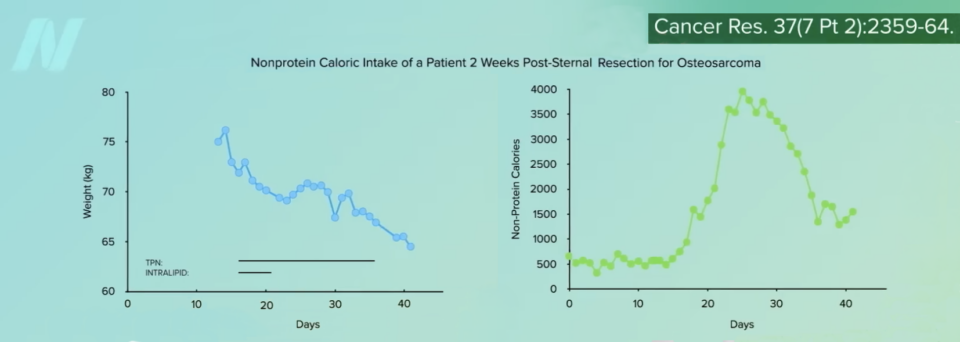
Attempts to correct or reverse cachexia through therapeutic nutritional interventions have had little success. The best treatment for cancer cachexia, therefore, is to treat the cause and cure the cancer. In fact, forcing extra nutrition on cancer patients could be playing right into the tumor’s hands. Like in pregnancy, when the fetus gets first dibs on nutrients even at the mother’s expense, the tumor may be first in the feeding line. Maybe the loss of appetite that occurs with cancer is actually a protective response. But in the 1960s, TPN—total parenteral nutrition—was born. People no longer had to eat; all the nutrition they needed could be infused straight into their veins, ushering in the modern era of nutrition support.
TPN became widely accepted and implemented, growing into a multibillion-dollar industry. Should it be routinely given to malnourished cancer patients? The answer’s not as obvious as one might think. When it was put to the test in dozens of randomized trials, “the results were both disappointing and surprising. Parenteral nutrition did not just fail to provide any benefit to these patients; it caused harm.” Not only did it appear to provide zero survival benefit, but there was also an increase in complications and infections, and a decrease in tumor response to chemotherapy, presumed to be due to all those extra nutrients stimulating tumor growth.
Similarly, trials of oral nutritional interventions, such as giving bottles of Ensure to malnourished patients with cancer, found no survival advantage. Despite the lack of demonstrated benefit, many oncologists’ knee-jerk reaction to the idea of cancer patients fasting is to worry that they’re not eating enough already. But you don’t know until you put it to the test, which we’ll explore in the next blog.
Doctor’s Note
This is part of an ongoing series about cancer and fasting. I previously laid the groundwork in these two blogs: Chemotherapy is Expensive—Is It Effective? and How Much Do New Chemotherapy Drugs Extend Life?.
Stay tuned for three more blogs on fasting and cancer:
What is the fasting-mimicking diet? I’ve got a video on that: The 5-2 Diet and the Fasting-Mimicking Diet Put to the Test.
All of my videos on fasting can be found on this topic page or in the recordings of my fasting webinar series.

CoBak 3 Pack Clear Ring Cover Compatible with Oura Ring 5 | Support Charging with Cover on, 0.5mm ultra-thin transparent TPU anti-scratch protector for Oura Ring 5, for men/women.
$9.58 (as of November 24, 2026 03:38 GMT +00:00 - More infoProduct prices and availability are accurate as of the date/time indicated and are subject to change. Any price and availability information displayed on [relevant Amazon Site(s), as applicable] at the time of purchase will apply to the purchase of this product.)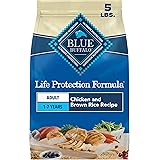
Blue Buffalo Life Protection Formula Chicken Adult Dry Dog Food, 5 lb | Real Chicken #1 Ingredient, Supports Immunity with Antioxidant-Rich LifeSource Bits, Promotes Healthy Muscle Development
$14.97 (as of November 24, 2026 03:25 GMT +00:00 - More infoProduct prices and availability are accurate as of the date/time indicated and are subject to change. Any price and availability information displayed on [relevant Amazon Site(s), as applicable] at the time of purchase will apply to the purchase of this product.)
Amazon Echo Show 5 (newest model), Smart display, Designed for Alexa+, 2x the bass and clearer sound, Charcoal
$54.99 (as of November 24, 2026 03:25 GMT +00:00 - More infoProduct prices and availability are accurate as of the date/time indicated and are subject to change. Any price and availability information displayed on [relevant Amazon Site(s), as applicable] at the time of purchase will apply to the purchase of this product.)
Milk-Bone Original Biscuits Large Dog Treats, 10 Lb.
$14.98 (as of November 24, 2026 03:25 GMT +00:00 - More infoProduct prices and availability are accurate as of the date/time indicated and are subject to change. Any price and availability information displayed on [relevant Amazon Site(s), as applicable] at the time of purchase will apply to the purchase of this product.)












Post Comment