
Why I’m Buying a 11.7% Yield Stock I’d Warn You Away From—Here’s the Untold Truth
Ever stumbled upon an investment so juicy that it’s almost too wild to touch? Well, that’s exactly how I felt when I bumped into the BondBloxx CCC-Rated USD High Yield Corporate Bond ETF, ticker symbol XCCC. Imagine diving headfirst into a pool where nearly a third of the swimmers might be sinking—but with the promise of catching a hefty 16% yield to maturity and an 11.7% distribution yield. Sounds tempting, right? But hold up—this isn’t your everyday ETF. This one’s packed with bonds so low on the credit ladder that they’re flirting with disaster, ranked deep in what we call “junk” territory. It’s the kind of high-risk, high-reward move that makes you wonder: can you really outrun the defaults and still come out alive with profits? In this deep dive, I’m breaking down not just the numbers, but the gritty realities behind investing in these triple-C rated bonds—where danger meets opportunity. Ready to question everything you thought you knew about junk bonds? Let’s get into it. LEARN MORE
img#mv-trellis-img-1::before{padding-top:69.73293768546%; }img#mv-trellis-img-1{display:block;}img#mv-trellis-img-2::before{padding-top:64.16015625%; }img#mv-trellis-img-2{display:block;}img#mv-trellis-img-3::before{padding-top:55.95703125%; }img#mv-trellis-img-3{display:block;}img#mv-trellis-img-4::before{padding-top:74.0234375%; }img#mv-trellis-img-4{display:block;}img#mv-trellis-img-5::before{padding-top:62.98828125%; }img#mv-trellis-img-5{display:block;}img#mv-trellis-img-6::before{padding-top:66.015625%; }img#mv-trellis-img-6{display:block;}img#mv-trellis-img-7::before{padding-top:65.0390625%; }img#mv-trellis-img-7{display:block;}img#mv-trellis-img-8::before{padding-top:65.0390625%; }img#mv-trellis-img-8{display:block;}img#mv-trellis-img-9::before{padding-top:65.0390625%; }img#mv-trellis-img-9{display:block;}img#mv-trellis-img-10::before{padding-top:65.0390625%; }img#mv-trellis-img-10{display:block;}img#mv-trellis-img-11::before{padding-top:62.01171875%; }img#mv-trellis-img-11{display:block;}img#mv-trellis-img-12::before{padding-top:62.01171875%; }img#mv-trellis-img-12{display:block;}
I think this is one ETF I don’t really recommend you guys get into, but I’ll admit it still caught my attention.
There were so many exchange traded funds in the US. Thousands of them, and some are so specific that I would never have searched for them. I manage to hear about the BondBloxx CCC-Rated USD High Yield Corporate Bond ETF from one of Renaissance Macro’s podcast.
The ticker symbol is XCCC.
I think a lot of you might be interested in this, so let me share the yield to maturity. It’s about 16% right now. If we talk about the distribution yield of the ETF, its about 11.7% now.
There’s a good reason I’d say you’re probably better off giving it a miss, though I could be wrong. It only makes sense if you have some money to spare and fancy trying a small experiment just for a cheap thrill.
In this article, I’m going to explain more than just this week’s income. I’ll also give you a breakdown of this grade of fixed income.
CCC Is Deep Junk: S&P Saw 28.4% of CCC-rated Credit Default in 2024
A CCC rating in fixed income means the credit quality of the fixed income in this ETF is deep in junk territory. It means the company borrowing the money is in a weak position, and the rating agencies think there is a real chance it cannot pay everyone back.
The “high yield” market, which most people call junk bonds, is a mix of ratings. From better to worse, you get BB, B, CCC, and then D, which means the company has already defaulted.
A default simply means the company stopped paying what it promised. Imagine you lend a friend $10,000 to start a business. The friend agrees to pay you interest every month. A default is the month the friend says, “Sorry, I cannot pay you anymore.” You may get some of your money back later.
You may get nothing.
At this point, some of you might be wondering about something I said earlier. I mentioned that these things are poor quality and prone to defaults, so how likely are they to default?
I’m going to show you the default rate, and I’ll go through the default statistics year by year a bit later, so you can see how often it really happens.
But this also makes it interesting to watch the CCC-rate corporate bond ETF interesting.
I like to watch how CCC bonds perform compared to the whole high yield market.
When the weakest borrowers start to struggle first, it can be an early sign that credit is getting tighter. It is a bit like watching the weakest runner in a race to see if the track is getting slippery.

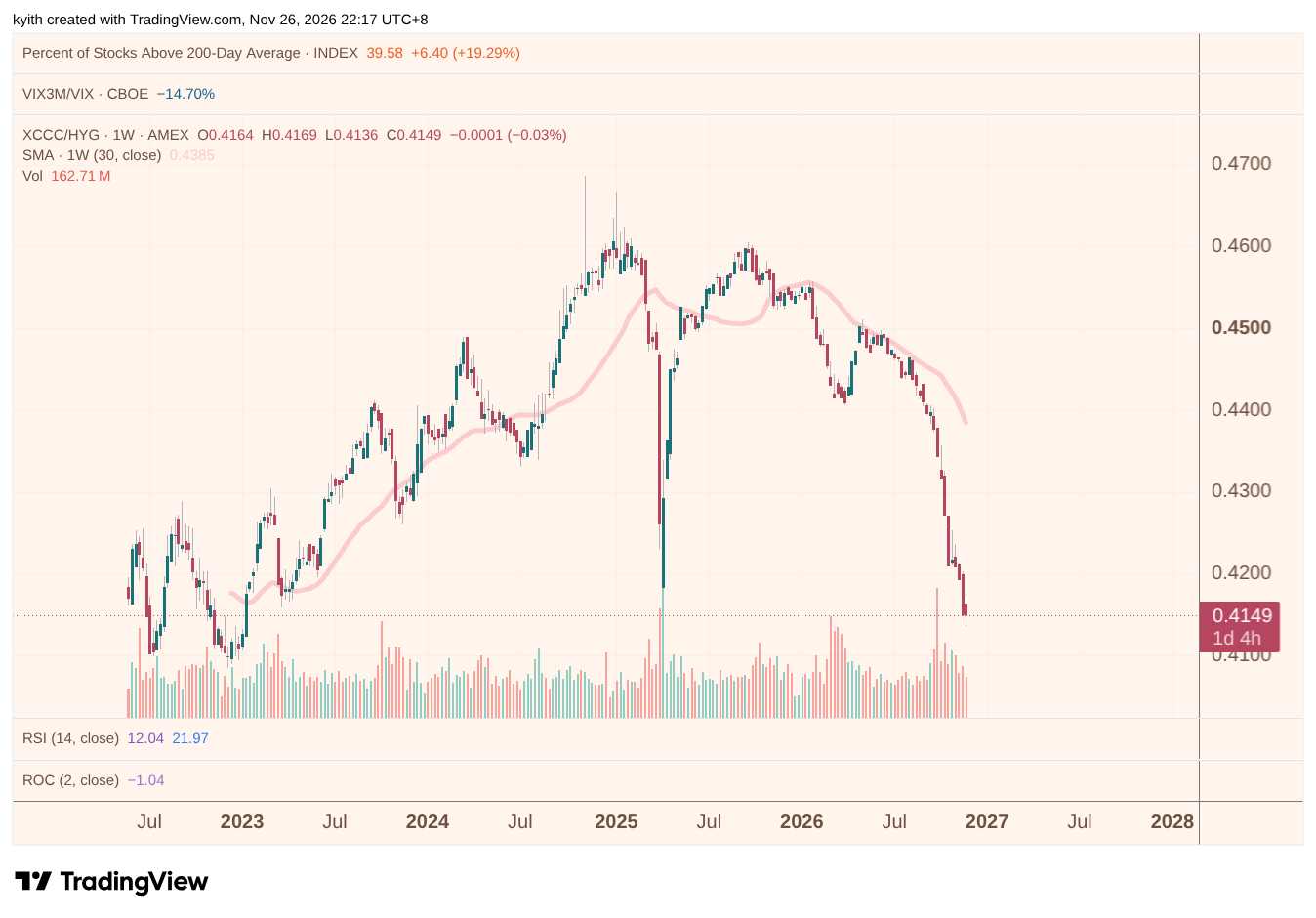
In the chart above, we are looking at the CCC-rated corporate bond ETF divided by HYG, which is a regular high yield bond ETF. When this ratio goes up, the CCC-rated bonds are doing better than high yield bonds in general. That usually means the market doesn’t have much to worry about, since the weakest bonds aren’t getting worse.
But look at the chart over here. The ratio is dropping a lot, which means the CCC-rated bonds as a group are doing pretty badly compared to high yield bonds as a whole. I could be reading this wrong, but if price is leading everything, it may be a sign that we’re in a shaky spot.
I was also fascinated if the high yield to maturity would compensate the default risks we are taking over time.
The popular high yield fund HYG has a yield to maturity of about 6%. XCCC has been paying about 17%.
For a lot of fixed-income investors looking for income, this used to be the death knell. We can all remember times when someone put $250,000 into a single bond from one company, then either lost their money or went through a lot of stress when that company seemed to be heading under, though nobody was really sure it would.
I have always seen something like investing in a single bond as dangerous.
But I always wondered what it would be like to own a basket of them instead.
Some of these may not default, and yes, some of them will not get through a normal economic cycle unscathed. But if they are priced properly, the returns you earn may already account for that risk. So you only need enough of them in the basket that not too many default. If you stay invested long enough, you can still earn those returns.
We can see here that the potential yield on this triple C rated bond is much higher than even the higher rated bonds.
That’s because every year there are CCC rated bonds that go into default, and you’ll see that later. This is what makes the hypothesis quite interesting to me.
Say you have an ETF that holds a basket of these bonds, and you know some of them will default along the way.
How would the returns look if you invested in it for the long term?
XCCC Holds 176 Bonds From 123 Companies, Capped at 2% Each
XCCC tracks the Bloomberg US High Yield 300MM CCC 2% Issuer Capped Index.
- The 2% Issuer Capped means no single company can be more than 2% of the index. If one company has lots of bonds, together they are still cut down to 2%.
- Only bonds rated CCC are kept. When the three agencies (Moody’s, S&P and Fitch) disagree, the middle rating counts.
- MM means million, so each bond must have at least $300 million still outstanding to get in. Bonds below that size are too small and too hard to trade. So the fund only holds fairly large, tradable issues. A bigger bond is usually easier to buy and sell, which matters for a fund that already trades thinly.
Here are other information about this ETF:
- Number of bonds. 176 bonds from 123 companies.
- Cost. 0.40% a year.
- Size. About $146 million. It’s small, compared to HYG at about $17 billion.
- The fund provides monthly distribution payout.
- Average coupon: 7.6%
- Average yield to worst: 16.9%
- Spread duration (which measure the securities sensitivity to change in credit spread): 2.48
- Started. May 2022.

The chart above shows the top 10 holdings of this ETF.
The biggest four are probably just above 2%, and I think the rest are below 2%. I like that this is one of the unique features we hope it has. We don’t want any one issuer to hold too much of this ETF, just in case that issuer defaults and the whole thing suffers.
As I invest for longer, I’m starting to realise that the key to capturing returns while also managing risk is how much diversification you build into the strategy itself. I might be wrong about this, so I’d love to hear what you think.
XCCC Returned About 5% a Year Over Roughly Five Years
We tabulated the returns ourselves:

I did that because I don’t think the XCCC ETF gave us good enough return data.
Over here, you can see the starting price for the year and the ending price for the year. You can also see the price return, the income return, and the total return, which is the two of them put together.
Actually, I worked it out, and it comes to an annualized return of about 5% over roughly the last five years.
If you ask me, that’s actually better than what global aggregate bonds have given over the same stretch!
But you know what? They’re earning this 5% even though some of the ETF is in default!
I think that’s pretty surprising, because you’d expect those defaults to drag the return down. Still, the rest of the portfolio is doing enough to cover them, and the yield holds up.
The income: did it grow?
Since it started in 2022, this fund has been paying out monthly dividends.
So in the table below, I’ve put together how much is actually paid out per calendar year. I also included the net asset value per unit on 1 June each year. Using that 1 June price, we can work out the prevailing yield. I hope that gives you a rough sense of where the yield usually sits:
| Year | Paid per share | Payouts | Price on 1 June | Prevailing yield |
|---|---|---|---|---|
| 2022* | $2.77 | 7 | $41.62 | 11.4%* |
| 2023 | $4.25 | 12 | $36.55 | 11.6% |
| 2024 | $4.18 | 12 | $37.44 | 11.2% |
| 2025 | $3.83 | 12 | $37.99 | 10.1% |
| 2026* | $3.12 | 10 | $36.69 | 10.2%* |
*2022 and 2026 are part years. I scaled them up to a full year using the average payout so far.

The distribution yield every year is pretty high if you put in a lump sum, about 10%.
I think this is the kind of fund that a lot of financial advisors like to sell for retirement planning. But I suppose even they probably wouldn’t dare to sell a CCC corporate ETF for people’s retirement. I could be wrong about that, though.
I think you might notice one or two things here. The first is that the aggregated distribution per year doesn’t go up with inflation in lockstep. I could be reading this wrong, but over this short time period, people on fixed incomes seem to be doing better than the poorer groups, and the distribution is actually going down.

Again, if you look at the last column, which shows the yield based on the initial NAV, you’ll see that the yield goes down as the years go on.
I might be wrong, but I’m not sure that’s what you’d want. It starts off with a high income, and that’s appealing. For folks who need 4% and are drawn in by the high yield, it might work out fine. But I think the bigger question is what happens after 15 years or so.
Once your needs start to outpace the payouts, how would you feel about that?
XCCC Trades 24% Below Its Peak and Has Never Recovered
Now let us look at what actually happened to the price.
The fund started trading on 26 May 2022 at about $41. Within days it reached its highest close, about $41.84. It has never been back there since.
Today it trades at about $31.75. That is about 24% below the peak, and the lowest point it has ever reached was just a few days ago. So the worst moment is right now.

This chart leaves out the monthly payouts. The payouts are the reason people buy this fund, so I will look at them next.
If you own it or have watched it, write how you would feel seeing a 24% drop on money you set aside for income.
Only 7% of HYG Is CCC or Worse. XCCC Is That 7% Slice
Even HYG, the iShares iBoxx $ High Yield Corporate Bond ETF, the fund people call risky, keeps most of its money in securities better quality than CCC.
About 91% of HYG sits in BB and B rated bonds.
Only about 7% is CCC or worse.
So XCCC is basically a way to own just that 7% slice, and nothing else.
Many of you know the iShares Core Global Aggregate Bond ETF, ticker AGGU. The worst quality bonds in AGGU are rated BBB.
Here is how the yields compare:
| Measure | HYG | XCCC |
|---|---|---|
| Paid out over the past 12 months | 6.1% | about 11.6% |
| 30 day SEC yield | 7.5% | 16.8% |
| Yield if held to maturity | 8.2% | 17.3% |
| Number of bonds | 1,331 | 176 |
Look at the gap between what the fund paid over the past year and the yield to maturity.
I read that wider gap as the market quietly saying, “We expect some of these bonds to go bad, or to trade below face value.” The headline yield is not what you get to keep.
CCC Defaults Ran 13.8%, 30.9% and 28.4% in 2022–2024
I think a lot of us want to find out how likely a default is.
I also want to know how that compares to the normal junk bonds, which I’d say are BB+ and below. Some people also count triple B rated bonds that sit lower than B itself, so I’m not totally sure where the line falls.
I think S&P Global would be a good place to look. They do a lot of fixed income ratings, and they’ve always had some historical studies on this.
Default, Transition, and Recovery: 2024 Annual Global Corporate Default And Rating Transition Study
The tables will list four different fixed income ratings. Next to each one, they’ll show the percentage of that cohort that defaulted.


Do you notice anything interesting here?
A lot of my readers probably invest in something like the global aggregate bond fund, which holds bonds rated at least triple B or A. If you look year by year, you can see how small a percentage of these bonds actually default.
I think that’s because bonds usually get downgraded before they default. A bond that’s no longer rated A or triple B will often slip down to double B first, and only later does it default.
The second thing I noticed is that defaults are very common in CCC. Every year, a certain percentage of CCC bonds default. That makes it very interesting to look at a triple C rated corporate bond ETF as a basket.
Even during this period when it’s listed, S&P Global data show CCC-rated credit to default at:
- 2022: 13.8%
- 2023: 30.9%
- 2024: 28.4%
So how does it get 5% p.a. return????
In the charts below, I’m comparing investment grade, which is BBB, against the really junk bonds at CCC. I wanted you to be able to see the contrast year by year, so you can get a sense of how big the difference is between them.


When you invest in CCC-rated corporate bonds,
I don’t think the main thing to figure out is whether any one of them will default.
Defaults are going to be the norm with these bonds, so I’d treat that as a given.
What I think matters more is what happens when you buy them as a basket. Even if many of them default, you could still end up with a good outcome overall, and that’s the part I’d focus on. So the real question to look at is whether the basket as a whole gives you a good return after the defaults.
The Documents Don’t Say How XCCC Sells Defaulted Bonds
I went through the fund’s documents looking for one thing. What happens when one of the bonds goes bad?
The prospectus doesn’t say much. It warns that junk bonds may be more likely to default, and that you could lose all or a substantial part of your investment. It only mentions in passing that the fund may incur expenses to seek recovery upon default.
The longer document behind it, the Statement of Additional Information, goes into more detail.
A default simply means the company stopped paying what it promised. Picture the fund holding 100 bonds, and one company files for bankruptcy. The fund won’t just get a cheque.
The document says it probably won’t receive any interest while the bankruptcy drags on. It may have to spend its own money to protect what is left. And it may be handed something different in place of the bond, like shares in the company, or a slice of a loan.
That is the part that stayed with me.
Shares in a failed company are not what an income investor thought they were buying. The fund says those leftovers can be hard to sell and hard to price. If it takes part in the negotiations, it may even be stopped from selling for a while. The fund also says shares received this way are not in its index, so they can cause tracking error and tax problems.
So a bond in trouble doesn’t simply vanish from the fund.
The documents say a bond that only falls in price is not automatically removed. The index does only hold bonds that are still paying their coupons, so I’d guess a defaulted bond eventually leaves.
But I couldn’t find a rule on how fast the fund sells, or what it does with the leftovers. That is the part I’d ask BondBloxx directly.
Epilogue
This ETF is listed on a US stock exchange and is usually a fixed income fund. When an ETF like this pays qualified dividends, the broker will often withhold the dividend tax and then return the money to your account at the end of the tax season, which is usually the start of the following year. Interactive Brokers is one example of a broker that does this.
For this high yield one, though, I think almost all of the payouts are most likely not qualified. That means a 30% withholding tax will probably apply to them and you have no way to claw back.
I think that’s the end of this article, and I do find this ETF interesting.
Most of the time, we want investors to be careful about the grade of the fixed income they buy, because if it’s really poor, they should expect poor outcomes. This ETF is the opposite case, since all of its fixed income is poor quality.
That’s what makes it so interesting to me. It sits so far on the other side, and it’s supposed to be dangerous. We’ve seen the default rates, and it’s not like defaults only happen once in a while. They happen every year, so in this fund they’re unavoidable.
That’s why I keep coming back to whatever returns you might get from it. What stands out most is that, over this period, it probably beats the global aggregate bonds.
I think this basket is unique. If the default rate went up to 50%, I’m not sure how things would play out. A lot of it depends on whether the market keeps overestimating the default risk.
It’s a bit like selling options. The expected return tends to be positive because there’s a premium built in. We usually overpay for put protection, so we buy the put at a higher price than the actual realised volatility justifies.
The same question applies here. Do the companies actually compensate us too much for the default risk? If they do, then investing over a long period might work out, even after we factor in all the defaults.
That said, four or five years is probably too short to see that play out. Even in this short window, some of the default rates have already looked pretty crazy.
I think the article already has enough caveats, so it’s worth reading it with that in mind. Part of the returns is there to compensate for the risk itself.
If there’s one thing to learn from this, it’s what happened to some people when Credit Suisse wiped out its AT1 bonds. They were badly affected. We’ve seen the same kind of trouble in the past with Rickmers Maritimes issues, fixed income and Hyflux defaults. All of these show how dangerous it is to put so much money into just one or two bonds, especially when the coupon yield reaches your hurdle rate. That looks risky to me.
I’ve come to the idea that safety comes from diversification. It’s not just the number of bonds that matters, but also how spread out they are across sectors and across different credit qualities.
If we’re thinking about which attributes matter most, I hope that’s what stands out from the article. Those are the important ones.
I’ll probably put a small portion of it into Crystalys, my other portfolio, but I think I’ll put only a minute amount into it. I’m not sure there’s empirical research showing that we get paid enough in yield to make up for the default risk.
So I see that small portion as a way for us to find out how it really works. We can learn from it directly.
Just so you know, I’m not going to be able to help if things go wrong with your bai your die. That part is on you, and I hope that’s okay. I wanted to say it up front so you can plan around it.

Kyith is the Owner and Sole Writer behind Investment Moats. Readers tune in to Investment Moats to learn and build stronger, firmer wealth foundations, how to have a Passive investment strategy, know more about investing in REITs and the nuts and bolts of Active Investing.
Readers also follow Kyith to learn how to plan well for Financial Security and Financial Independence.
Kyith worked as an IT operations engineer from 2004 to 2019. Currently, he works as a Senior Solutions Specialist in Fee-only Wealth Advisory Firm Providend. All opinions on Investment Moats are his own and does not represent the views of Providend.
You can view Kyith’s current portfolio here, which uses his Free Google Stock Portfolio Tracker.
His investment broker of choice is Interactive Brokers, which allows him to invest in securities from different exchanges all over the world, at very low commission rates, without custodian fees, near spot currency rates.
You can read more about Kyith here.
GHOST Energy Drink, Zero Sugars, 12-Pack, Welch's Grape, 16oz | Energy & Focus Pre Workout Drink, No Artificial Colors, Gluten-Free, Vegan - 200MG Natural Caffeine, L-Carnitine, Taurine
$23.98 (as of November 27, 2026 03:25 GMT +00:00 - More infoProduct prices and availability are accurate as of the date/time indicated and are subject to change. Any price and availability information displayed on [relevant Amazon Site(s), as applicable] at the time of purchase will apply to the purchase of this product.)
Amazon Fire TV Stick HD (newest model), free & live TV, Alexa Voice Remote, powered by the TV, effortless setup, find shows faster with Alexa+
$15.99 (as of November 27, 2026 03:29 GMT +00:00 - More infoProduct prices and availability are accurate as of the date/time indicated and are subject to change. Any price and availability information displayed on [relevant Amazon Site(s), as applicable] at the time of purchase will apply to the purchase of this product.)
Pure Life Purified Bottled Water - 15 Pack, 16.9 Fl Oz | Still Drinking Water Enhanced with Minerals for a Crisp Taste
$4.46 (as of November 27, 2026 03:25 GMT +00:00 - More infoProduct prices and availability are accurate as of the date/time indicated and are subject to change. Any price and availability information displayed on [relevant Amazon Site(s), as applicable] at the time of purchase will apply to the purchase of this product.)
2027 Upgrade Magic Bouncing Ball, Pop up Ball, Magic Ball (Light Blue) | 6-Light Pop-Up Metaball, Dual Form Interactive Bouncy Balls for Dog Fetch and Outdoor Games
$14.99 (as of November 27, 2026 03:29 GMT +00:00 - More infoProduct prices and availability are accurate as of the date/time indicated and are subject to change. Any price and availability information displayed on [relevant Amazon Site(s), as applicable] at the time of purchase will apply to the purchase of this product.)











Post Comment