
How Eoin Hinchy’s ‘Accidental’ Move Unlocked a Million-Dollar Entrepreneurial Empire Overnight
Ever stumbled upon a problem so persistent that it nags at you every single day—so much so that you decide to just build your own solution? That’s exactly what Eoin Hinchy did, albeit without the usual entrepreneurial fanfare. He wasn’t the kid with a paper route or the next Steve Jobs in the making—just a guy obsessed with sport and computers, quietly wrestling with the same tedious security tasks day in, day out. Fast forward a few years, and here we are: Tines, an AI platform that has galloped into unicorn territory with a cool $1.1 billion valuation. What’s even more fascinating? The driving force behind this tech marvel isn’t just innovation—it’s empathy. How’s that for shaking up the tech scene? Eoin and his co-founder Thomas Kinsella didn’t build Tines as a business gambit; they created it to free brilliant security teams from the drudgery of repetitive work—and in doing so, they built a powerhouse that’s rewriting the rules of enterprise automation. Curious about how a guy with “no entrepreneurial bone” in his body turned a personal frustration into a global unicorn? Then buckle up, because this story is as much about grit and guts as it is about groundbreaking AI. LEARN MORE
Eoin Hinchy never intended to start his own business and created AI platform Tines simply as a solution to a problem he was facing every day running security teams for tech companies. Now with a valuation of $1.1bn, Tines is firmly in unicorn territory. The co-founder and CEO talks to Sarah Freeman about the company’s challenges and opportunities and why empathy is one of the driving forces behind its success
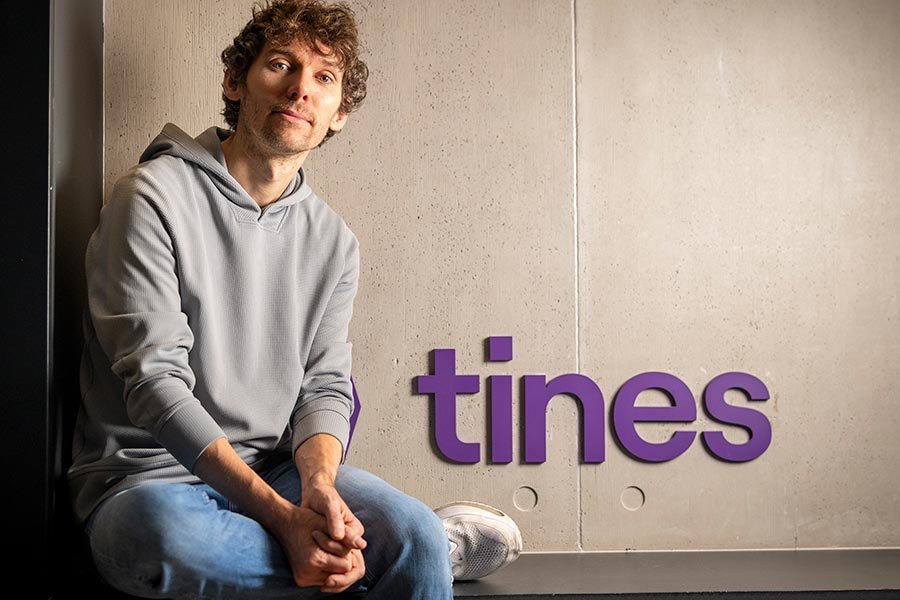
Eoin Hinchy has become something of a poster boy for tech entrepreneurship. As the CEO and co-founder of Tines, the Irish enterprise AI platform and the country’s latest unicorn, the tousle-headed 42-year-old’s easygoing manner and anti-hierarchical modus operandi set him apart.
Tines has secured a total of $272m in venture capital backing across six funding rounds. The capital has propelled the company into unicorn status, cementing its valuation at $1.125bn. The company reported revenue of $39.6m for the year to January 2025, up from $19.1m a year earlier. For someone who is now synonymous with enterprise and drive, however, he didn’t set out with any grand designs.
“I wasn’t the kid that mowed lawns or had a paper route for pocket money. I was obsessed with sport and computers, that’s all I cared about. I loved building things like little computer programmes, but I didn’t have an entrepreneurial bone in my body.”
Hinchy spent 15 years building and running security teams for companies such as eBay, PayPal and Docusign, and says he loved his job.
“I never had any ambition to do anything else, certainly never dreamed about starting a company.”
In 2017, however, Hinchy found his security team at Docusign spending an inordinate amount of time on tasks they’d already done once that day, like running down phishing emails, responding to security alerts and ensuring that infrastructure was within compliance.
“I had an awesome team. Everybody knew their jobs inside out and we could respond to any type of security attack. But we were completely overwhelmed with repetitive manual work.”
Hinchy estimates the team was spending 80 per cent of its working hours like this and it proved to be an ongoing frustration.
“The reason we invented computers [was] so people wouldn’t have to do work over and over again. [They] could spend their time on more impactful, enjoyable and business additive work.”
The challenge, he says, was that while the team were excellent at their jobs, they didn’t have the skills to automate the repetitive parts themselves. So they were reliant on third-party resources or other teams to go and build software for them.
“We carved out a budget and started to look for tools we could buy.”
Ultimately, Hinchy says, they spent six months looking for a suitable platform but couldn’t find anything that came close to meeting their requirements.
“So, being the petulant Irish man that I am, I said, ‘You know what? I’ll just go do it myself.’ And so I founded Tines, honestly with an ambition of nothing more grandiose than to build a product that I wished I’d had as a practitioner.”
Hinchy says he didn’t do any research, nor did he talk to anybody in that first year. He and his co-founder Thomas Kinsella just built the product that he had been looking for. Kinsella now heads the company’s customer experience, go-to-market strategies, and AI integration roadmap to drive enterprise adoption. Hinchy’s advice for those seeking to emulate his success in starting a company is simple.
“Stop talking about it, stop thinking about it, just do it. And then above all else, just do what’s right by your customers. Many early-stage founders get caught up thinking about fundraising or messaging or sales methodologies. Just deliver value to your customers and the rest will take care of itself.”
After creating Tines, Hinchy and Kinsella began to speak with potential customers and partners, many of whom had looked at other platforms too.
“A lot of our early sales conversations were around repairing the scar tissue that some of these folks had experienced.”
The advantage Tines had, Hinchy says, was the benefit of empathy. They wanted to solve an issue and weren’t just approaching it as a market opportunity.
“I still maintain that probably the reason we have been [so] successful is because we experienced these problems first-hand ourselves. It comes from a very genuine place.”
Since the foundation of the company eight years ago, technology has advanced inordinately.
“As ChatGPT began to emerge, we were extraordinarily excited and knew that this was going to transform the way that everybody approached these problems. Over the years we’ve released a ton of AI capabilities into the platform, and they’ve all been really well received. But being 100 per cent honest, we’ve always struggled with [asking] what is the killer use case for AI that’s going to take it from a science experiment to something that’s [adding] material value to my business.”
About a year ago, Hinchy says, they began to realise that what AI is uniquely good at is writing code. This prompted questions about their customers’ needs.
“We’ve essentially spent eight years building a platform that allows people who aren’t software engineers to produce code, but we’ve had to do it in a quite roundabout way. So we began to re-imagine everything about the platform, because it went from a world where you needed to be a software engineer to [a world where] now everybody can.”
And so Tines 3B was born, a new product with the same mission as the original company but using the technology of this AI era.
“We released that platform about six months ago, and I would say it has probably accelerated our trajectory by about a decade. I’m not exaggerating; that is not hyperbole.”
The timing, Hinchy says, is “extraordinarily serendipitous” with people now ready to stop experimenting with AI and get actual results.
Talk of an AI doomsday doesn’t worry him unduly. He says his “watered-down hot take” is essentially that the value we see from AI doesn’t come close to justifying the $20 trillion market capitalisation of AI companies. To back up such an astronomical figure, people must really believe that this technology is going to be extraordinarily powerful and change every single facet of our existence.
“I think there is a healthy dose of publicity, PR and marketing behind a lot of these headlines in order to help justify some of these market capitalisations that are coming down the tracks.”
The engineer and MBA graduate-turned-CEO says there’s a discernible difference between leading a successful startup and being at the helm of a billion-dollar company.
“It’s to do with the responsibility we feel to help our customers navigate an extraordinarily uncertain time. In the heady days of 2018, customers understood what their investment and strategy was going to look like on a three- to five-year horizon. Today, most executives are planning on a quarter-to-quarter basis.
With security threats evolving so rapidly now, an enterprise strategy of three to five years would be foolhardy.
“When we were a five-person company, we thought we were moving really, really quickly, which we were for that time. Now we’re having to move even faster. We’re 500 people today, and the necessity for us to move as agilely and nimbly as possible has never been greater, because that’s what our customers demand.”
Hinchy dismisses the notion of looking for a rest. “I think some people think that once you get to a billion-dollar valuation, you’ve kind of made it. Like ok, we’re on easy street, let’s put our feet up and close an IPO or a great acquisition. That is just not the case. The need to work, show up for your customers, fight and be competitive, has never been felt, at least from my point of view, more acutely than today.”
He says the idea that things get easier as the company grows is not reflective of his experience.
“I actually think they kind of get harder. Or you know, maybe more accurately, they stay just as hard as they ever did.”
He also sees the massive potential in what they’re doing. “A huge public company is ripe to be created in this space. A new enterprise technology stack is being formed around AI enablement, and I think a company of Tines’s shape [with] a product of 3B’s shape has an unfair advantage to be the [business] that helps create that category. Now, whether we do it or not is really all down to our ability to execute and seize this opportunity.”

To rest on their laurels, Hinchy says, would be flying in the face of great potential. In any event, the company will create 100 new jobs in Ireland over the next two years. With a growing global customer base, 70 per cent of which is in North America, along with offices in Dublin, Boston, San Francisco and Sydney, there is no hint of slowing down anytime soon.
“We’ve just wrapped up our best quarter in company history. This quarter will be another record [one]. We’ve done all the hard work, so to exit now would be a disservice [to] the opportunity that’s ahead of us. I have never been as bullish as I am today on the future of Tines.”
BassBloom ROAR 3 Portable Bluetooth Speaker,IPX6 Waterproof,20W | Powerful Sound with JIKE Bass,24H Playtime,Bluetooth 5.4,RGB Lights,Wireless TWS Pairing,Outdoor for Camping
$17.09 (as of November 29, 2026 03:39 GMT +00:00 - More infoProduct prices and availability are accurate as of the date/time indicated and are subject to change. Any price and availability information displayed on [relevant Amazon Site(s), as applicable] at the time of purchase will apply to the purchase of this product.)
Apple Watch Series 12 GPS 42mm Smartwatch | Light Gold Aluminum Case, Sand Sport Band - S/M. Health + Fitness + Sleep Tracking, Heart Rate, Safety
$299.00 (as of November 29, 2026 03:29 GMT +00:00 - More infoProduct prices and availability are accurate as of the date/time indicated and are subject to change. Any price and availability information displayed on [relevant Amazon Site(s), as applicable] at the time of purchase will apply to the purchase of this product.)
Amazon Kindle Paperwhite Signature Edition 32GB (newest model), Thinner, new aluminum design, 7" display, Auto-adjusting front light, Seaglass Green
$249.99 (as of November 29, 2026 03:39 GMT +00:00 - More infoProduct prices and availability are accurate as of the date/time indicated and are subject to change. Any price and availability information displayed on [relevant Amazon Site(s), as applicable] at the time of purchase will apply to the purchase of this product.)
Pounce Beam Cat Toy,Paw Glow Dog Projector,Pawglow Projector,Interactive Pet Projector Toy for Dogs and Cats, with Selectable Projection Patterns for Supervised Play (A)
$29.99 (as of November 29, 2026 03:29 GMT +00:00 - More infoProduct prices and availability are accurate as of the date/time indicated and are subject to change. Any price and availability information displayed on [relevant Amazon Site(s), as applicable] at the time of purchase will apply to the purchase of this product.)










Post Comment