Bhutan Dumps Bitcoin While BlackRock Loads Up — What’s Really Triggering This Crypto Tug-of-War?
Bitcoin’s price is playing a fascinating game of tug-of-war — and it’s not your everyday back-and-forth. Amid rising global tension, Bitcoin has stubbornly held the $71,500 mark, refusing to bow down. But behind this apparent resilience, an intriguing drama unfolds: on one side, Bhutan’s government is quietly selling off over 500 BTC, adding a subtle wave of selling pressure. On the flip side, institutional giants like BlackRock are scooping up massive chunks— pulling more than 2,200 BTC off exchanges, signaling serious long-term bets rather than quick flips. So, what gives? Is this a classic battle of weak hands versus strong wallets, or a sign that the market’s quietly gearing up for something bigger? If Bitcoin holds above $71,200 and breaks through $72,500, it might just prove that the buyers are wearing the crown. Ready to dive deeper into this stealthy standoff shaping Bitcoin’s near future? LEARN MORE
Despite ongoing global tensions, Bitcoin’s price action has so far hinted at resilience. However, something may be cooking behind the scenes. While BTC has reclaimed the $71,500-level, the market is currently seeing a clear tug-of-war between distribution and accumulation.
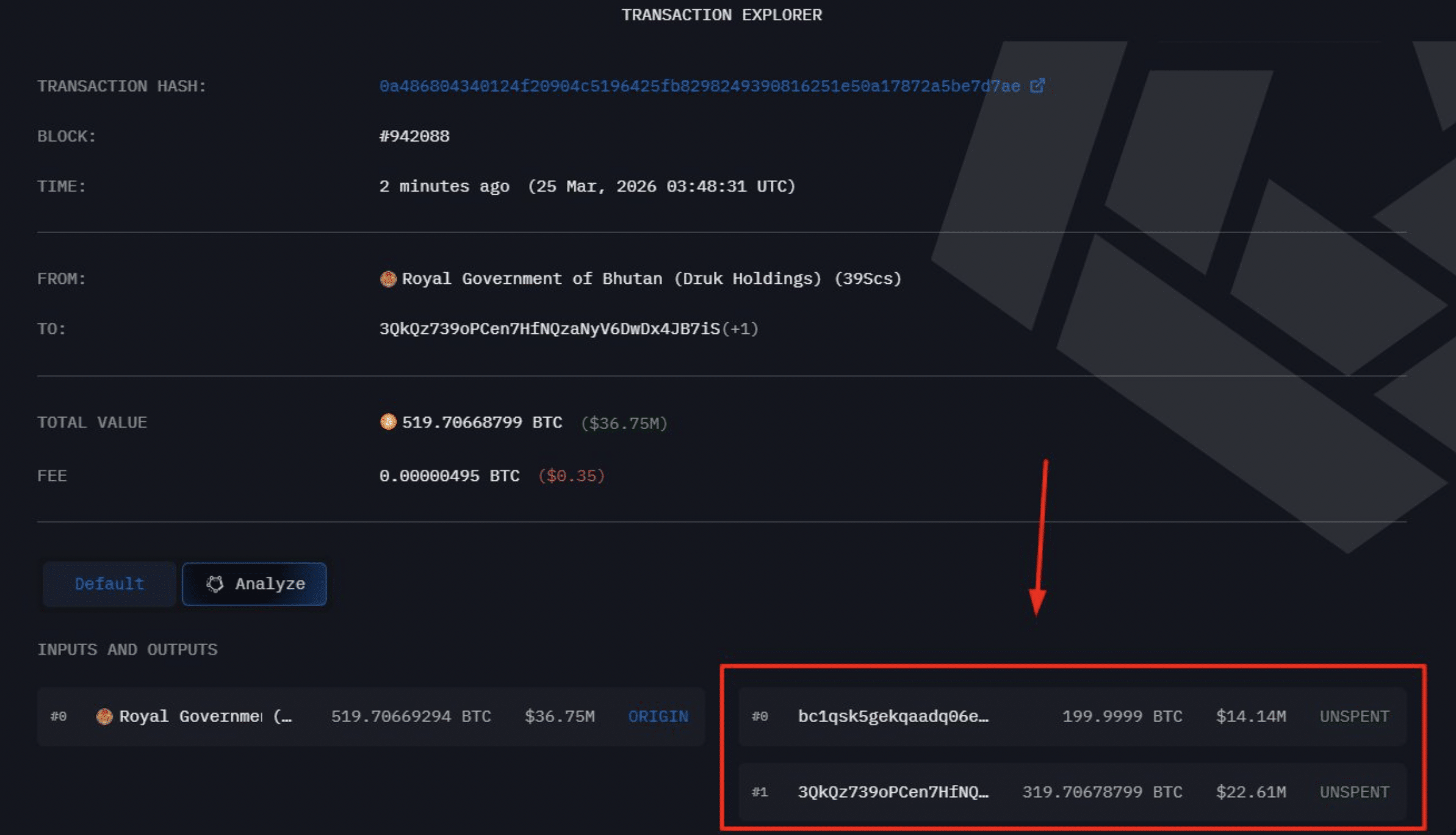
On one hand, data from Arkham indicated that Bhutan’s government has been steadily offloading Bitcoin [BTC], with over 500 BTC entering the market and adding visible selling pressure.

On the other hand, institutional demand has been stepping in just as aggressively. BlackRock, for instance, withdrew more than 2,200 BTC from exchanges – A move typically associated with long-term accumulation rather than short-term selling.

This may be a sign that supply entering the market is being efficiently absorbed by stronger hands. If Bitcoin continues to hold above the $71,200-support and manages to break through the $72,500-resistance, it would signal that buyers are firmly in control.
Bitcoin exchange netflow analysis
Meanwhile, Bitcoin’s on-chain data has been painting a picture of a market that is quietly strengthening under the carpet. A closer look at exchange flows revealed a consistent pattern of net outflows, signaling that investors may be steadily withdrawing BTC from exchanges.

This behavior typically reflects accumulation, as coins moved off exchanges are less likely to be sold in the immediate term.
Even during periods of volatility, such as in mid-March when sharp inflows were followed by a massive outflow, the broader trend remained intact.
On-chain metrics confirm this trend
At the same time, long-term holder activity might provide us deeper insights into market behavior.
Metrics like Mean Coin Age, Age Consumed, and Dormant Circulation all showed that while most coins have continued to age in wallets, there have been occasional spikes. During the same, older coins briefly moved, particularly in early, mid, and late-March.

Such bursts often indicate profit-taking or strategic repositioning by larger holders. However, since Mean Coin Age quickly recovers after each spike, it also means that coins return to dormancy just as fast, reinforcing a broader trend of accumulation rather than sustained distribution.
Further supporting this narrative is the behavior of the Spent Output Profit Ratio (SOPR), which has largely hovered around the critical level of 1.

It alluded to a market in equilibrium, where neither profit-taking nor loss-driven selling has been overwhelmingly dominant. The recent drop to around 0.982 suggested another round of weak hands being flushed out, even as Bitcoin held on near the $71K-level.
Taken together, these metrics all pointed to market that may be consolidating, rather than weakening.
Similar moves in the past
These movements align with a broader shift in market behavior. For instance – A Bitcoin whale, inactive for over 13 years, recently resurfaced, signaling that even the oldest holders are beginning to reposition.
A similar pattern emerged on 24 March, where a whale deployed around $16 million into altcoins like ENA, AAVE, AVAX, along with UNI and PENDLE. All this is evidence that rather than exiting, whales might be reallocating, quietly positioning for a stronger rally on the charts ahead.
Final Summary
- Persistent exchange outflows reinforced the narrative of long-term holding and reduced immediate selling risk.
- Short-term volatility has continued to flush out weak hands, as seen through SOPR dips below 1.

Roku Smart TV – 40-Inch Select Series, 1080p Full HD TV – Roku TV with Voice Remote – Flat Screen LED Television with Wi-Fi for Streaming Live Local News, Sports, Family Entertainment
$127.48 (as of March 26, 2026 02:13 GMT +00:00 - More infoProduct prices and availability are accurate as of the date/time indicated and are subject to change. Any price and availability information displayed on [relevant Amazon Site(s), as applicable] at the time of purchase will apply to the purchase of this product.)
EHEYCIGA Orthopedic Dog Beds for Extra Large Dogs 44x32Inch, Waterproof Memory Foam XL Pet Bed with Sides, Non-Slip and Egg-Crate Foam Big Dog Couch Bed with Washable Removable Cover, Grey
$39.98 (as of March 26, 2026 02:17 GMT +00:00 - More infoProduct prices and availability are accurate as of the date/time indicated and are subject to change. Any price and availability information displayed on [relevant Amazon Site(s), as applicable] at the time of purchase will apply to the purchase of this product.)
Alex Tech 10ft - 1/2 inch Cord Protector Wire Loom Tubing Cable Sleeve Split Sleeving For USB Cable Power Cord Audio Video Cable – Protect Cat From Chewing - Black
$7.64 (as of March 26, 2026 02:13 GMT +00:00 - More infoProduct prices and availability are accurate as of the date/time indicated and are subject to change. Any price and availability information displayed on [relevant Amazon Site(s), as applicable] at the time of purchase will apply to the purchase of this product.)
Best Pet Supplies Interactive Squeaky Dog Chew Toy, Ideal Dog Toys for Chewers, Small, Medium & Large Dogs, and Fetch Lovers - Crinkle Duck (Blue), Large
$5.99 (as of March 26, 2026 02:13 GMT +00:00 - More infoProduct prices and availability are accurate as of the date/time indicated and are subject to change. Any price and availability information displayed on [relevant Amazon Site(s), as applicable] at the time of purchase will apply to the purchase of this product.)













Post Comment