Is Ethereum’s Empire Crumbling? Inside Founder Sell-Offs and Whale Exodus Sparking a Silent Market Storm
Ethereum’s recent slide isn’t your run-of-the-mill tumble — it’s like watching a heavyweight boxer slowly getting cornered, jab after jab, by a relentless foe named macro pressure, unwinding leverage, and evaporating liquidity. By February 21st, ETH dipped below $1,980, putting the squeeze on profitability for everyone from casual holders to the whale-sized giants clutching tens of thousands of tokens. But here’s the kicker: this wasn’t some sudden panic dump. Nope, it followed a series of deliberate moves — sustained distribution, derivatives trimming, and the big players playing it safe with reduced risk appetite. What’s really intriguing is how unrealized losses stretched across all whale groups, yet on-chain data hints that these big fish aren’t swimming away just yet; instead, they’re weathering the storm, suggesting this could be more of a “conviction test” than a full-blown exit. Makes you wonder — is this the calm before the accumulation-led resurgence or just another twist in Ethereum’s rollercoaster saga?
Ethereum’s decline unfolded progressively as macro pressure, leverage unwinds, and thinning liquidity weighed on price structure.
As downside momentum accelerated, Ethereum [ETH] slipped below the $1,980 threshold on the 21st of February, compressing profitability across major holder groups.
This breakdown did not occur in isolation; it followed sustained distribution, derivatives deleveraging, and reduced risk appetite across large balance sheets.
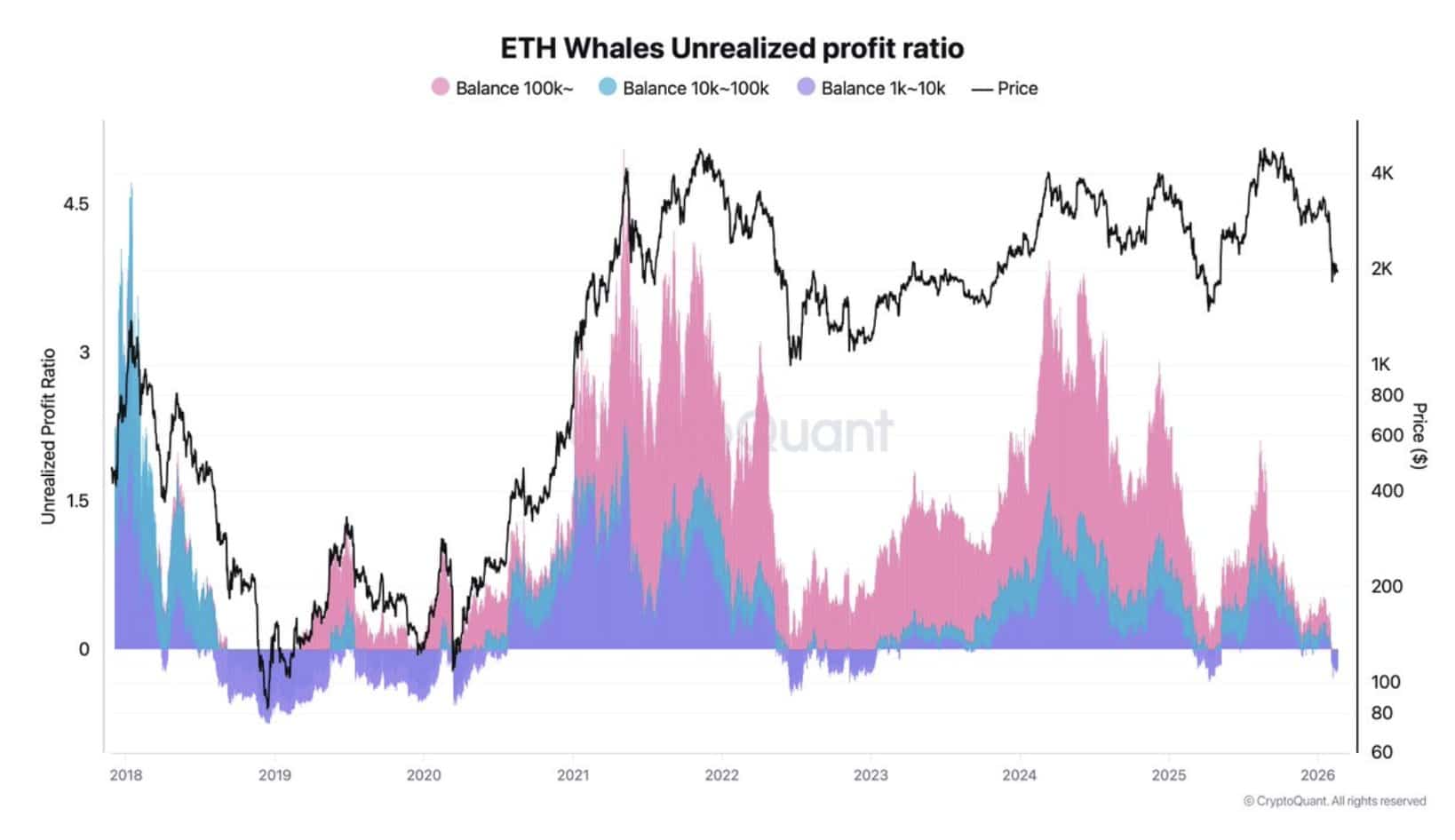
As prices weakened, unrealized losses spread simultaneously across all whale cohorts, from 1,000–10,000 to 100,000+ ETH wallets.
Spot now trades below the $2,075 mega-holder cost basis, confirming losses even among the largest addresses.

Source: CryptoQuant
Long-term holders hovers near breakeven, while short-term cohorts remain deeply underwater near 0.5.
Despite this pressure, on-chain positioning shows restrained sell behavior. Realized cap trends indicate whales are largely holding rather than distributing, suggesting strategic absorption.
Historically, such cohort-wide stress reflects conviction testing, where unrealized pain precedes accumulation-led bottom formation rather than structural exit.
Vitalik’s sales re-emerge amid broader whale loss pressure
Liquidity absorption trends continued to develop even as founder-linked wallets returned to distribution flows. This activity did not begin recently.
A fortnight earlier, Vitalik had already conducted smaller ETH sales, forming a staggered disposal pattern rather than a single liquidation event.
The latest withdrawal of 3,500 ETH, worth approximately $6.95 million, from Aave [AAVE] therefore reflects continuation, not sudden capitulation.

Source: LookOnChain
This pacing differs from distress selling, where large volumes typically hit exchanges quickly. Instead, collateral withdrawals suggest treasury rebalancing or liquidity repositioning.
These flows also align with rising unrealized losses across whale cohorts. However, on-chain positioning shows limited aggressive distribution.
The activity therefore reflects cautious loss management rather than a panic exit.
While founder sales can influence sentiment, their scale here signals measured portfolio adjustment within a fragile market environment.
Kalshi markets price heavy on ETH weakness


Greenies Feline Smart Purees Healthy Indoor Lickable Cat Treats with Real Chicken, 0.49 oz. Tubes, 20 Count
$14.98 (as of March 30, 2026 02:16 GMT +00:00 - More infoProduct prices and availability are accurate as of the date/time indicated and are subject to change. Any price and availability information displayed on [relevant Amazon Site(s), as applicable] at the time of purchase will apply to the purchase of this product.)
Yellow Onion, 1 Each
(as of March 30, 2026 02:16 GMT +00:00 - More infoProduct prices and availability are accurate as of the date/time indicated and are subject to change. Any price and availability information displayed on [relevant Amazon Site(s), as applicable] at the time of purchase will apply to the purchase of this product.)
Viper Biothane Working Lead for Dogs 6ft Black
$25.99 (as of March 30, 2026 02:20 GMT +00:00 - More infoProduct prices and availability are accurate as of the date/time indicated and are subject to change. Any price and availability information displayed on [relevant Amazon Site(s), as applicable] at the time of purchase will apply to the purchase of this product.)
Pur Luv Chicken Jerky Dog Treats, Made with 100% Real Chicken Breast, 16 Ounces, Healthy, Easily Digestible, Long-Lasting, High Protein, Satisfies Dog's Urge to Chew
$11.89 (as of March 30, 2026 02:16 GMT +00:00 - More infoProduct prices and availability are accurate as of the date/time indicated and are subject to change. Any price and availability information displayed on [relevant Amazon Site(s), as applicable] at the time of purchase will apply to the purchase of this product.)











Post Comment