Is USDC Poised to Dethrone USDT? The 600% Surge in Stablecoin Usage That Could Rewrite Crypto’s Future
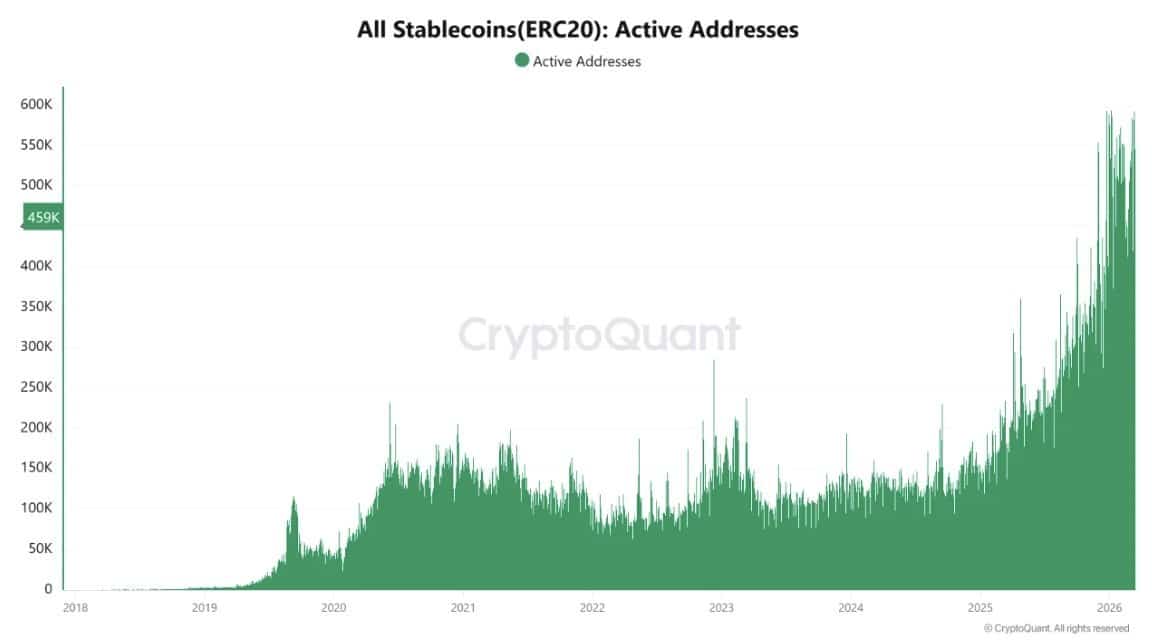
Ever wonder what it takes for a digital asset to stop being a whisper on the blockchain and start roaring as a backbone of global finance? Well, ERC20 stablecoins just rewrote that playbook, skyrocketing active addresses from a modest 85,000 in March 2025 to a staggering 600,000 by March 2026. That’s not just a flash in the pan — it’s a 600% leap signaling a fundamental shift from sporadic hype to real, persistent usage. The blockchain alley is buzzing, and stablecoins aren’t just playthings for DeFi traders anymore; they’re morphing into the very arteries of transactional flow — think payments, cross-border swaps, and settlements that actually move the needle. With this surge comes an undeniable truth: as stablecoins become the linchpin of market liquidity, the ecosystem’s heartbeat depends ever more on their rhythm. Curious how USDC is taking the lead over USDT, and why this matters more than ever? Stick around — the stablecoin saga is just heating up. LEARN MORE
ERC20 stablecoin activity is undergoing a structural expansion, as active addresses surged from roughly 85,000 in March 2025 to nearly 600,000 in March 2026.
This 600% growth reflects more than temporary spikes, as activity has trended upward steadily since 2024. As participation broadens, the pattern shifts from isolated bursts to sustained usage, which suggests deeper integration across the network.

At the same time, this rise signals a change in function.
Stablecoins are moving beyond DeFi trading pairs toward transactional infrastructure. As a result, flows increasingly reflect payments, settlements, and cross-border transfers rather than speculative positioning.
However, rising activity also implies higher dependency on stablecoin liquidity.
As usage concentrates around these assets, they become central to capital movement across markets. This dynamic suggests crypto liquidity is becoming more efficient, while also more sensitive to stablecoin-driven demand cycles.
Stablecoin flows shift as USDC gains dominance over USDT
Stablecoin flows show a clear rotation in market preference, as USD Coin [USDC] leads supply expansion year-to-date.
USDC added $4.5 billion, marking the largest increase across all tracked assets. This rise reflects strong inflows during a volatile period.
Tether [USDT] moved in the opposite direction, with its supply contracting by roughly $2 billion, signaling capital outflows. As this divergence forms, it highlights a shift toward perceived stability and regulatory clarity.

This gap suggests growing usage beyond simple liquidity storage. As volumes expand, USDC strengthens its role in DeFi and payments infrastructure.
However, this concentration also implies that liquidity is becoming more centralized. As capital rotates, market dependence on fewer stablecoins increases, shaping how liquidity flows across the broader ecosystem.
Stablecoin flows show consolidation, not capitulation
Stablecoin flows reflect a cautious but balanced shift, as liquidity moves away from exchanges without fully exiting the market. Exchange Reserves stand at $65.37 billion, down 0.72% in 24 hours.
Net Outflows reached over $485 million, signaling movement toward self-custody. This suggests capital is being parked rather than actively deployed. However, this shift also reduces immediate sell pressure on exchanges, which can support price stability.
Total stablecoin supply sits at $316.45 billion, rising just 0.17% weekly. USDT grew 0.08% to $184.1 billion, while USDC fell 0.22% to $79.1 billion, showing mixed demand.
This balance implies liquidity is rotating rather than expanding, keeping markets stable in the short term while leaving momentum dependent on renewed capital deployment.
Final Summary

Happy Belly Light Roast Coffee Pods, Breakfast Blend, Compatible with Keurig 2.0 K-Cup Brewers, 24 Count
$7.58 (as of March 23, 2026 02:11 GMT +00:00 - More infoProduct prices and availability are accurate as of the date/time indicated and are subject to change. Any price and availability information displayed on [relevant Amazon Site(s), as applicable] at the time of purchase will apply to the purchase of this product.)
Comfort Expression Orthopedic Dog Bed for Extra Large Dogs 42x30 Inch, Waterproof Egg Crate Foam XL Pet Bed with Removable Bolsters, Dog Couch with Washable Cover & Non-Slip Bottom, Grey
$39.99 (as of March 23, 2026 02:16 GMT +00:00 - More infoProduct prices and availability are accurate as of the date/time indicated and are subject to change. Any price and availability information displayed on [relevant Amazon Site(s), as applicable] at the time of purchase will apply to the purchase of this product.)
Nespresso Capsules Vertuo, Variety Pack, Medium and Dark Roast Coffee, 30 Count Coffee Pods, Brews 7.8 oz.
$42.00 (as of March 23, 2026 02:11 GMT +00:00 - More infoProduct prices and availability are accurate as of the date/time indicated and are subject to change. Any price and availability information displayed on [relevant Amazon Site(s), as applicable] at the time of purchase will apply to the purchase of this product.)
Organic Banana Bunch (4-5 Count)
(as of March 23, 2026 02:11 GMT +00:00 - More infoProduct prices and availability are accurate as of the date/time indicated and are subject to change. Any price and availability information displayed on [relevant Amazon Site(s), as applicable] at the time of purchase will apply to the purchase of this product.)













Post Comment