Nvidia’s Crash Below the 200-Day Moving Average: Is This the Silent Signal Investors Can’t Afford to Ignore?
So here we are, watching Nvidia’s shares slip below their 200-day moving average despite CEO Jensen Huang’s bold bet that their Blackwell and Rubin lines might rake in a staggering $1 trillion from data centers by 2027. It’s like showing up with a shiny new product at the party, only to find the crowd’s already halfway out the door. Trading near $172 and teetering on the edge of a crucial $170 support level that’s held strong since late 2025, Nvidia’s poised for a technical shakeup—a signal that the game might be changing for real this time. But let’s not put all the blame on Nvidia alone—there’s a storm brewing, with geopolitical shake-ups, soaring oil prices, and inflation jitters all gnawing away at market confidence. The tension between hope and fear here is palpable, and the ripples are rattling the giants of Wall Street as we speak. Ready to dive deeper into what’s moving these markets and what it means for investors? LEARN MORE
Nvidia shares fell below their 200-day moving average after this week’s GTC event failed to revive the stock, even as CEO Jensen Huang projected that the company’s Blackwell and Rubin product lines could help drive as much as $1 trillion in data center revenue through 2027.
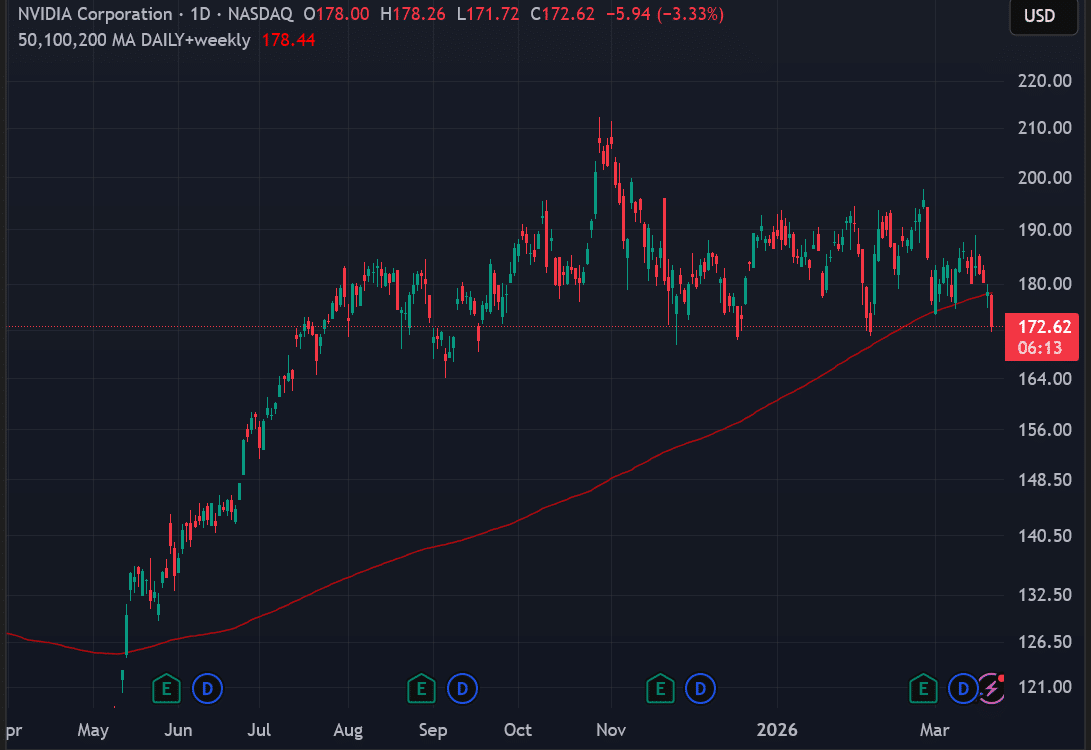
Nvidia was down about 3.5% on the day, trading near $172 and approaching a key support level around $170 that has held since September 2025. The 200-day moving average sits near $178, and Nvidia is on pace to close below that level today, signaling a key shift in trend. A confirmed close below it would mark a technical breakdown after holding above the long-term trend line since its recovery in May 2025 following the tariff-driven selloff.
The weakness is not just about Nvidia. Markets have been rattled for weeks by geopolitical turmoil and shifting monetary policy expectations. The US and Israel’s war with Iran has driven crude sharply higher, with Brent recently trading above $105 a barrel and US crude near $99, while US gasoline prices have jumped more than 30% since the conflict began.
That energy shock is feeding inflation fears at a bad time. US consumer prices rose 0.3% in February from the prior month and 2.4% from a year earlier, while producer prices rose 0.7% in February, the biggest monthly increase in seven months.
The Fed held rates steady on March 18 and warned that the economic outlook remains uncertain, with specific attention to Middle East developments. Interest rate futures now suggest traders see little chance of cuts before mid 2027.
That backdrop has hit equities hard. The S&P 500 is nearing 6,495 on Friday, down about 7% since early February, while the Nasdaq Composite is near 21,535, down nearly 9% from its February highs. Both indexes fell again on Friday as oil rose and investors repriced the rate path.
Sparkling Ice, Black Raspberry Sparkling Water, Zero Sugar Flavored Water, with Vitamins and Antioxidants, Low Calorie Beverage, 17 fl oz Bottles (Pack of 12)
$12.00 (as of April 11, 2026 02:23 GMT +00:00 - More infoProduct prices and availability are accurate as of the date/time indicated and are subject to change. Any price and availability information displayed on [relevant Amazon Site(s), as applicable] at the time of purchase will apply to the purchase of this product.)
(Pack of 2) Replacement Remote Control Only for Roku TV, Compatible for TCL Roku/Hisense Roku/Onn Roku/Sharp Roku/Element Roku/Westinghouse Roku/Philips Roku Smart TVs (Not for Roku Stick and Box)
$9.98 (as of April 11, 2026 02:23 GMT +00:00 - More infoProduct prices and availability are accurate as of the date/time indicated and are subject to change. Any price and availability information displayed on [relevant Amazon Site(s), as applicable] at the time of purchase will apply to the purchase of this product.)
Apple EarPods Headphones with USB-C Plug, Wired Ear Buds with Built-in Remote to Control Music, Phone Calls, and Volume
$19.00 (as of April 11, 2026 02:23 GMT +00:00 - More infoProduct prices and availability are accurate as of the date/time indicated and are subject to change. Any price and availability information displayed on [relevant Amazon Site(s), as applicable] at the time of purchase will apply to the purchase of this product.)
Brayhoo Dog Tags Personalized for Pets — Custom Deeply Engraved, Lightweight, Silent Silicone Name ID Tags — No More Jingling
$7.99 (as of April 11, 2026 02:22 GMT +00:00 - More infoProduct prices and availability are accurate as of the date/time indicated and are subject to change. Any price and availability information displayed on [relevant Amazon Site(s), as applicable] at the time of purchase will apply to the purchase of this product.)













Post Comment