
Why Ether.fi’s Gut-Wrenching Shutdown of weETH Bridging on Smaller Chains Could Signal a Major Crypto Shakeup You Can’t Afford to Ignore
Ever wonder why some bridges—digital ones, that is—suddenly get the chop while others stay standing tall? Well, ether.fi just flipped the script on its weETH bridging, pulling the plug on several low-traffic networks like Scroll, Swell, and zkSync, effective June 30, 2026. It’s not just a random cutback; it’s a strategic retreat, narrowing focus and cranking up the fortress walls on risk management. You see, in a DeFi world where the grass wasn’t always greener on every chain, liquidity’s been hoarding itself on Ethereum, leaving the smaller chains barely a trickle of value—and guess who has to foot the security bill for all those quiet bridges? You got it. This move isn’t just about tightening screws; it’s about survival in a landscape ricocheting from costly exploits and vulnerabilities. So, if you’re holding weETH on those networks, better get moving before the deadline—or brace yourself for a manual rescue operation with a 0.5 weETH toll. It’s a classic case of less is more—and when it comes to cross-chain bridges, less really does mean safer and smarter. Ready to dive deeper? LEARN MORE.
ether.fi will disable weETH bridging across several lower-activity networks, marking a shift toward tighter risk controls as DeFi protocols reassess multi-chain exposure.
The protocol said bridging will be deprecated on Scroll, Swell, Bera, zkSync, Mode, Blast, Morph, and Sonic, with the changes taking effect on 30 June 2026.
Users holding weETH on these chains have been asked to bridge assets back to Ethereum or other supported networks before the deadline.
Bridge cuts target low-usage chains
ether.fi said the decision is part of efforts to “harden” its cross-chain infrastructure by consolidating activity onto fewer, higher-usage networks.
The affected chains were selected based on usage, total value locked [TVL], and integration depth. The protocol added that further deprecations may follow under similar criteria.
After the deadline, users who fail to migrate funds will still be able to recover assets through a manual process, though a fixed fee of 0.5 weETH will apply.
Data shows liquidity concentrated on Ethereum
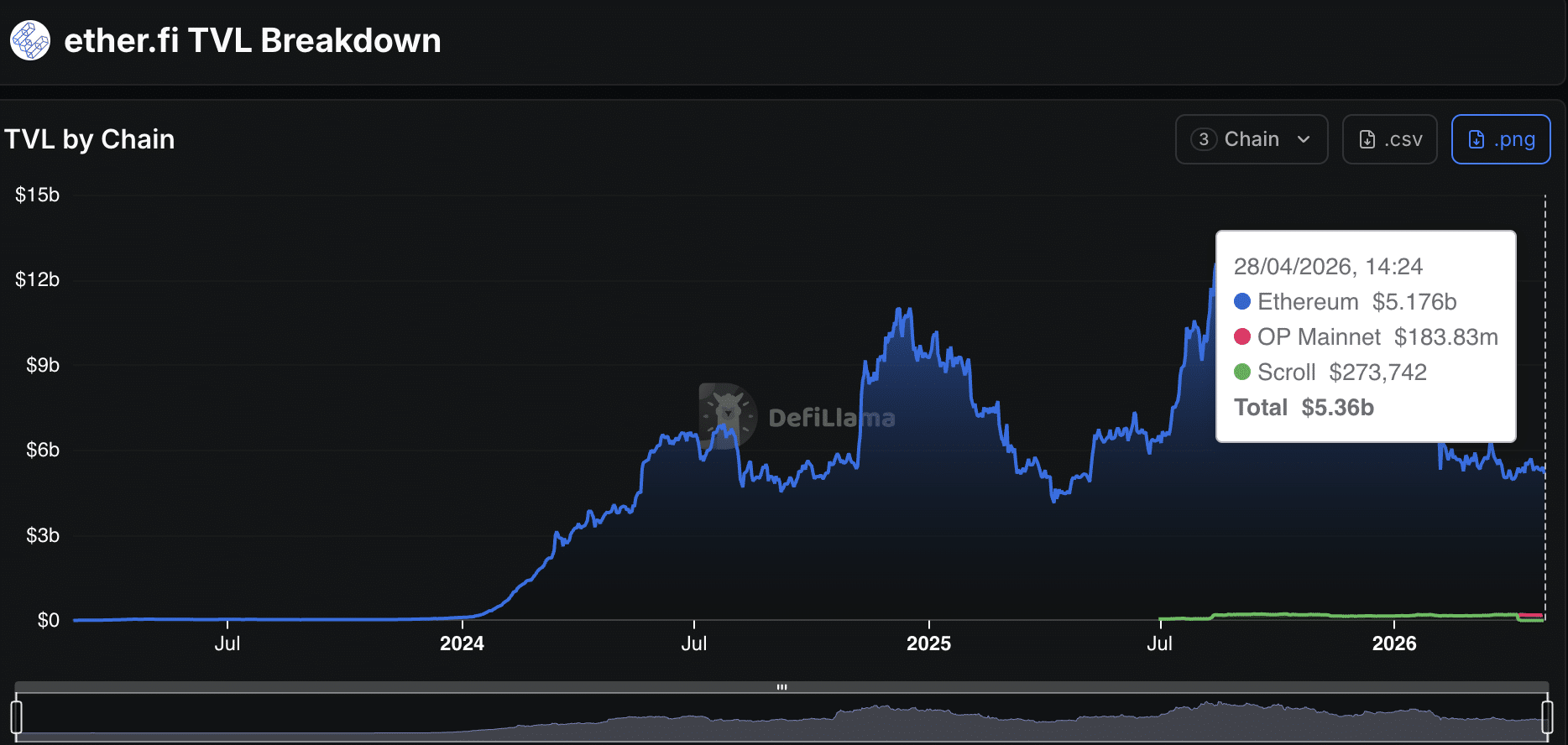
Data from DefiLlama shows why the move may have been necessary.
As of late April, ether.fi holds over $5.1b in TVL on Ethereum, compared to roughly $183m on OP Mainnet. Also, chains such as Scroll had just a few hundred thousand dollars.

The imbalance suggests that the majority of liquidity remains concentrated on Ethereum. Also, several supported chains are contributing a negligible share of total value locked.
Maintaining bridge infrastructure across these networks, therefore, introduces additional complexity and security overhead without meaningful capital efficiency.
Post-exploit tightening across DeFi
The decision follows heightened scrutiny of cross-chain risk following recent incidents involving restaking assets.
The rsETH-related exploit linked to Kelp DAO earlier this month triggered broader concerns about how vulnerabilities can propagate across interconnected DeFi protocols, including exposure on lending platforms such as Aave.
Against that backdrop, ether. fi’s move signals a broader shift away from aggressive multi-chain expansion toward liquidity consolidation and tighter operational control.
Security over expansion
Cross-chain bridges remain among the most vulnerable components of DeFi infrastructure, often serving as entry points for exploits.
By reducing the number of supported chains, ether.fi is effectively narrowing its attack surface while focusing resources on securing its core liquidity hubs.
The move also reflects a changing priority across the sector, where protocols are increasingly favouring deeper liquidity and stronger security guarantees over wide but thin multi-chain distribution.
Final Summary
- ether.fi will disable weETH bridging on several low-activity chains by 30 June, citing risk reduction and infrastructure consolidation.
- The move highlights a broader DeFi shift toward concentrating liquidity and reducing cross-chain exposure following recent exploits.

Apple AirPods Pro 3 Wireless Earbuds with Active Noise Cancellation | Live Translation, Heart Rate Sensing, Hearing Aid Feature, Bluetooth Headphones, Spatial Audio, USB-C Charging
$179.00 (as of October 5, 2026 03:19 GMT +00:00 - More infoProduct prices and availability are accurate as of the date/time indicated and are subject to change. Any price and availability information displayed on [relevant Amazon Site(s), as applicable] at the time of purchase will apply to the purchase of this product.)
Milk-Bone MaroSnacks Small Dog Treats with Real Bone Marrow, 40 Oz. | Dog treats with 12% protein
$11.48 (as of October 5, 2026 03:10 GMT +00:00 - More infoProduct prices and availability are accurate as of the date/time indicated and are subject to change. Any price and availability information displayed on [relevant Amazon Site(s), as applicable] at the time of purchase will apply to the purchase of this product.)
Sheba Perfect Portions Cuts Wet Cat Food, Multipack, 2.6 oz, 24 ct | Chicken, Salmon & Turkey cuts in gravy, grain-free, protein-rich, no corn/soy, essential vitamins & minerals, twin-pack trays
$27.96 (as of October 5, 2026 03:10 GMT +00:00 - More infoProduct prices and availability are accurate as of the date/time indicated and are subject to change. Any price and availability information displayed on [relevant Amazon Site(s), as applicable] at the time of purchase will apply to the purchase of this product.)
Ring Wired Doorbell 2K Plus (Newest Model) — Retinal 2K with wide-angle video, 6x Enhanced Zoom, and Night Vision, Nickel Silver
$89.99 (as of October 5, 2026 03:27 GMT +00:00 - More infoProduct prices and availability are accurate as of the date/time indicated and are subject to change. Any price and availability information displayed on [relevant Amazon Site(s), as applicable] at the time of purchase will apply to the purchase of this product.)











Post Comment