
DeepBook’s $239.7K Bad Debt Crisis: Is Leveraged DeFi on the Brink of a Major Collapse?
Ever wonder how fast things can go south when you’re dancing on the edge of leverage in DeFi? DeepBook found out the hard way on May 9th—its USDC margin pool got undercollateralized, triggering a rough patch that left nearly $239,700 in bad debt. Imagine this: collateral values dropping faster than your liquidation engines can keep up during volatile markets. Yeah, leverage can be a double-edged sword—it supercharges gains but can also unleash chaos in liquidity pools before you even blink. But here’s the kicker: DeepBook’s insurance fund stepped in, cushioning users from losses and staving off wider contagion in its $16 million ecosystem. This episode screams a crucial warning—how well can these leveraged systems actually handle sudden shocks, and is the race for leverage efficiency exposing deeper cracks beneath DeFi’s shiny surface? Buckle up, cause the fallout and lessons from this event might just redefine how we think about risk and resilience in on-chain trading. LEARN MORE.
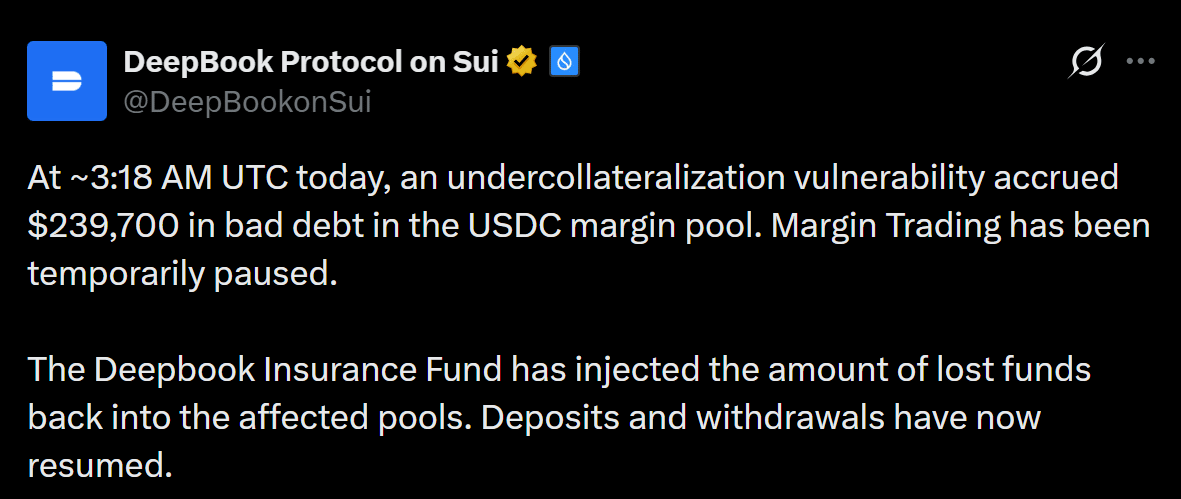
DeepBook’s leveraged trading infrastructure faced mounting pressure after its USDC margin pool became undercollateralized on the 9th of May.
On a post on X, the protocol announced that around 3:18 AM UTC, the imbalance generated nearly $239,700 in bad debt.

The disruption unfolded as collateral values deteriorated faster than DeepBook’s liquidation engines could react during volatile conditions.
Withdrawal thresholds near 2.0x and liquidation targets around 1.25x briefly failed to absorb the shock. That weakness exposed how rapidly leverage can destabilize shared liquidity pools once volatility accelerates.
However, protocol solvency remained intact as the insurance fund fully restored affected balances without user losses.
That response prevented broader contagion across DeepBook’s roughly $16 million ecosystem liquidity, while reinforcing how liquidation latency still threatens leveraged DeFi systems during sharp market swings.
Margin pause limits contagion risk
As bad debt rapidly accumulated inside DeepBook’s USDC margin pool, governance responded by pausing margin trading within minutes. The suspension prevented additional leverage exposure from spreading across the protocol during volatile trading conditions.
Before the disruption, DeepBook processed a steady $10–15 million in daily trading volume.
Meanwhile, ecosystem liquidity held near $16.09 million, reflecting growing activity across Sui’s trading layer.
The pause sharply reduced leveraged flows, though spot Central Limit Order Book (CLOB) activity continued operating without major disruption.
That separation prevented broader liquidation spirals from destabilizing shared liquidity pools and emerging prediction markets.
However, the event also exposed how rapidly collateral shocks can overwhelm leveraged systems once volatility accelerates beyond liquidation response speed.
Leverage efficiency continues to expose DeFi fragility
As DeepBook recovered from the bad debt event, deeper pressure inside leveraged DeFi systems became increasingly visible. The disruption showed how quickly collateral deterioration can outpace liquidation engines once volatility accelerates across margin markets.
Earlier liquidity shocks across MakerDAO, Compound, and Aave [AAVE] exposed similar weaknesses during fast-moving market conditions. DeepBook’s roughly $16 million TVL helped contain broader contagion, though the imbalance still revealed growing fragility beneath shared-liquidity infrastructure.
That pressure partly stems from rising leverage efficiency across modern DeFi architectures. Higher leverage multipliers improve capital usage, yet they also amplify sensitivity to collateral price swings and execution latency.
However, spot liquidity remained stable while protocol solvency held firm.
Even so, repeated stress events may gradually weaken user confidence across leveraged on-chain trading systems.
Final Summary
- DeepBook’s $239,700 USDC margin pool bad debt exposed how fast undercollateralization can hit leveraged DeFi during volatile conditions.
- DeepBook’s containment highlighted DeFi resilience, though repeated liquidation failures still expose growing fragility across leveraged on-chain systems.

YISHU 6Ft Surge Protector Power Strip with 8 Widely Outlets & 4 USB Ports | 3 Side Outlet Extender with 6 Feet Extension Cord, Flat Plug, for Home, Office, College Dorm Room Essentials
$9.98 (as of October 25, 2026 03:23 GMT +00:00 - More infoProduct prices and availability are accurate as of the date/time indicated and are subject to change. Any price and availability information displayed on [relevant Amazon Site(s), as applicable] at the time of purchase will apply to the purchase of this product.)
FUJIFILM instax mini 13 Instant Film Camera - Dreamy Purple
$78.00 (as of October 25, 2026 03:34 GMT +00:00 - More infoProduct prices and availability are accurate as of the date/time indicated and are subject to change. Any price and availability information displayed on [relevant Amazon Site(s), as applicable] at the time of purchase will apply to the purchase of this product.)
reatoy Cat Deterrent Spray for Furniture Protection, Anti Scratch and Urine Marking, Plant-Based Safe Formula for Indoor & Outdoor 150ML
$19.98 (as of October 25, 2026 03:23 GMT +00:00 - More infoProduct prices and availability are accurate as of the date/time indicated and are subject to change. Any price and availability information displayed on [relevant Amazon Site(s), as applicable] at the time of purchase will apply to the purchase of this product.)
Sheba Perfect Portions Cuts Wet Cat Food, Multipack, 2.6 oz, 24 ct | Chicken, Salmon & Turkey cuts in gravy, grain-free, protein-rich, no corn/soy, essential vitamins & minerals, twin-pack trays
$27.96 (as of October 25, 2026 03:13 GMT +00:00 - More infoProduct prices and availability are accurate as of the date/time indicated and are subject to change. Any price and availability information displayed on [relevant Amazon Site(s), as applicable] at the time of purchase will apply to the purchase of this product.)













Post Comment