Unlock the Secret Strategy Behind Index Trackers That Wall Street Doesn’t Want You to Know
Index trackers—sometimes called index funds—might just be the sneaky little champions of the investing world that most folks overlook. Ever pondered why some of the brightest financial minds, including the legendary Warren Buffett and Yale’s own David Swenson, swear by these humble funds? Here’s the kicker: these trackers don’t aim to outsmart the market—they just quietly mimic it, offering a low-cost, diversified way to invest that often beats the so-called “expert” active investors over time. It’s like showing up to the race without trying to sprint but still managing to finish ahead of most rivals. Intrigued? Welcome to a strategy where playing it ‘average’ might just be the smartest move you make—and where your portfolio gains can grow with a lot less hassle and head-scratching. Ready to dive into the why, how, and which of index trackers? LEARN MORE
Index trackers – also known as index funds – are the investment vehicle of choice for passive investors.
Why? Because index trackers provide a low-cost way to build a diversified portfolio that will outperform the average active investor.
Index trackers come highly recommended by some of the biggest names in investing.
Yale’s famed endowment fund manager, David Swenson, neatly summed up the advantages of trackers:
“With all assets, I recommend that people invest in index funds because they’re transparent, understandable, and low cost.”
Even Warren ‘Gazillionaire’ Buffett says index funds are the best investment vehicles for most people.
Safety in numbers
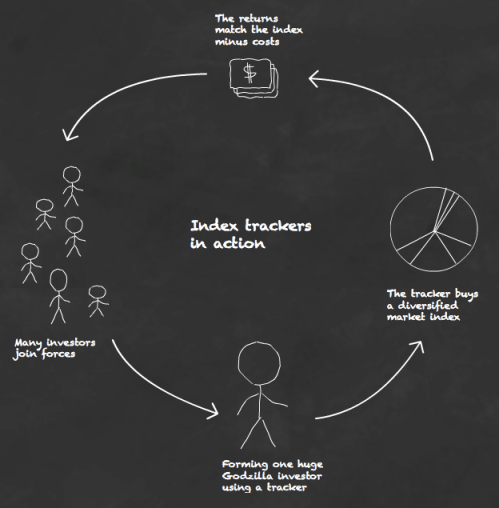
Like other funds, tracker funds enable lots of investors to club together to increase their buying power. They collectively buy shares or other assets across many more companies than any individual could.
For example, index trackers make it possible to invest in all the world’s stock markets via just one global tracker fund.

Trackers are therefore a good way for everyday investors to get into the stock market without exposing themselves to the dangers of individual stock-picking.
Risks and costs are reduced thanks to the scale and diversity of the fund.
And while you’ll never beat the market you’re tracking with an index fund, you won’t lag it by much, either.
Indexes in (just a little) detail
Most funds have an aim. The aim of a tracker fund is to reproduce the returns of a specific market index.
An index is a basket of securities (such as shares or bonds) that is used to represent a particular segment of the market.
Famous indices that you’ll have heard of on the news include the:
- FTSE 100
- Dow Jones Industrial Average
- Nikkei 225
An index is rather like a scoreboard or league table. It provides a systematic way of measuring how a particular market is performing.
There are many weird and wonderful indices out there, from the All-Peru index to the Volatility Arbitrage index.
But virtually all of us only need to concern ourselves with the very biggest ones.
You need to decide:
- The market you want to track (for instance UK domestic equity).
- Which indices track that market, and how the indices differ.
You can then make an informed choice about which tracker to go for.
For example, global equities are covered by a number of indices. Some of the most popular are the MSCI World and the FTSE Global All Cap.
UK equity is similarly covered by a number of indices. The two most popular are the FTSE 100 and the FTSE All-Share:
- The FTSE 100 tracks the 100 largest listed UK firms, and covers nearly 90% of the market .
- The FTSE All-Share covers more than 98% of the market, by bundling together the FTSE 100, FTSE 250 and FTSE Small Cap indices.
If you wanted the most diversified UK index, you’d pick the All-Share.
However we believe that a global index fund should be at the heart of most UK investors’ portfolios. That’s because with this single fund your money is diversified into thousands of companies from across the world.
You can find out which index a tracker mimics by reading its fund factsheet or web page.
Whose indices are they, anyway?
Indices are created and managed by private companies such as FTSE Russell and MSCI.
These outfits define markets slightly differently, which is why their respective ‘global trackers’, for example, won’t own exactly the same companies.
You can even invest in funds that track (supposedly) more ethical versions of their indices, tweaked to reduce exposure to, say, oil and gas companies or cigarette makers.
However because these niche indices differ from the broader markets, you can expect to earn a slightly different return when you go down this route – for better or worse.
Some firms are bigger than others
One thing that surprises new passive investors is that an index typically doesn’t give every company an equal weighting.
Instead, most indices are weighted by market capitalisation – or ‘market cap’.
The bigger a company’s market cap, the larger its place in the index.
Let’s say we have an index containing just three firms. If Company A is worth £700 billion, Company B £200 billion, and Company C £100 billion, then:
- 70% of your tracker would be invested in Company A
- 20% in Company B
- 10% in Company C
As share prices rise and fall, those weightings then change automatically. A company whose value doubles becomes a bigger part of the index. One whose fortunes decline occupies less space.
Market-cap weighting reduces trading, which helps keep costs down. It also reflects where investors have collectively put their money – a wisdom of crowds approach that typically does better than striving to outsmart the market.
The downside is that today’s biggest firms dominate even the broadest trackers.
At the time of writing, a global equity index is heavily weighted to US technology giants, simply because they account for such a large share of the world’s listed stock market.
Not everyone is comfortable with this level of concentration, fretting that it leaves them exposed to the fortunes of a handful of super-sized companies.
It’s worth mentioning though that if tomorrow’s winners emerge from elsewhere in the market, then the index will gradually adjust to reflect that, too.
Gain with less pain
A tracker’s job is to deliver the return of its index.
It usually does this by holding stocks (or other assets) in proportion to their presence in the index.
Some trackers will hold the lot, some only a sample, and yet others will replicate index returns using more complicated financial products.
These differences in methodology help explain tracking error – the extent to which a tracker fails to accurately track its index in any particular year.
Other drivers of index fund performance include the fees they charge investors and the fund provider’s costs of running the fund and buying and selling assets.
Tiny differences can see two funds that track the same index delivering slightly different returns over time – although rarely by enough to sweat the difference.
How trackers win by being average
The key point is that trackers don’t try to pick the winners. They don’t market time.
They just plod along tracking the index, handing over the returns due from the performance of its component securities.
By its very nature, a tracker fund will never hit three cherries on the fruit machine. It will never turn in a stellar index-trouncing result.
Its task is just to replicate the index.
In fact, a tracker will usually undershoot its benchmark, due to fund costs.
But a tracker’s limited ambition makes it cheap to run. And it’s because they are cheap that most trackers outperform expensive active funds in the long run.
Types of trackers
There are two main types of tracker funds:
- Index funds – The majority of these are now structured as Open Ended Investment Companies (OEIC), while a few are unit trusts. The US equivalent is called a mutual fund.
- Exchange Traded Funds (ETFs) – These are basically index funds wrapped up in a product quoted on the stock market, which you buy and sell like other shares. Buying ETFs can therefore incur higher trading costs, though that’s less of an issue these days with low-cost platforms. Also there is a far greater choice of ETFs than index funds. An ETF may be the only way to get exposure to some markets.
You can read more about the different types of tracker in our archives.
We also keep a watching eye on the lowest-cost index funds for UK investors.
Take it steady,
The Accumulator
p.s. This article on index trackers has been updated after ten years hard labour. Comments below are preserved for posterity but may be out-of-date. Check the date!
Ring Battery Doorbell (newest model), Speckled White with Indoor Cam Plus, White
$59.99 (as of September 20, 2026 03:22 GMT +00:00 - More infoProduct prices and availability are accurate as of the date/time indicated and are subject to change. Any price and availability information displayed on [relevant Amazon Site(s), as applicable] at the time of purchase will apply to the purchase of this product.)
blink plus plan with monthly auto-renewal
$11.99 (as of September 20, 2026 03:12 GMT +00:00 - More infoProduct prices and availability are accurate as of the date/time indicated and are subject to change. Any price and availability information displayed on [relevant Amazon Site(s), as applicable] at the time of purchase will apply to the purchase of this product.)
UP URARA PUP Spring and Summer Dog Collar with Bow Tie, Cherry Bowtie Collar Adjustable for Girl Boy Dog, Spring Pink Bow Collar for Dogs, M
$16.99 (as of September 20, 2026 03:10 GMT +00:00 - More infoProduct prices and availability are accurate as of the date/time indicated and are subject to change. Any price and availability information displayed on [relevant Amazon Site(s), as applicable] at the time of purchase will apply to the purchase of this product.)
Flea and Tick Collar for Cats 5 Pack, 8 Months Protection, Plant-Based Ingredients, Water-Resistant, Adjustable & Lightweight, Suitable for Adult Cats & Kittens, White
$28.99 (as of September 20, 2026 03:10 GMT +00:00 - More infoProduct prices and availability are accurate as of the date/time indicated and are subject to change. Any price and availability information displayed on [relevant Amazon Site(s), as applicable] at the time of purchase will apply to the purchase of this product.)













Post Comment