
Government Surplus Takes a Hit — Here’s What Rising Spending Means for Your Wallet and the Market’s Next Move
Ever wonder if a government surplus can feel like both a triumph and a tease? Ireland’s 2025 numbers just dropped, showing a €10.7 billion surplus—sure, it’s impressive, but less than half the €23.4 billion splash from 2024. At first glance, it might look like a step back, but peel back the layers, and you’ll spot a hefty €14.2 billion one-off revenue boost from a European Court ruling that skewed last year’s figures. That’s like hitting the jackpot once and then playing solid poker the next hand—not bad at all. Revenue dipped slightly overall, but strip out that unusual windfall, and Ireland actually grew its income by nearly €10 billion. Meanwhile, spending climbed by nearly 7%, yet government debt quietly slipped down to 34.8% of GDP—the lightest load since the stormy days of 2008. With four straight years of surpluses stacking over €50 billion and a government ready to pump up capital spending by 14%, the story is more about steady progress than flashy fireworks. So, what does this all mean for Ireland’s economic journey? Buckle up, because the next few paragraphs will unpack how these numbers reflect not just balance sheets—but the pulse of a nation gearing for growth and resilience. LEARN MORE
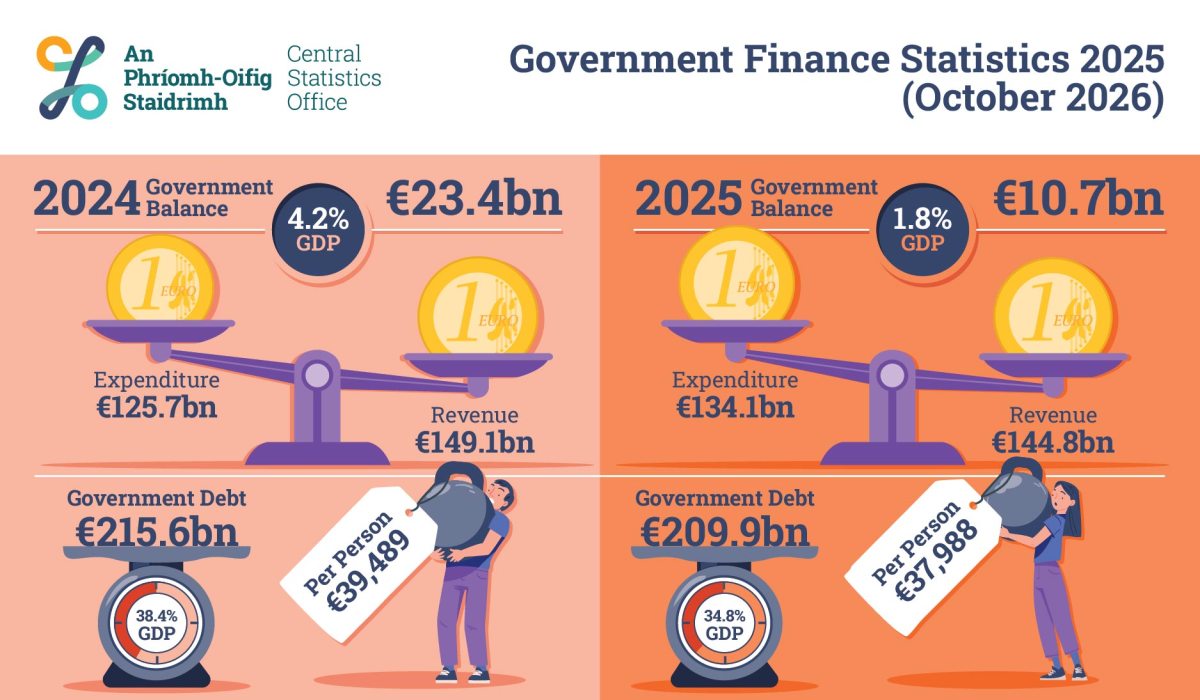
Ireland recorded a government surplus of €10.7bn in 2025, less than half the €23.4bn surplus recorded the previous year, according to new figures from the Central Statistics Office (CSO).
The General Government Balance (GGB) surplus represented 1.8% of gross domestic product (GDP), with the year-on-year decline largely reflecting a €14.2bn one-off revenue receipt in 2024 arising from a Court of Justice of the European Union ruling.
Government revenue totalled €144.8bn last year, down €4.3bn on 2024. However, excluding the exceptional receipt in the previous year, revenue increased by €9.9bn.
Government expenditure rose by €8.4bn, or 6.7%, to €134.1bn in 2025, while gross general government debt fell by €5.6bn to €209.9bn at the end of the year.
The debt figure was equivalent to 34.8% of GDP, according to the CSO’s Government Finance Statistics 2025.
Bill Drakeford, statistician in the CSO’s Government Accounts Compilation & Outputs Division, said 2025 marked the fourth consecutive year of a government surplus.
The combined surplus between 2022 and 2025 amounted to just over €50bn, driven by almost €400bn in tax receipts over the period.
“When comparing 2024 and 2025, it should be noted that in 2024 there was a one-off capital receipt of more than €14bn,” Drakeford said.
EY Ireland chief economist Rossa White said the latest CSO releases showed further progress in the State’s public finances and long-term growth potential.
White said government debt had fallen to 63% of national income, its lowest share since 2008, when Ireland’s banking crisis began, while net debt declined to 41% of national income.
He also highlighted plans to increase capital spending by 14% next year, saying infrastructure investment would reach a record share of government expenditure this year, with a new high expected in 2027.
“This investment will boost Ireland’s growth potential longer-term and provide a dividend from the strong revenues that the State is garnering right now,” White said.

Separately, the CSO’s Measuring Ireland’s Progress report showed that Ireland had the highest proportion of STEM graduates among people in their 20s across the EU for the second consecutive year.
White also noted that life expectancy for a baby born in Ireland had reached 83 years, placing the country sixth in the EU.

Amazon Kindle Colorsoft Signature Edition 32GB (newest model), Thinner, new aluminum design, 7" color display, Auto-adjusting front light, Fig
$319.99 (as of October 21, 2026 03:33 GMT +00:00 - More infoProduct prices and availability are accurate as of the date/time indicated and are subject to change. Any price and availability information displayed on [relevant Amazon Site(s), as applicable] at the time of purchase will apply to the purchase of this product.)
Pop Up Catio Outdoor Cat Enclosure Rolling 27" Cat Hamster Ball for Outside | Foldable Breathable Mesh Pet Playpen with Zipper, Portable Lightweight Ball Cage for Indoor Cats, Travel, Lawn & Backyard
$19.98 (as of October 21, 2026 03:22 GMT +00:00 - More infoProduct prices and availability are accurate as of the date/time indicated and are subject to change. Any price and availability information displayed on [relevant Amazon Site(s), as applicable] at the time of purchase will apply to the purchase of this product.)
ALOHA Organic Plant Based Protein Bar | Peanut Butter Chocolate Chip, 12 Ct | 14g Plant-Based Protein, 10g Fiber, 5g Sugar | No Sucralose or Stevia | Non-GMO, Vegan & Dairy Free
$20.57 (as of October 21, 2026 03:12 GMT +00:00 - More infoProduct prices and availability are accurate as of the date/time indicated and are subject to change. Any price and availability information displayed on [relevant Amazon Site(s), as applicable] at the time of purchase will apply to the purchase of this product.)
Coca-Cola Soda Soft Drink Fridge Pack Cans, 12 fl oz, 12 Pack | Carbonated drink with classic cola flavor
$7.68 (as of October 21, 2026 03:12 GMT +00:00 - More infoProduct prices and availability are accurate as of the date/time indicated and are subject to change. Any price and availability information displayed on [relevant Amazon Site(s), as applicable] at the time of purchase will apply to the purchase of this product.)













Post Comment