
Why 120 Years of Economic “Growth” Has Failed to Boost Your Wealth — And What Nobody’s Telling You About Getting Rich
You know, it’s funny how most people instantly assume that a booming economy means instant stock market success. Like, if the GDP numbers are lighting up green, the stock ticker must be doing backflips, right? Well, as it turns out, that’s not always how the game plays out. I came across some fascinating research by Jason, Jay, Philip, and Yen Xiang that really flips this idea on its head. They dug into decades of data across developed and emerging markets, and guess what? Faster economic growth doesn’t necessarily translate into better stock returns. Surprising? Absolutely. Disappointing for many expecting smooth sailing? You bet. But here’s the kicker—what actually drives returns isn’t just how fast the economy’s chugging along, but how companies are growing their earnings per share and what kind of dividends they’re handing out to shareholders. So if you’re gearing up to invest in emerging markets, you might want to rethink your strategy beyond just chasing that GDP growth number. Curious to dive deeper into why a booming economy might not fatten your portfolio like you thought?
<a href="https://download.ssrn.com/2026/4/5/6523858.pdf?response-content-disposition=inline&X-Amz-Security-Token=IQoJb3JpZ2luX2VjEPb%2F%2F%2F%2F%2F%2F%2F%2F%2F%2FwEaCXVzLWVhc3QtMSJGMEQCICdtAiSJtRWjXiuk2HCQJ%2BnzSEXw8tPm1ctaVf07vnMgAiBfoCSalswwV9LHAwePwx%2FS7t6Ibjmzvy6y6ZSM7AGGlSrGBQi%2F%2F%2F%2F%2F%2F%2F%2F%2F%2F%2F8BEAQaDDMwODQ3NTMwMTI1NyIM08CpYPb4xWzsCBKRKpoF%2FDKS4ckWWCgKlOT3HCdHCM7LyeCyWi2nhVMvDDDYnFU5E%2FjQVOATR1VsWM8iiowPPoPRIYbG0lIgt7gZY7NDmlm2SNadbjzmsqTfLMw%2Bhcb45KLxbCdUM2KS7jGarENVtiDRdaFp4AP5b8pUkktUSiDGeGPMw7PWAzkdZa5YZycs4RzdAgFKDChW9%2FXoGR0cGjbFcjQ%2F2ZekViUgSE7OYYgf27Mura0V0y%2FHpOpT48holGvB99VYLfkTRchqyHHbVhp8hi4tgS7BFijarRytIvLdLS0PgH8ntD5CEhCVyQTu4iwSF%2BBdJPdw2kvLpjUGmhe5B5GmQ9QIsqk1aLFyrSLH%2BuCz7qYB6QsIS2zc9Mox4vwVsXYI9SPBAc6F%2FwzSezCGOG9eR58cCmjbvg0XyBO%2B3zzF7GlbJ0fiOIEG%2FDtKVg25tIP%2BloqaHj1O8gacQbVf97l3DRIRGWIxovemgrKqH543isSM9aUEoaem%2BvRWKV1SulkxkrjbzgBItA445QFMonvxYLfGxizXmWgIOgArsAOZHWS0iutndcq%2FRHq0Z%2BV6uE6BGS5M7WDdba1Md2ytKunWpJMgWIK6qhmzi%2FSz6wjR2NOjGk7yktYFJLAyAcM2pdvxHpvmQXeVnJB2%2FsaxZK3WB9sHFHyV7MqEs34elBVQ3LBu2FoIIqOL5x5r1vA024i7BUf%2BLH0Nt0%2F%2FBpixISuH11h%2FeLYEUQSipqIVXXutBEGmj5tc%2FRqHw5pBf9mBT5n4zmDqGqnoTu7EOxswn
img#mv-trellis-img-1::before{padding-top:74.567901234568%; }img#mv-trellis-img-1{display:block;}img#mv-trellis-img-2::before{padding-top:71.535580524345%; }img#mv-trellis-img-2{display:block;}img#mv-trellis-img-3::before{padding-top:80.170316301703%; }img#mv-trellis-img-3{display:block;}img#mv-trellis-img-4::before{padding-top:33.209417596035%; }img#mv-trellis-img-4{display:block;}
A lot of people seem to believe that when an economy is doing well, its stock market will automatically do well too.
But in this research by Jason, Jay, Philip and Yen Xiang, it seems to show that this isn’t always the case. [What matters more for emerging markets investors: Economic growth or EPS Growth?]
Whether a country has a developed or an emerging market, strong economic growth doesn’t always turn into better stock returns.
What returns are more tied to:
- Price of what you pay relative to the valuation.
- Earnings per share, Free cash flow starting yield (which is also valuation)
- Earnings growth and how that translates to shareholder return. The usual shareholder return is dividends and whether the dividends grow over time. More and more, shareholder return is also buy back securities and retiring securities.
Faster Economic Growth, Better Returns? Not Quite.
You would think that countries with faster-growing economies would also give investors better stock market returns. The evidence says otherwise.
In their 2002 book Triumph of the Optimists, Elroy Dimson, Paul Marsh and Mike Staunton looked at 101 years of data, from 1900 to 2000, across many countries. After stripping out inflation, they found that countries whose economies grew faster per person did not deliver better stock returns. If anything, they did slightly worse.
The authors have since added more countries and extended the data to 2021.
The pattern still holds: faster economic growth goes with slightly lower stock returns, though the link is weak enough that it could be down to chance. Other researchers who looked only at emerging markets over shorter periods found the same thing. There is no reliable link between how fast an economy grows and how well its stock market does.
This is a real problem for anyone investing in emerging markets.
The main reason people put money into these countries is their fast growth. In exchange, they accept a bumpier ride: prices swing more, laws and institutions are less established, and politics and the economy can be unstable. If fast growth doesn’t actually show up in stock returns, the case for taking on those extra risks becomes much harder to make.
That said, GDP is only one way to measure how fast an economy is expanding. Other measures of growth may turn out to track emerging market stock returns more closely.
21 Developed Markets, 120 Years: No Link to Economic Growth
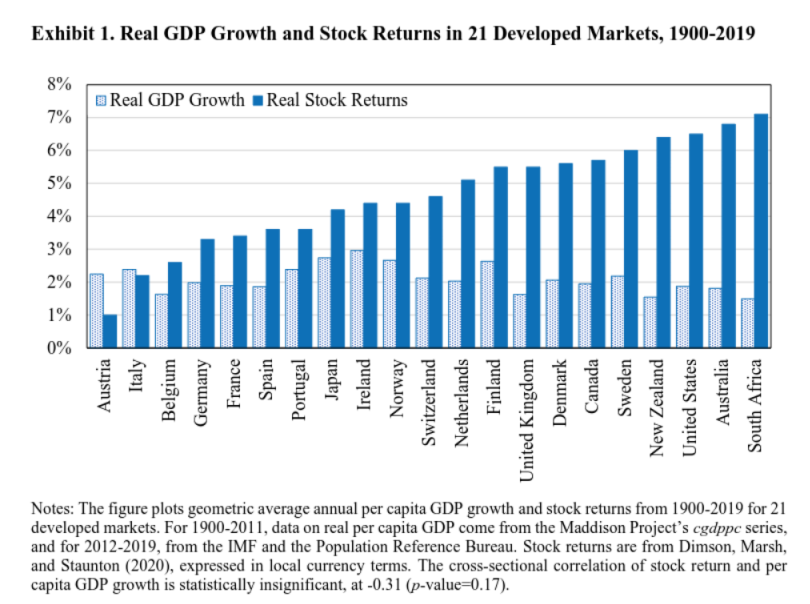
Dimson, Marsh and Staunton have tracked stock returns for 21 developed countries from 1900 to 2019, after stripping out inflation. For each of these countries, the authors of this paper also worked out how fast the economy grew per person each year over the same period, again after inflation.
The chart below lists the 21 countries, ranked from the weakest stock market to the strongest, alongside how fast each economy grew. Returns are in each country’s own currency and before tax.
Austria comes last, with stocks returning just 1.0% a year above inflation. South Africa comes top at 7.1% a year.

What stands out is that there’s no clear link between how fast a country’s economy grew and how well its stock market did.
If anything, the faster-growing countries did slightly worse. But the pattern is weak, and there is roughly a 1 in 6 chance it would appear purely by luck. That’s far too high to call it a real effect.
In fact, the true odds of it being luck are probably even higher. Our calculation treats each country as a separate data point, but neighboring economies tend to move together. Belgium and the Netherlands, for example, have had broadly similar fortunes over the past 120 years. So we effectively have fewer independent data points than it looks, which makes the result even less convincing.
Emerging Markets Are No Different
The chart below does the same comparison for 15 countries usually classed as emerging markets.
It covers stock returns and economic growth per person, both after inflation, mostly from 1988 onwards. As before, the countries are ranked from the weakest stock market to the strongest. Portugal comes last and Mexico comes top.

Once again, there’s no meaningful link between how fast these economies grew and how well their stock markets did.
This time, faster-growing countries did very slightly better, but the pattern is so weak that it could easily be pure chance. For all practical purposes, there is no relationship.
China is the example that surprises most people. Its economy grew at a remarkable pace, yet its local stock market delivered fairly modest returns.
A note on China’s numbers
The researchers’ figures for China differ from an earlier study by Ritter (2012), mainly because they measured China’s returns differently.
China has two main groups of stocks. The first is shares listed on the mainland exchanges in Shanghai and Shenzhen, known as A-shares. The second is Chinese companies listed overseas, mainly in Hong Kong and New York.
For most of China’s stock market history, foreigners found it hard to buy mainland A-shares. Before 2014, an overseas investor needed special government approval and an allocated quota to invest. That changed with Stock Connect, a scheme that lets investors buy mainland shares through the Hong Kong exchange.
Because foreigners couldn’t easily buy A-shares, the widely used MSCI China index was built mostly from Chinese companies listed in Hong Kong and the US, especially in the 1990s. Those overseas-listed shares did worse on average than mainland A-shares. Ritter used the MSCI index and found Chinese stocks had a negative return after inflation. The authors of this paper used mainland A-shares, starting in 1993 since China’s stock market only opened in 1990, and found a positive return of 4.4% a year.
Their figures reflects what an ordinary Chinese investor would have earned. Ritter’s reflects what a foreigner limited to a narrow set of overseas-listed Chinese companies would have earned.
What Actually Drives Returns: Earnings and Dividends per Share
In the table below, the authors look at the same 15 emerging markets, but this time they compare stock returns with three measures instead of one.
- The first is economic growth per person.
- The second is growth in company profits per share, meaning how much each share earns.
- The third is growth in dividends per share, meaning how much cash each share pays out to its owner. All figures are after inflation.
Reliable profit figures for many emerging markets only go back to 1995, so this comparison covers a shorter period, from 1996 to 2019. For China, the data starts in 2000. For Russia, it starts in 1997. In a few countries and years, companies on average made losses, which makes growth rates hard to calculate. To stop these unusual years from distorting the results, the authors capped each year’s growth at no more than 50% up or 50% down. They then worked out the average yearly growth rate over the whole period.


Even over this more recent period, there is still no reliable link between how fast these economies grew and how well their stock markets did. The pattern is weak, and there’s roughly a 1 in 3 chance it is pure luck. So fast economic growth on its own remains a poor reason to invest in emerging markets.
Profits and dividends tell a different story.
Countries where company profits per share grew faster also had noticeably better stock returns. That link is strong, with only about a 1 in 25 chance of it being a fluke. The link with dividend growth is also fairly strong, with about a 1 in 10 chance of being luck.
The lesson for investors is this.
When deciding whether to invest in emerging markets, or which ones to favour, how fast a country’s economy is growing matters far less than how fast its listed companies are growing profits and dividends for each share. A booming economy doesn’t help shareholders unless that growth actually reaches them.
What This Means for Your Portfolio
I think this paper, and probably the papers before it, show us that we shouldn’t base our investing on the idea that if an economy is doing well, it must be a good market to invest in.
We’ve seen this happen before with countries like China and India. You could put Singapore in that group too. Even if you feel Singapore is the safest place for economic growth, this research suggests that strong growth doesn’t automatically turn into stock returns.
What I’d keep in mind is that valuation of an economy matters.
Valuation means you should be buying a basket of securities, in a country with a high earnings yield and a high free cash flow yield of a country. Eventually, that means the average/median dividend yield for a country is high too.
That’s not the only thing to look at, though.
Earnings growth of the securities listed in a country matters as well.
To some extent, countries with companies that have higher earnings growth can’t have valuations that are too low either.
So I don’t think the lowest valuation is always the best pick. Countries with good forward earnings growth usually don’t trade at extremely low valuations on their own. That’s what makes these kinds of things so hard to predict.
More importantly, we have to consider if the country has an environment that encourages shareholder returns. Having earnings growth, high earnings yield does not mean much if they don’t translate to shareholder yield.

Kyith is the Owner and Sole Writer behind Investment Moats. Readers tune in to Investment Moats to learn and build stronger, firmer wealth foundations, how to have a Passive investment strategy, know more about investing in REITs and the nuts and bolts of Active Investing.
Readers also follow Kyith to learn how to plan well for Financial Security and Financial Independence.
Kyith worked as an IT operations engineer from 2004 to 2019. Currently, he works as a Senior Solutions Specialist in Fee-only Wealth Advisory Firm Providend. All opinions on Investment Moats are his own and does not represent the views of Providend.
You can view Kyith’s current portfolio here, which uses his Free Google Stock Portfolio Tracker.
His investment broker of choice is Interactive Brokers, which allows him to invest in securities from different exchanges all over the world, at very low commission rates, without custodian fees, near spot currency rates.
You can read more about Kyith here.

Roku TV Remote Control (Official Manufacturer Product) | Simple Setup & Pre-Set App Shortcuts - Replacement Remote Compatible with RokuTV Models ONLY (Not Roku Players)
$9.99 (as of October 28, 2026 03:23 GMT +00:00 - More infoProduct prices and availability are accurate as of the date/time indicated and are subject to change. Any price and availability information displayed on [relevant Amazon Site(s), as applicable] at the time of purchase will apply to the purchase of this product.)
Topical Flea and Tick for Cats & Kittens Over 1.5 lbs, Waterproof, Monthly At-Home Cat Care for Cats 8 Weeks or Older, 6-Dose Supply
$28.99 (as of October 28, 2026 03:23 GMT +00:00 - More infoProduct prices and availability are accurate as of the date/time indicated and are subject to change. Any price and availability information displayed on [relevant Amazon Site(s), as applicable] at the time of purchase will apply to the purchase of this product.)
CHRANFSN S-5XL Pet Pouch Hoodie,Hoodies with Dog Pouch,Cat Hoodie with Pouchs,Pet Carrier Holder Long Sleeve Pullover Tops
$9.99 (as of October 28, 2026 03:23 GMT +00:00 - More infoProduct prices and availability are accurate as of the date/time indicated and are subject to change. Any price and availability information displayed on [relevant Amazon Site(s), as applicable] at the time of purchase will apply to the purchase of this product.)
Alex Tech 10ft - 1/2 inch Cord Protector Wire Loom Tubing Cable Sleeve Split Sleeving For USB Cable Power Cord Audio Video Cable – Protect Cat From Chewing - Black
$8.99 (as of October 28, 2026 03:23 GMT +00:00 - More infoProduct prices and availability are accurate as of the date/time indicated and are subject to change. Any price and availability information displayed on [relevant Amazon Site(s), as applicable] at the time of purchase will apply to the purchase of this product.)











Post Comment