
Why AI’s Wild Rise Is Burning Down Old Industries—and What You MUST Do to Win Big Before the Flames Die Out
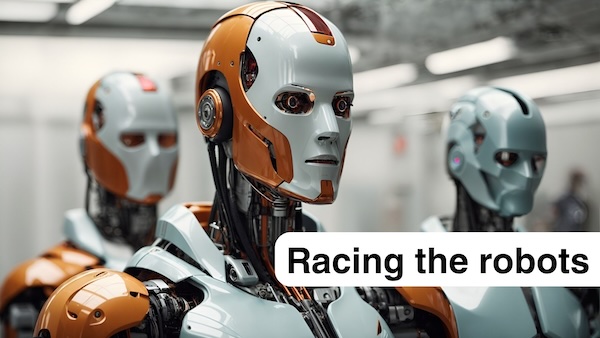
So here we are again, folks — AI is all anyone seems to want to talk about, right? But before you rush to rejig your entire retirement plan because some bot claims the robots are coming to snatch your job or make your 401(k) extinct, let’s pump the brakes. I’ve had a handful of readers hit me up recently, asking if the so-called AI revolution means they should fast-track their FIRE or, heck, rethink their entire investing game. My instantaneous gut reply? “Search me.” Seriously.
Now, don’t mistake my skepticism for denial. There’s no ignoring the fact that nearly $2 trillion is forecasted to flood this space by 2026—that’s not some niche hobby, it’s a tidal wave of capital and hype. But what exactly is AI gonna *mean* for your money? The truth is, much like betting on the next mega-trend, pouring everything into AI looks as risky as a double-or-nothing spin on the stock market roulette wheel. The future’s fuzzier than a toddler’s bedtime story, with visions swinging wildly from utopian breakthroughs to, well, let’s just say something that would send any financial planner running for cover.
So, do you really want to flip your carefully laid plans on their head for what might end up being just a glorified, albeit smarter, Clippy? Probably not. Let’s take a closer look before you drag your retirement into the AI frenzy.

Three Monevator readers in a fortnight emailed to ask how I think the much-vaunted ‘AI revolution’ should cause us to rethink our financial planning. (Or to ask a chatbot to rethink it, I suppose.)
My knee-jerk response: “Search me.“
It’s not that I doubt the borderline hysteria about AI we’ve seen in recent years will amount to anything.
From the sheer wodge spent on it – it will approach $2 trillion by the end of 2026, according to Goldman Sachs – to the disruptive potential of the technology itself, boom or bust, artificial intelligence will amount to something.
But what thing?
Everyone knows AI is big business. We’ve all read what it can do for us today, and what it might do to us tomorrow.
Are these actionable insights, though? Enough to change your investing strategy, let alone your retirement planning?
Unless you’ve very strong opinions, I’d suggest not. (Even then, you should hedge in case you’re wrong.)
Making investment decisions based on the AI rollout looks like betting on mega-trends on steroids. And we’ve seen before how such apparently sure bets often fail to pay off. Not least because their bright futures had already long been priced into share prices.
Double-edged blade runner
Besides, with AI we still can’t be certain there will even be a bright future. From what the experts tell us, the range of outcomes remains about as wide as it could be without bringing Gandalf in to cast some magical spells around.
Have a read of Anthropic’s pre-IPO document. Therein Anthropic floats an age of economic miracles, whilst also warning it might end humanity.
Scenario planning for a future with a Star Trek utopia at one extreme and a Terminator hellscape at the other makes debating the flaws in the 4% rule seem like child’s play.
Then again, humanity has muddled through before. So perhaps that’s the likeliest outcome with AI, too?
Blend together the extremes of utopia and hellscape, and we could end up with something like a more useful Microsoft Clippy.
Do you really want to turn your financial planning upside down for that?
Heads or tails
Two of those Monevator emailers said they are pulling forward their own FIRE dates on account of AI. (FIRE being short for Financial Independence Retire Early).
They want to get out while the going is still good – or at least still going!
Interestingly, though, my other correspondent said they planned to work for longer because of AI. Not because they enjoyed using it, but again for gloomy reasons. They want to pile up more of a pot before quitting, given the extra uncertainty they see.
I’m not able to offer personal financial advice, as I always say. But it’s not obvious to me what the definitive answer would be anyway.
I don’t suppose a financial planner has ever been fired for telling a client to work longer and to save more money.
But ‘artificial intelligence gives people a new reason to put off retirement for one more year’ is hardly the revolution we were promised.
The big issues
Let’s consider three of the main concerns for anyone considering the impact of AI on their retirement planning.
They all seem pretty intractable, especially given the pace of change we’re seeing. But let’s have a poke at them regardless:
- What does AI mean for the future of work, and how does that affect my career path and exit date?
- What about my investments? Will AI blow up the stock market? Will it cause a Great Depression? Or has saving become unnecessary because AI will usher in an era of abundance for everyone?
- How will AI affect the world I will retire into? Does this change what I must plan for?
As I said: intractable. If you were asked these questions in an interview for Goldman Sachs or Oxbridge, you’d be assessed on how you answered, not on the exact answers you gave. There are no right answers yet.
I’d suggest however that in thinking about them, it becomes clear that for most of us, steady as she goes remains the best – if boring – way forward.
Oh, I know many reasonable people think AI is nonsense. Autocomplete on steroids at best. To such folk even considering the impact of AI may seem like anxiety theatre.
But at the same time, other well-placed insiders say the technology will put most white collar workers out of a job, at least for a transition period.
And that’s not even bringing true general intelligence into it, should we see it anytime soon!
So sure, if you’re confident you know what will happen then feel free to plan accordingly. Though I’d still leave a margin of safety, just in case.
But the rest of us could have some pondering to do.
Killer robots
Incidentally, this isn’t hypothetical for me. By destroying what was left of the Internet economy, AI has already disrupted what had become my day job – this website.
Monevator is not unusual here. The majority of informational websites have seen their traffic fall, by as much as 90%.
Chatbots answer questions based on what they learned in training, or else they do a quick search and then answer. Meanwhile the Googling human now rarely sees the original source of this information, nor even thinks about where it came from.
What’s more, I’d suggest the best AI models write better than 95% of humans. While such writing still has a signature that’s there if you look for it, most people don’t (if they’re even reading articles anymore.)
So writing used to be a valuable skill, but now it’s a commodity. And publishing – aggregated writing – is a business model clinging on by its fingertips.
In other words, AI has already done away with the old job of investment blogger.
For now, Monevator remains viable thanks to those who have become members to access our premium articles and support our work. (As always, huge thanks to you!)
But what I’d thought would be an annuity-type revenue stream – Monevator and our thousands of articles – now seems like it will be obsolete in a few years. And the freelance writing I might have done instead looks like becoming a hobby for eccentrics.
So yes: it can happen! AI can destroy businesses just as we heard it could, even if it hasn’t come for your workplace yet.
Of course, AI should also bring with it new kinds of jobs – or at least new ways to make money – in all but the worst-case scenarios.
And we can’t extrapolate from my media experience to all sectors.
Mass-produced cars were a death knell for blacksmiths and horse carriage manufacturers. But bankers and dentists carried on undisturbed.
This uneven disruption is what makes an industrial revolution so topsy-turvy to live through.
AI and you
Let’s now consider my three key questions about AI from the perspective of someone close to FIRE.
#1) AI, work, and when to get out
A reminder: many experts think AI could be seriously disruptive to work. Like, wiping out 50% of white-collar jobs disruptive, as Anthropic’s Dario Amodei predicted in May 2025.
However this hasn’t happened yet. And Sam Altman, Amodei’s rival at OpenAI, has walked back his own predictions of a jobs apocalypse.
Meanwhile academics at Stanford University recently found that:
In the Census data, only 5 percent of firms report any employment impact, with equal numbers reporting gains and losses. Eighty percent of executives surveyed by the Federal Reserve Bank of Atlanta said AI investments have yet to alter their headcount or improve productivity. A large-scale Danish study linking data on AI adoption by workers to firms found that AI adoption results in the restructuring of worker tasks and time, but that these changes are not yet affecting worker employment, hours or earnings.
A recent study found that among firms adopting AI, employment grew by 10 percent in the two years following adoption.
Taken together, the data suggest firm AI adoption is moving quickly but unevenly throughout the economy, with many firms still in the experimentation stage and only the more advanced adopters deploying AI more broadly.
The authors of that study concluded that “AI’s effects on overall employment is likely small, though a tough job market for new graduates may be partly due to AI.”
This is only one study, but it’s representative of the lack of clarity in the data. And it’s hard to square this with the dire predictions from Silicon Valley, or even anecdotal reports from friends who tell me they’ve already got AI agents doing the work of five underlings.
On the other hand, it’s easy to see the lack of a great AI displacement in the labour data in the US – the epicentre of any AI revolution, if there is one. Unemployment there has hit lows last reached in the 1990s.
Just because it hasn’t happened yet, doesn’t mean it won’t eventually. But according to the early forecasts of some AI leaders, we should already be neck deep in P45s.
And we’re not.
Olden is golden
For anyone approaching the final straight before pulling the plug on work, then, I see little to worry about.
Most jobs aren’t disappearing yet due to AI, so yours isn’t likely to anytime soon. If you hoped to get a couple more years in before hitting your number, you probably will.
Of course this doesn’t go for everyone. I’ve explained above how the media sector is being eviscerated by AI. But it’s pretty difficult to find other widespread job losses, even in the most obvious places.
Computer programming, for instance, has definitely been hugely transformed by AI in the past two to three years. But job postings are rising.
Now, if you’re young or far from your envisaged end goal, things could be different. The technology is still new and improving fast, so who knows where we’ll be in a decade. Moreover if there is an impact on jobs showing up from AI to date, it’s at the entry-level.
But I’d say the bigger threat from AI for near-retirees to their dreams of FIRE is that the pundits predict older hands will be the most employable in an AI-driven workplace. Grunt work will give way to planning and orchestration, and you need experience for that.
If so, then perhaps you’ll be more tempted to put FIRE on hold to stay for longer, by higher pay or even a better work environment?
There are worse reasons to see a plan disrupted.
Whatever works for you
If you’re on a skimpy FIRE plan then I guess there might be a risk in pulling the plug early if those predicted job dislocations do actually show up in the next couple of years. Going back to work if you hit an unlucky sequence of returns might not be possible for you, in that case.
But honestly? I think anyone who is getting out of work early specifically due to fears about AI has just found the right excuse to unlock the door.
More power to them, if so. But it’s no reason for those only a little further down the trail to fret.
A more interesting question is if you foresee a dark future but your plan still presumes a few more years at work before you hit ‘your number’.
In that case, pulling the plug early might make sense. We’ll get to that below.
#2) Have you got enough saved to take on AI in FIRE?
If the uncertainty when it comes to the future of work and jobs is big, wild, wooly, then it’s mammoth when it comes to money and investing.
To see how quickly this gets wacky, consider that OpenAI made headlines last year when it warned its own would-be investors with the line:
It may be difficult to know what role money will play in a post-AGI world.
Again though, opinions vary. Not least those of OpenAI’s head Sam Altman, who has walked back his earlier thinking.
In fact the OpenAI website no longer predicts the end of money! So that’s nice.
Still, it’s common to read about AI researchers who aren’t bothering to save for retirement. In a recent podcast for The Atlantic, one Nate Soares said that:
“I do not save for retirement right now. I have a 401(k) from when I worked at Google, but I haven’t contributed for a decade.”
But don’t be too reassured. While Elon Musk has opined that saving could be “pointless“ because super-AI will usher in super-abundance with enough for everyone, Soares is from the high p(doom) school that fears the AI apocalypse will wipe out homo sapiens alongside their retirement accounts.
Hence why bother?
More pedestrian predictions – relatively speaking – come from the likes of Ark’s Cathy Wood, who says AI will drive global GDP towards 7%.
Never mind the death-bots, think of the profits we’ll make!
Then there are the true believers who think the best way to protect yourself from an economic future where AI eats all the pies is to put more money into the AI outfits themselves.
On the other hand, plenty of seasoned investors have warned that AI mania is just the latest bubble.
This week the hedge fund veteran Paul Singer said that:
Virtually every alarm bell warning of a substantial bear market ahead is ringing.
With the Nasdaq down 6% on the day as I type, Singer is surely getting a more sympathetic hearing than he would have a few months ago…
Stay on target
Needless to say, I’m still saving and investing for the future.
At the very least it’s a variation of Pascal’s Wager. (That is, what if you’re wrong and neither abundance nor doom comes to pass?)
But mostly it’s because, once more, muddling through seems the likeliest outcome.
Again, younger people may face more difficult times ahead. But if you’ve nearly made it to retirement – with years or decades of saving and postponed pleasure sunk behind you – then why switch strategies now? The hard yards are done.
I suppose if you’re adamant that something nasty is coming with AI, you might take it easy with your contributions in the final straight. So if you were hoping to be able to live on the equivalent of a 3% sustainable withdrawal rate, you could consider pulling the ripcord when you can make do on 4%.
If you suspect Skynet will have humanity under its thumb by 2035, you’ll probably be glad you got the Saga cruises in while you could.
Alternatively, there’s CoastFIRE. This more relaxed route to retirement lets you better enjoy the world as you find it today, along with the most flexibility for properly getting back into the workforce should you need it – and it still be there – tomorrow.
Churn und Drang
Asset allocation may be a thornier and more practical issue. After all, AI could eat up great gobs of the economy without truly destroying either capitalism or the planet.
Again, just ask your nearest website publisher. Shares in Reddit, for instance, fell 30% in a day this week because Google AI is choking off Reddit traffic.
Ironically, Google (or rather its parent Alphabet) itself was down the day before. Search ad revenue isn’t growing as fast as it did under the old ’20 blue links’ model, it seems.
But as ever most people will do best not to bet their pensions on predicting winners and losers. If you never had an edge before, then this is not the time to look for one.
Indeed it’s hard to explain to an index investor just how much harder it’s been to pick stocks of late. The market has had a one-track mind, but a changeable one at that.
A couple of years ago many feared the US tech giants were too big and too expensive – and this became true of the US market writ large. Things reached a head in 2026 when AI ‘picks and shovels’ stocks such as chip makers multi-bagged. It seemed like the AI trade was single-handedly keeping the index afloat.
Yet fortunately for passive investors – well, assuming you were diversified – the market has been rebalancing away some of this AI froth for you.
I say fortunately because this week such stocks were truly shellacked!
As for bonds, I’ve read people say that AI is going to lead to hyper-inflation – mostly through government money-printing to deal with its consequences – and others warn of deflation, when half of us lose our jobs.
Again I’d split the difference and keep hold of my bonds, personally. Anything else seems a punt.
Invest in all outcomes
So much for the short-term. In the long-term I believe everyone should – metaphorically-speaking – own the robots with a portion of their wealth.
That’s easily achieved with a global tracker fund though, given its outsized allocation to the US.
If AI ultimately proves a bubble then okay, it’s nothing we haven’t lived through before and you’ll own plenty of other stocks. And if AI isn’t a bubble, then you’ll want to own your bit of the bountiful future.
Naughty active investors may try to be cuter. For example, you might allocate more money towards companies growing the energy grid, should their prices ever look right again. Earlier this year I even suggested to Moguls that luxury giants such as Hermes and Ferrari could be a good way to play an AI revolution. (One that follows the not-so-revolutionary script of the rich getting richer by the end.)
Okay, so I’m 2,000 words into an article about AI and FIRE and I’m still saying it’s no justification for changing your plan. As long as your plan involved proper diversification and having enough safety buffers to get you through a downturn, I believe that’s true.
Because there is always upheaval going on. Until it’s proven to be definitely otherwise, AI is just the latest one we get to live and invest through.
Meanwhile if it really is something genuinely bigger and more existential, I don’t think there’s much practical that we can do about it, given our vantage point from here. So keep calm and carry on.
#3) Will retirement be different in the AI era?
It’s hardly false modesty to say this article hasn’t exactly been packed with ‘actionable insights’. But this final section will be the fuzziest of all.
So let’s keep it pretty short.
Because… what can I say? If I was sure I’ll be scrabbling over the ruins of a Tesco looking for unopened cans of beans while being pee-pewed at from laser-armed hunter-killer drones before I reach my 60th birthday, I’d have stopped working yesterday.
As a motivation, that would even beat getting out of the Monday stand-ups.
But we can’t know that for sure yet, nor most of the other outcomes being touted by the futurists – no more than we know when we’re going to pop our clogs.
Not very helpful for retirement planning in either case.
As I alluded to somewhere in the word jungle above, if you’re very gloomy about the dystopian potential of AI then maybe it makes sense to retire earlier than planned. Provided your investments can still pay your way in relative comfort of course.
There’s not much point in slaving away for years to save more money for a world you don’t think you’ll enjoy much. Perhaps in that case it’s rational to enjoy more of the one you do, while you can.
However that would also be true if you feared climate change, or if you were worried about the nuclear arms race in the early 1980s or long-haired layabouts in the 1960s or the rise of fascism in the 1930s.
It’s legitimate to think about the risks of profound shocks, but it’s nothing new.
Hence my boring advice is that it’s better to stick to your plan, and plan for a future that’s kind of not half as good as the old days but still not totally terrible.
Old-timers have been propping up bars to inflict that sort of lament on the young for millennia.
Plant trees anyway
When you think back over the past 100 years, the world has changed out of sight – from electricity to cars to computers to the decline of religion and the rise of women in the workplace, to funny cat videos. The list goes on for as long as you can keep doomscrolling.
Yes, it’s possible that AI really will be a game-changer on a different level. We’ve never had the promise of unlimited thinking power at our fingertips before.
On the other hand, such promises are not the sort the FCA would endorse. Anything could happen and the future is very uncertain. As usual.
Personally I think it’s always a good idea to save and invest in case you might not be able to – or want to – work in the future. That certainly motivated my own investing journey more than daydreams of doing nothing under a palm tree. I wanted the independence.
Having an ‘FU fund’ at your back was always the bonus on the way to FIRE. And if on the big day you decide you no longer want to quit work? Well, then unless you’d really straight-edged your way to your number, no major harm done. You’re now just a richer person who has a job instead of a poorer one.
I think that’s the safest way to approach the potential for AI to ‘change everything’, too.
I guess it’s possible AI could make money irrelevant. But I don’t know – it seems like at the least there’ll be an interim stage where you’ll get to go on a few benders on the way.
And if it turns out the tech guys were blowing smoke (I know, perish the thought) and AI is just a different kind of software, then you’ll surely be glad you kept to your original plan.
Remember, they may train the swear words out of the chatbots, but there’s nothing to prevent you saying F-U to a robot.

The Farmer’s Dog Human-Grade Crunchy Dog Biscuits, Peanut Butter & Pumpkin | All-Natural Dog Treats Made with Real Ingredients For Puppies and Adult Dogs, For All Ages, Sizes and Breeds
$13.48 (as of November 10, 2026 03:26 GMT +00:00 - More infoProduct prices and availability are accurate as of the date/time indicated and are subject to change. Any price and availability information displayed on [relevant Amazon Site(s), as applicable] at the time of purchase will apply to the purchase of this product.)
INABA Churu Cat Treats, Lickable, Squeezable Creamy Purée Cat Treat with Green Tea Extract & Taurine, 0.5 Ounces Each Tube, 50 Tubes, Tuna & Chicken Variety
$32.96 (as of November 10, 2026 03:23 GMT +00:00 - More infoProduct prices and availability are accurate as of the date/time indicated and are subject to change. Any price and availability information displayed on [relevant Amazon Site(s), as applicable] at the time of purchase will apply to the purchase of this product.)
Dr Pepper, Zero Sugar, 12 Ounce, 12 Count
$6.46 (as of November 10, 2026 03:23 GMT +00:00 - More infoProduct prices and availability are accurate as of the date/time indicated and are subject to change. Any price and availability information displayed on [relevant Amazon Site(s), as applicable] at the time of purchase will apply to the purchase of this product.)
Purina Pro Plan Complete Essentials Chicken & Rice Dry Dog Food, 35 lb Bag | Shredded Blend crunchy kibble with tender pieces, real chicken as the first ingredient, live probiotics for digestive health
$74.48 (as of November 10, 2026 03:23 GMT +00:00 - More infoProduct prices and availability are accurate as of the date/time indicated and are subject to change. Any price and availability information displayed on [relevant Amazon Site(s), as applicable] at the time of purchase will apply to the purchase of this product.)







Post Comment