
Australia’s April CPI Surge: What RBA’s Next Move Could Mean for Your Wallet and the Market’s Fate
Ever get that feeling when the numbers almost tell you everything… but not quite? That’s the vibe hanging around Australia’s April Consumer Price Index (CPI) release this week. Inflation’s forecasted to ease a tiny bit—down to 4.4% year-on-year from March’s 4.6%—yet it’s still glaringly above that sweet spot the Reserve Bank of Australia (RBA) targets. It’s like that stubborn weed you thought you’d pulled out but it’s come back with a vengeance. And with the government chopping fuel excise in half, we might be seeing a bit of a breather in monthly inflation figures, though the underlying Trimmed Mean CPI suggests inflation is still flexing some muscles behind the scenes. What does all this mean for the RBA’s game plan and, more intriguingly, the Australian Dollar’s dance on the forex floor as mid-year policy talks loom? Buckle up; the crossroads ahead could shake more than just the charts. LEARN MORE
The highlight in the Australian economic docket this week is the April Consumer Price Index (CPI) figures, which are expected to be released by the Australian Bureau of Statistics (ABS) on Wednesday at 01:30 GMT. Consumer inflation is forecast to slow down to a 4.4% year-on-year (YoY) rate, down from 4.6% in March, yet still at its highest levels since 2023, and well above the Reserve Bank of Australia’s (RBA) 2% to 3% target for price stability.
The Australian government’s decision to halve fuel excise in April might have contributed to taming monthly inflation to 0.6% in April from the previous month’s 1.1% reading. The Trimmed Mean CPI, however, considered more relevant to assess underlying inflationary trends, is expected to have accelerated to 3.4% in the 12 months to April from 3.3% in March and 0.4% monthly from the previous 0.3% rate.
On the whole, these numbers might provide a momentary respite to the RBA, but they do not ease pressure on the central bank to keep tightening borrowing costs. Investors are pricing a pause at the next monetary policy meeting due in mid-June, as the consequences of Iran’s conflict seem to be starting to take a toll on the Australian economy.
What to expect from Australia’s inflation rate numbers?
April’s CPI figures are expected to confirm that the higher energy prices stemming from the Middle East conflict keep boosting consumer prices, although recent reports warn about pass-through effects, with inflationary effects visible on a range of products from food to recreation or building materials.
In this context, the central bank would celebrate some moderation on the CPI growth, especially after the labour data released last week showed that the Unemployment Rate unexpectedly rose to 4.5% in April, its highest level since September..
The RBA, nevertheless, remains focused on inflation as the main target of its monetary policy. The minutes of May’s meeting showed nearly unanimous support for the third consecutive interest rate hike and reflected a hawkishly-leaning stance as the board projects price pressures to remain above target for an extended period.
Analysts from Westpac support that view, as they see Australian inflation peaking at 5% this year, and return to the RBA’s target only in late 2027: “Brent oil is now expected to average $125 per barrel in Q2. Headline inflation is now expected to peak lower at 5.0%yr in Q3 2026, but prove more persistent, ending the year at 4.9%yr and reaching 2.5%yr by end-2027.”
Interest rates, however, are likely to remain steady at June’s meeting, with an August hike on the table. May’s minutes also revealed that most RBA board members consider the current 4.35% Cash Rate target as somewhat restrictive, and that there is now some margin to observe how households and businesses react to the current conditions and to developments in the Middle East. Any sign of inflation moderation, even a mild one, in this case, will support that stance.
How could the Consumer Price Index report affect AUD/USD?
With inflation figures well above target, and the US-Iran conflict in a stalemate, any deviation in the Consumer Price Index data might have a significant impact on the Australian Dollar’s volatility. April’s will be the last CPI release before the RBA’s June monetary policy meeting, and, although it is unlikely to alter expectations of a rate pause, it will provide further insight into the banks’ next steps.
If final numbers meet market consensus, the impact on the Aussie is expected to be minor, with all eyes on the US-Iran peace process. A lower-than-expected inflation will practically confirm steady interest rates in June, and might cast doubt on an August rate hike, which is highly likely to add bearish pressure on the Australian Dollar (AUD).
The risk, however, is of a strong CPI reading, especially if the yearly inflation accelerates unexpectedly. This would signal stronger-than-expected second-round inflationary effects and increase pressure on the RBA to keep tightening its monetary policy. This option would have a positive impact on the AUD.
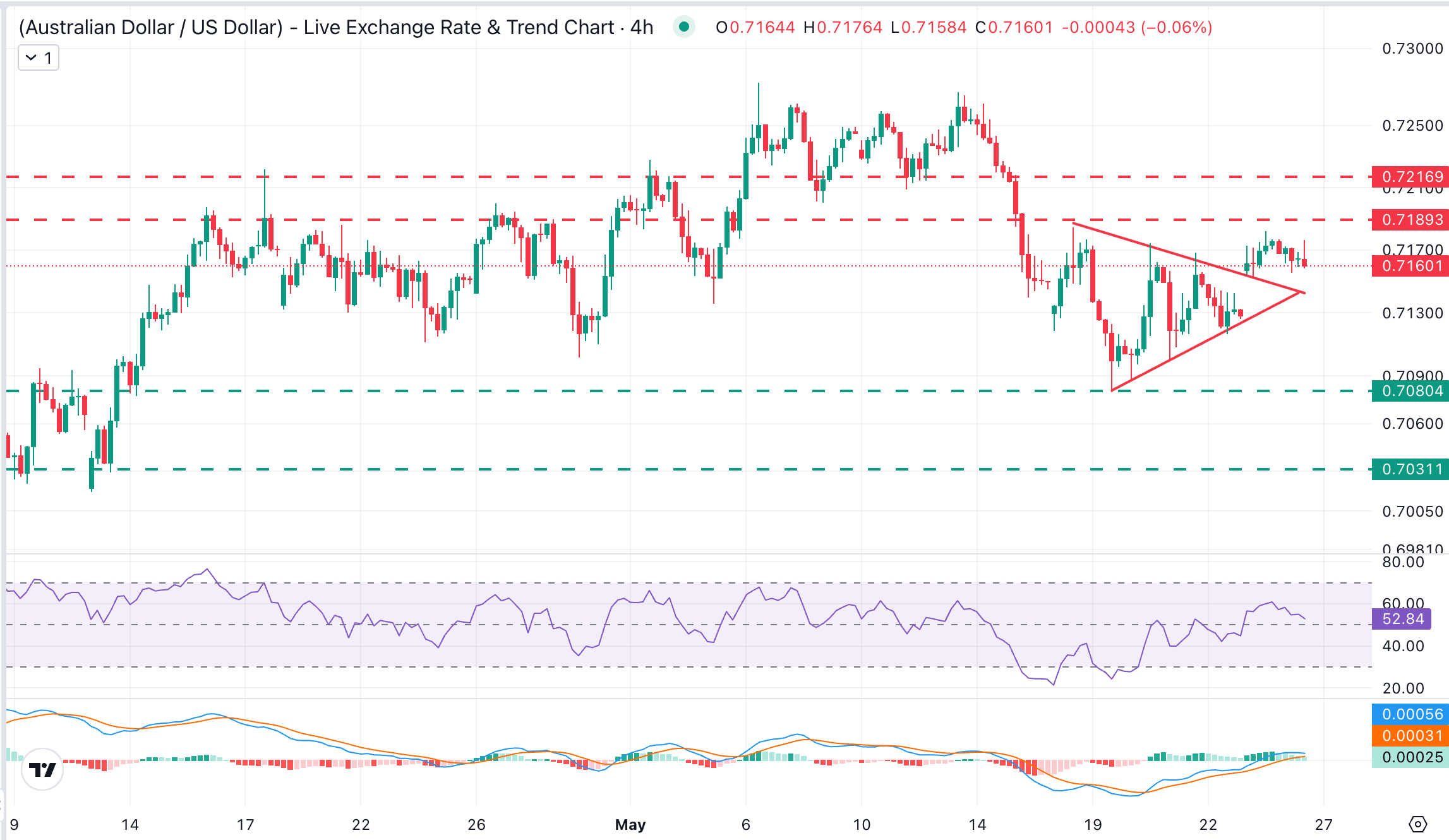
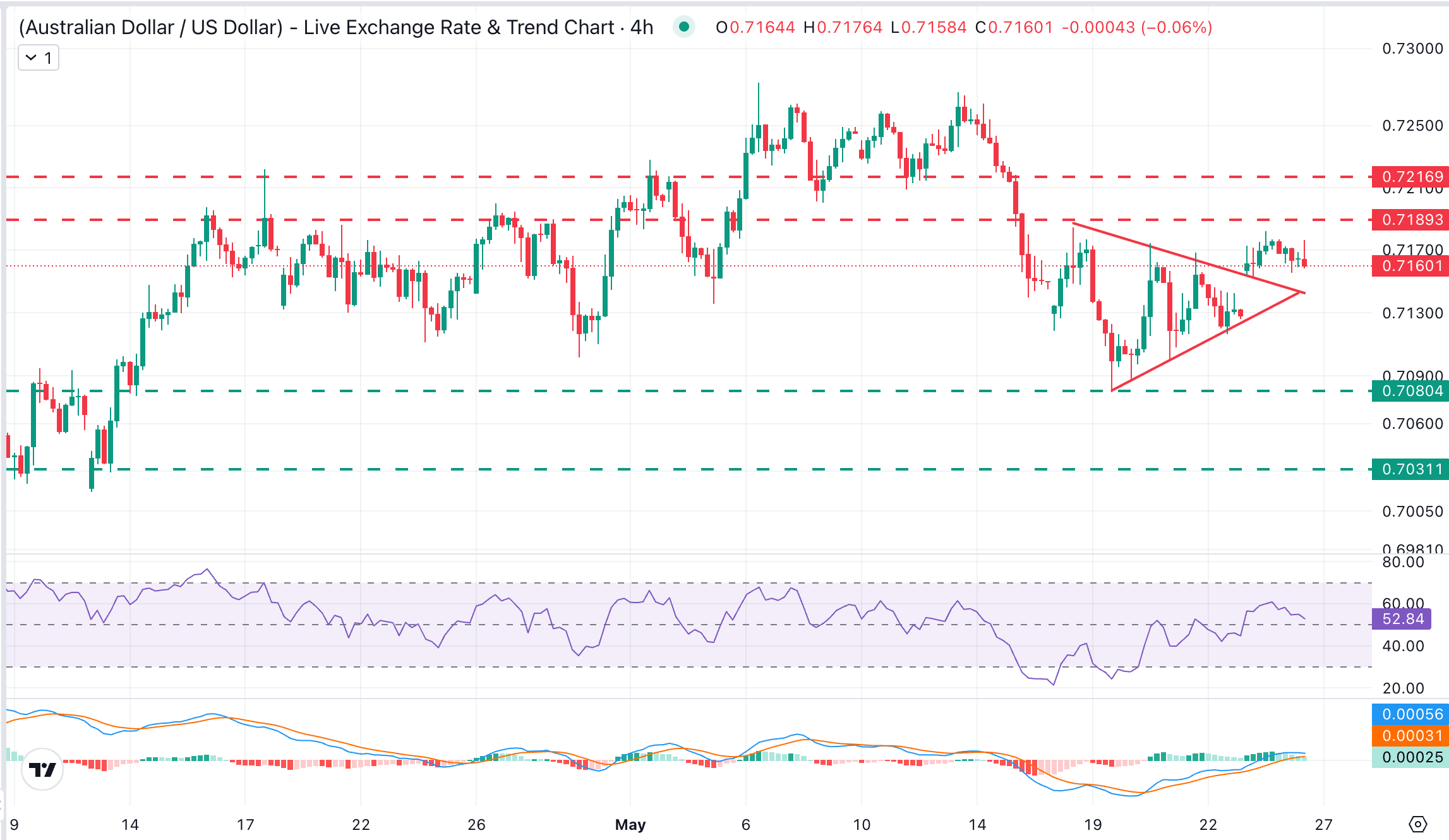
From a technical perspective, the AUD/USD is showing a somewhat stronger stance this week, according to FXStreet Analyst, Guillermo Alcala, although resistance around 0.7190 remains a significant hurdle for bulls: “The pair has broken above the triangle pattern observed last week, but bulls seem to be losing momentum after failing to breach resistance at the 0.7190 area.”
On the downside, Alcala sees key support at 0.7080: “Downside attempts are likely to find support at a reverse trendline, now in the area of 0.7145. Further down, a break of May’s 19 low at 0.7080 would signal the negation of the bullish view and expose the April 13 low, near 0.7030.”
Economic Indicator
Trimmed Mean CPI (MoM)
The Trimmed Mean Consumer Price Index (CPI), released by theAustralian Bureau of Statistics on a monthly basis, is a measure of underlying inflation. The Trimmed mean is calculated using a weighted average of percentage change from the middle 70% of the distribution of all CPI components in order to smooth the data from the more-volatile items. The MoM reading compares prices in the reference month to the previous month. Generally, a high reading is seen as bullish for the Australian Dollar (AUD), while a low reading is seen as bearish.
Economic Indicator
Trimmed Mean CPI (YoY)
The Trimmed Mean Consumer Price Index (CPI), released by the Australian Bureau of Statistics on a monthly basis, is a measure of underlying inflation. The Trimmed mean is calculated using a weighted average of percentage change from the middle 70% of the distribution of all CPI components in order to smooth the data from the more-volatile items. The YoY reading compares prices in the reference month to the same month a year earlier. Generally, a high reading is seen as bullish for the Australian Dollar (AUD), while a low reading is seen as bearish.
Nespresso Vertuo, Barista Flavored Pack, Medium Roast, 30-Count Coffee Pods | Medium-Roast Coffee Capsules, Caramel, roasted hazelnut and sweet vanilla flavors
$42.00 (as of October 11, 2026 03:09 GMT +00:00 - More infoProduct prices and availability are accurate as of the date/time indicated and are subject to change. Any price and availability information displayed on [relevant Amazon Site(s), as applicable] at the time of purchase will apply to the purchase of this product.)
Smart Bark Collar for Large Medium Small Dogs, Rechargeable No-Bark Collar, Stop Barking Collar, 2026 Upgraded Dog Bark Collar with 3 Modes, 7 Sensitivity, Bright Orange
$25.99 (as of October 11, 2026 03:20 GMT +00:00 - More infoProduct prices and availability are accurate as of the date/time indicated and are subject to change. Any price and availability information displayed on [relevant Amazon Site(s), as applicable] at the time of purchase will apply to the purchase of this product.)
Dog Dental Wipes for Teeth Cleaning, Finger Toothbrush Wipes for Dogs Cats,Dog Teeth Cleaning Wipes Reduce Bad Breath & Plaque Tartar, No-Rinse Daily Oral Care,Dog Toothbrush & Toothpaste Alternatives
$15.96 (as of October 11, 2026 03:20 GMT +00:00 - More infoProduct prices and availability are accurate as of the date/time indicated and are subject to change. Any price and availability information displayed on [relevant Amazon Site(s), as applicable] at the time of purchase will apply to the purchase of this product.)
Dog Allergy Relief Chews 170 Count Anti Itch Skin & Immune Support for Dogs | Itch Relief, Omega 3 Fish Oil, Probiotics, Hot Spots & Allergies, Paw Licking, Dry Skin & Coat Supplement, Beef Liver Flavor
$19.99 (as of October 11, 2026 03:20 GMT +00:00 - More infoProduct prices and availability are accurate as of the date/time indicated and are subject to change. Any price and availability information displayed on [relevant Amazon Site(s), as applicable] at the time of purchase will apply to the purchase of this product.)












Post Comment