
Bank of Japan’s Bold Move: Why Holding Rates at 0.75% Could Ignite a Surprising Inflation Surge – Are Investors Ready?
Ever wonder why some central banks seem to hit the “pause” button just when the world is swirling with uncertainties? Well, the Bank of Japan (BoJ) just did exactly that — holding steady on their short-term interest rate at 0.75%. No surprise, right? Markets were practically holding their breath for this move after a two-day deep dive into monetary policy. But here’s the kicker: not everyone on the BoJ board saw eye to eye. Three members pushed for a rate hike to 1.0%, citing rising price risks and economic developments that are painting a rather uncertain picture, especially with the ongoing Middle East tensions and their impact on oil prices. It’s like the BoJ is walking a tightrope — trying to keep inflation in check without tipping the economy over. The outlook? Growth might slow down in 2026, corporate profits and household incomes are feeling the squeeze, yet government support aims to cushion the blow. So where do we go from here? Will the BoJ stick to its guns on steady rates, or is a rate hike lurking just around the corner? Hang tight, because this saga is far from over. LEARN MORE
The Bank of Japan (BoJ) board members decided to leave the short-term interest rate unadjusted at 0.75%, following the conclusion of its two-day monetary policy review meeting on Tuesday.
The decision aligned with the market expectations.
Summary of the BoJ’s Monetary Policy Statement
BoJ makes policy decision by 6-3 vote.
BoJ board members Nakagawa, Takata and Tamura dissented to rate decision.
Nakagawa, Takata and Tamura proposed raising short-term interest rate target to 1.0% from 0.75%.
Proposal by Nakagawa, Takata and Tamura turned down by majority vote.
BoJ’s Nakagawa said while situation in Middle East remained unclear, given economic developments, risks to prices were skewed to the upside under accommodative financial conditions.
BoJ’s Takata said price stability target had been more or less achieved and that risks to prices in Japan were already skewed to the upside due to the second-round effects of price rises stemming from overseas developments.
Will continue to raise interest rates in accordance with developments in economy, prices, financial markets.
Will scrutinise timing, pace of policy adjustment with close eye on economic, price impact from Middle East development.
Will conduct monetary policy as appropriate from perspective of sustainably, stably achieving 2% inflation target.
Japan’s economic growth likely to decelerate in fiscal 2026.
Corporate profits, households’ real income to be pushed down by factors such as deterioration in terms of trade reflecting rise in crude oil prices.
Economy to be underpinned by government’s various measures such as fuel oil subsidies, other factors.
BoJ’s quarterly Outlook Report
Real interest rates are at significantly low levels.
Underlying inflation likely to be at level generally consistent with 2% target in second half of fiscal 2026 and fiscal 2027.
Risks to economic outlook skewed to downside.
Risks to inflation skewed to upside.
Japan’s economic growth is likely to decelerate in fiscal 2026.
The rise in crude oil prices reflecting the impact of the situation in the Middle East is expected to push down corporate profits and households’ real income.
Economy is expected to continue growing moderately, albeit at a decelerated rate.
Japan’s economic growth rate is likely to rise moderately from fiscal 2027 onward, since it is projected that the adverse effects of high crude oil prices will wane.
Projected year-on-year rate of increase in the CPI for fiscal 2026 is significantly higher, reflecting the rise in crude oil prices.
There are various risks to the outlook.
Necessary to pay particular attention to the impact of the future course of the situation in the Middle East on financial and FX markets.
Necessary to pay due attention to keep the risk of inflation significantly deviating upward from materializing.
Possible that the rise in crude oil prices is passed on to the price of various goods and services more easily than before.
Board’s core CPI fiscal 2026 median forecast at +2.8% vs +1.9% in January.
Board’s core CPI fiscal 2027 median forecast at +2.3% vs +2.0% in January.
Board’s core CPI fiscal 2028 median forecast at +2.0%.
Board’s real GDP fiscal 2026 median forecast at +0.5% vs +1.0% in January.
Board’s real GDP fiscal 2027 median forecast at +0.7% vs +0.8% in January.
Board’s real GDP fiscal 2028 median forecast at +0.8%.
BoJ Report on Risks
Possible that the rise in crude oil prices is passed on to the price of various goods and services more easily than before.
Attention will also need to be paid to the possibility that food prices could rise by more than expected through higher market prices for raw materials.
There is risk that large-scale disruptions in supply chains will occur, exerting a significant impact on the production activity of Japanese firms.
Regarding AI, strong business fixed investment could push up the global economy, but if profits do not expand in line with such investment, adjustment pressure could arise, accompanied by changes in asset prices.
Exchange rate developments are, compared to the past, more likely to affect prices.
Trade policies announced so far have partly led to a change in the trend of globalization.
Medium- to long-term inflation expectations have risen moderately.
Market reaction to the BoJ policy announcements
USD/JPY meets fresh supply and eases back toward 159.00 in an immediate reaction to the Bank of Japan’s (BoJ) no-rate-change decision, still down 0.08% on the day.
Japanese Yen Price Today
The table below shows the percentage change of Japanese Yen (JPY) against listed major currencies today. Japanese Yen was the strongest against the New Zealand Dollar.
| USD | EUR | GBP | JPY | CAD | AUD | NZD | CHF | |
|---|---|---|---|---|---|---|---|---|
| USD | 0.06% | 0.04% | -0.08% | 0.06% | 0.08% | 0.16% | 0.12% | |
| EUR | -0.06% | -0.04% | -0.19% | -0.02% | -0.01% | 0.04% | 0.06% | |
| GBP | -0.04% | 0.04% | -0.13% | 0.00% | 0.04% | 0.10% | 0.09% | |
| JPY | 0.08% | 0.19% | 0.13% | 0.18% | 0.19% | 0.24% | 0.22% | |
| CAD | -0.06% | 0.02% | 0.00% | -0.18% | 0.01% | 0.06% | 0.06% | |
| AUD | -0.08% | 0.01% | -0.04% | -0.19% | -0.01% | 0.07% | 0.08% | |
| NZD | -0.16% | -0.04% | -0.10% | -0.24% | -0.06% | -0.07% | -0.01% | |
| CHF | -0.12% | -0.06% | -0.09% | -0.22% | -0.06% | -0.08% | 0.01% |
The heat map shows percentage changes of major currencies against each other. The base currency is picked from the left column, while the quote currency is picked from the top row. For example, if you pick the Japanese Yen from the left column and move along the horizontal line to the US Dollar, the percentage change displayed in the box will represent JPY (base)/USD (quote).
This section below was published on April 27 at 23:00 GMT as a preview of the Bank of Japan Interest Rate Decision.
- The Bank of Japan is expected to keep rates on hold, but a hike is not off the table.
- Uncertainty spurring from the Middle East war will take its toll on the decision.
- Macro fundamentals back the case for additional rate hikes in Japan.
The Bank of Japan (BoJ) will announce its monetary policy decision on Tuesday, at around 3:00 GMT. The BoJ is widely expected to deliver a hawkish hold, keeping the benchmark interest rate unchanged at 0.75% while also hinting at a willingness to hike rates. The latest change in interest rates took place in December, when BoJ officials hiked by 25 basis points (bps)
Japanese policymakers are between a rock and a hard place: The Middle East war is a global source of uncertainty, while the local macro puts pressure on policymakers to act promptly.
Hotter-than-expected inflation and a tightening labor market hint at faster interest rate hikes, which run counter to the BoJ officials’ views.
In the meantime, the Middle East war continues. Hopes for a quick resolution fade as time goes by, with the war about to turn two months old.
What to expect from the BoJ interest rate decision?
According to the latest available data, the Consumer Price Index (CPI) rose 1.5% YoY in March, up from 1.3% in February and above the 1.4% anticipated by market players. Core annual inflation, which excludes volatile food and energy prices, rose to 1.8%, up from the expected 1.5%. Meanwhile, the Unemployment Rate stood at 2.6% in February.
If the BoJ could base monetary policy solely on these data, policymakers should pull the trigger in this meeting. However, the ongoing crisis in the Middle East paints a different picture. Rising Oil prices and persistent supply disruptions are expected to have a profound and prolonged impact on inflation worldwide. Japan is no exception. That opens the door for a surprise interest rate hike, although we are talking about Japan, and surprises are not usually in their script.
Policymakers are well aware of the situation. In a press conference in Washington following the 20-G meeting, BoJ Governor Kazuo Ueda noted that higher Oil prices “pose both upside risks to prices and downside risks to the economy, making policy responses difficult.”
Ueda added: “Developments in the Middle East will be a crucial factor (for the BoJ’s policy decision), but the outlook remains quite uncertain.” Finally, he repeated the central bank’s commitment to price stability: “We will take the most appropriate response to achieve our 2% price target in a sustainable and stable way.”
Governor Ueda will offer a press conference following the rate announcement, as usual. And while market participants anticipate a hawkish lean, the focus will be on how hawkish Japanese policymakers are willing to be in such an uncertain environment.
How could the Bank of Japan’s monetary policy decision affect USD/JPY?
Heading into the announcement, market participants expect the BoJ to hold its fire but deliver at least 50 bps rate hikes through 2026. The monetary policy Board is likely to keep rates on hold in its April meeting, not because it is the right decision, but to prevent a market shock. Policymakers are likely to anticipate additional rates coming, which will not be a big surprise.
There are two quite hawkish scenarios. The first would be the BoJ actually triggering a rate hike. The second would be to directly pre-announce a rate hike at the next monetary policy meeting. Furthermore, if officials hint at worries about growth, something that so far they have avoided, the case for additional rate hikes will increase, and hence, boost demand for the Japanese Yen (JPY). The odds for any of those happening are quite limited.
A dovish announcement is off the table, given the ongoing Middle East war.
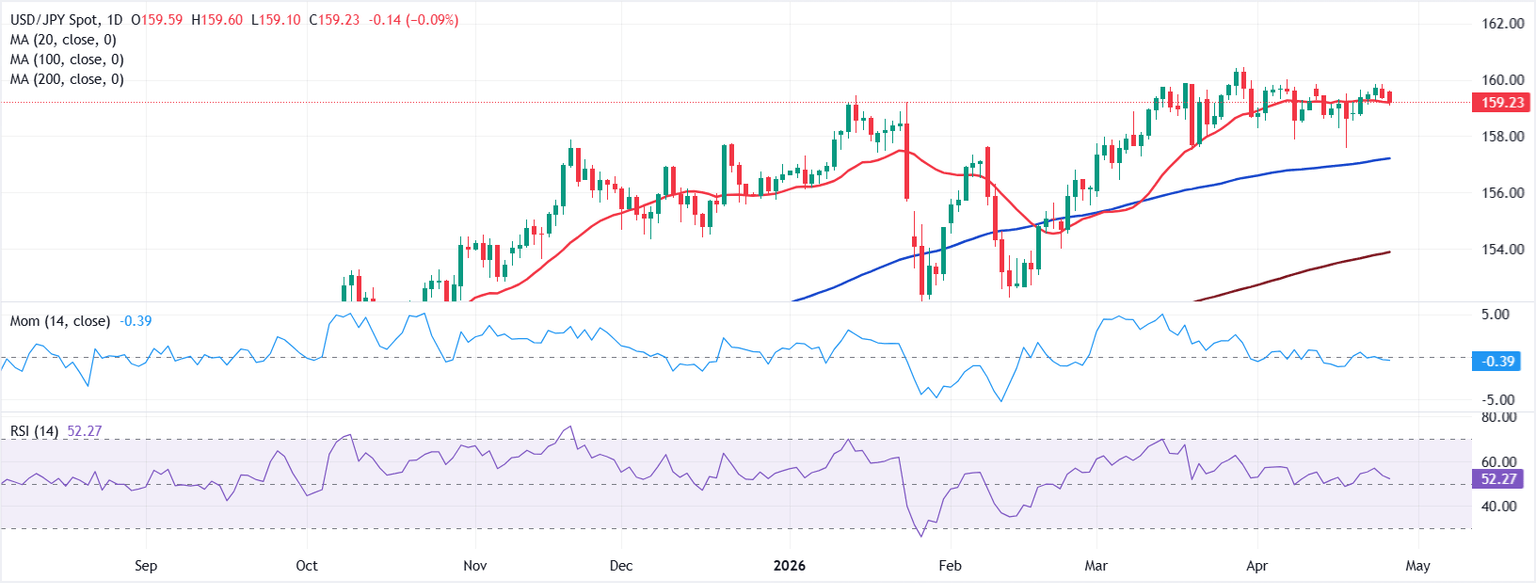
Valeria Bednarik, Chief Analyst at FXStreet, notes: “The USD/JPY pair trades in quite a limited range just below 160.00 since early April, driven by sentiment related to the Persian Gulf crisis. Speculative interest is looking at the US Dollar (USD) as the preferred safe-haven, with optimism boosting demand for the Greenback, and pessimism leading to USD sell-offs. The BoJ announcement, unless a surprise, is likely to have a limited impact on the pair.”

Bednarik adds: “From a technical point of view, the USD/JPY pair is neutral. In the daily chart, the pair develops around a flat 20-day Simple Moving Average (SMA), which has been unable to find a way since early April. The 100- and 200-day SMAs keep heading higher, far below the current level, in line with the former dominant bullish trend. At the same time, the pair develops not far below its 2026 peak in the 160.40 region. Finally, technical indicators head marginally lower within neutral levels, far from providing a clear directional clue. The pair could fall with a hawkish announcement, with a break below 159.00 opening the door for a test of the 158.40 region. Below the latter, the slide could continue towards 157.90. As previously noted, 160.00 provides resistance in the case of sudden JPY weakness, with additional gains aiming to retest the year high.”
Central banks FAQs
Central Banks have a key mandate which is making sure that there is price stability in a country or region. Economies are constantly facing inflation or deflation when prices for certain goods and services are fluctuating. Constant rising prices for the same goods means inflation, constant lowered prices for the same goods means deflation. It is the task of the central bank to keep the demand in line by tweaking its policy rate. For the biggest central banks like the US Federal Reserve (Fed), the European Central Bank (ECB) or the Bank of England (BoE), the mandate is to keep inflation close to 2%.
A central bank has one important tool at its disposal to get inflation higher or lower, and that is by tweaking its benchmark policy rate, commonly known as interest rate. On pre-communicated moments, the central bank will issue a statement with its policy rate and provide additional reasoning on why it is either remaining or changing (cutting or hiking) it. Local banks will adjust their savings and lending rates accordingly, which in turn will make it either harder or easier for people to earn on their savings or for companies to take out loans and make investments in their businesses. When the central bank hikes interest rates substantially, this is called monetary tightening. When it is cutting its benchmark rate, it is called monetary easing.
A central bank is often politically independent. Members of the central bank policy board are passing through a series of panels and hearings before being appointed to a policy board seat. Each member in that board often has a certain conviction on how the central bank should control inflation and the subsequent monetary policy. Members that want a very loose monetary policy, with low rates and cheap lending, to boost the economy substantially while being content to see inflation slightly above 2%, are called ‘doves’. Members that rather want to see higher rates to reward savings and want to keep a lit on inflation at all time are called ‘hawks’ and will not rest until inflation is at or just below 2%.
Normally, there is a chairman or president who leads each meeting, needs to create a consensus between the hawks or doves and has his or her final say when it would come down to a vote split to avoid a 50-50 tie on whether the current policy should be adjusted. The chairman will deliver speeches which often can be followed live, where the current monetary stance and outlook is being communicated. A central bank will try to push forward its monetary policy without triggering violent swings in rates, equities, or its currency. All members of the central bank will channel their stance toward the markets in advance of a policy meeting event. A few days before a policy meeting takes place until the new policy has been communicated, members are forbidden to talk publicly. This is called the blackout period.

AIPERRO Stainless Steel Litter Box with Lid | XL Metal Enclosed Cat Litter Boxes with High Sided for Big Cats | Anti-Urine Leakage, Non-Stick Boxes with Litter Scoop (Light Gray)
$37.59 (as of October 8, 2026 03:20 GMT +00:00 - More infoProduct prices and availability are accurate as of the date/time indicated and are subject to change. Any price and availability information displayed on [relevant Amazon Site(s), as applicable] at the time of purchase will apply to the purchase of this product.)
blink plus plan with monthly auto-renewal
$11.99 (as of October 8, 2026 03:20 GMT +00:00 - More infoProduct prices and availability are accurate as of the date/time indicated and are subject to change. Any price and availability information displayed on [relevant Amazon Site(s), as applicable] at the time of purchase will apply to the purchase of this product.)
Ridge Tracker Card Compatible with Apple Find My, Compatible with Android Slim Tracking Card - Wallet Finder, Item Locator for Luggage Tags, Passports, Phone - MFi Certified, IP68 Water Resistance
$32.99 (as of October 8, 2026 03:28 GMT +00:00 - More infoProduct prices and availability are accurate as of the date/time indicated and are subject to change. Any price and availability information displayed on [relevant Amazon Site(s), as applicable] at the time of purchase will apply to the purchase of this product.)
CELSIUS On The Go Strawberry Mango, Sugar Free Energy Drink Mix (14 Sticks per Pack)
$6.99 (as of October 8, 2026 03:07 GMT +00:00 - More infoProduct prices and availability are accurate as of the date/time indicated and are subject to change. Any price and availability information displayed on [relevant Amazon Site(s), as applicable] at the time of purchase will apply to the purchase of this product.)













Post Comment