
How This Painter Channels the Rebel Spirit of Antigone to Create Art That Defies Hate and Ignites Love
Curiosity—it’s like fuel for the fire in Alexandra Grant’s artistic engine. Ever wonder what happens when you mix relentless inquiry with explosive color and a dash of ancient Greek mythology? Well, Grant’s journey is exactly that combustible blend. From a school report card that cheekily claimed she “could learn in a dustbin,” to becoming a powerhouse painter who’s spent over a decade wrestling with the defiant spirit of Antigone, her work is a testament to transformation and defiance. But here’s the kicker: after years of channeling Antigone’s mantra—“I was born to love, not to hate”—Grant is stepping into a new chapter, one that’s less about readable words and more about feeling volcanic energy pulse from the canvas. It’s like watching a fireworks show where the smoke lingers long after the bang, asking us all—what if this mantra really works? Ready to dive into this vibrant saga of art, activism, and personal evolution? LEARN MORE
 4 min read
Alexandra Grant is relentlessly curious. It’s a quality that has followed the artist throughout her life. Once, one of her grade school teachers wrote on her report card: “Alexandra could learn in a dustbin,” she recalls over a video call from her Berlin studio.
The same inquisitive drive shapes how Grant, 53, works today. A voracious researcher, she often gravitates towards writers when thinking about painting (her mother thought she would be a writer). “What I love about being an artist,” she says, “is getting to follow a curiosity, follow a line of thought, and pursue it all the way to the end.”
One particular line of inquiry has occupied her mind for over 10 years. In 2014, after the police killing of Michael Brown, Grant (admittedly, “like many artists,” she says) turned to Antigone, a Greek myth associated with mourning and defiance. What started as a response to violence blossomed into her “Antigone 3000” series, a body of work exploring memory and resistance through volatile abstract paintings. These works—mixing abstract painting, collage, silkscreen, and text-based art—gradually morphed into giant, explosive canvases packed with clashing patterns and bright colors.
Over a decade later, Grant has reached the end of this arc and is saying goodbye to Antigone in a new show titled “Anakainōsis,” which means renewal in Greek. She chose the word for its personal implication—her decision to move forward in her painting career—but also how the myth reverberates across millennia. “Why is it that Antigone has lasted and been in the imagination of artists in every generation for 2000 years?” she says. “Ultimately, [Anakainōsis] is about transmutation, transformation, but it’s the transmutation and transformation that lasts.”

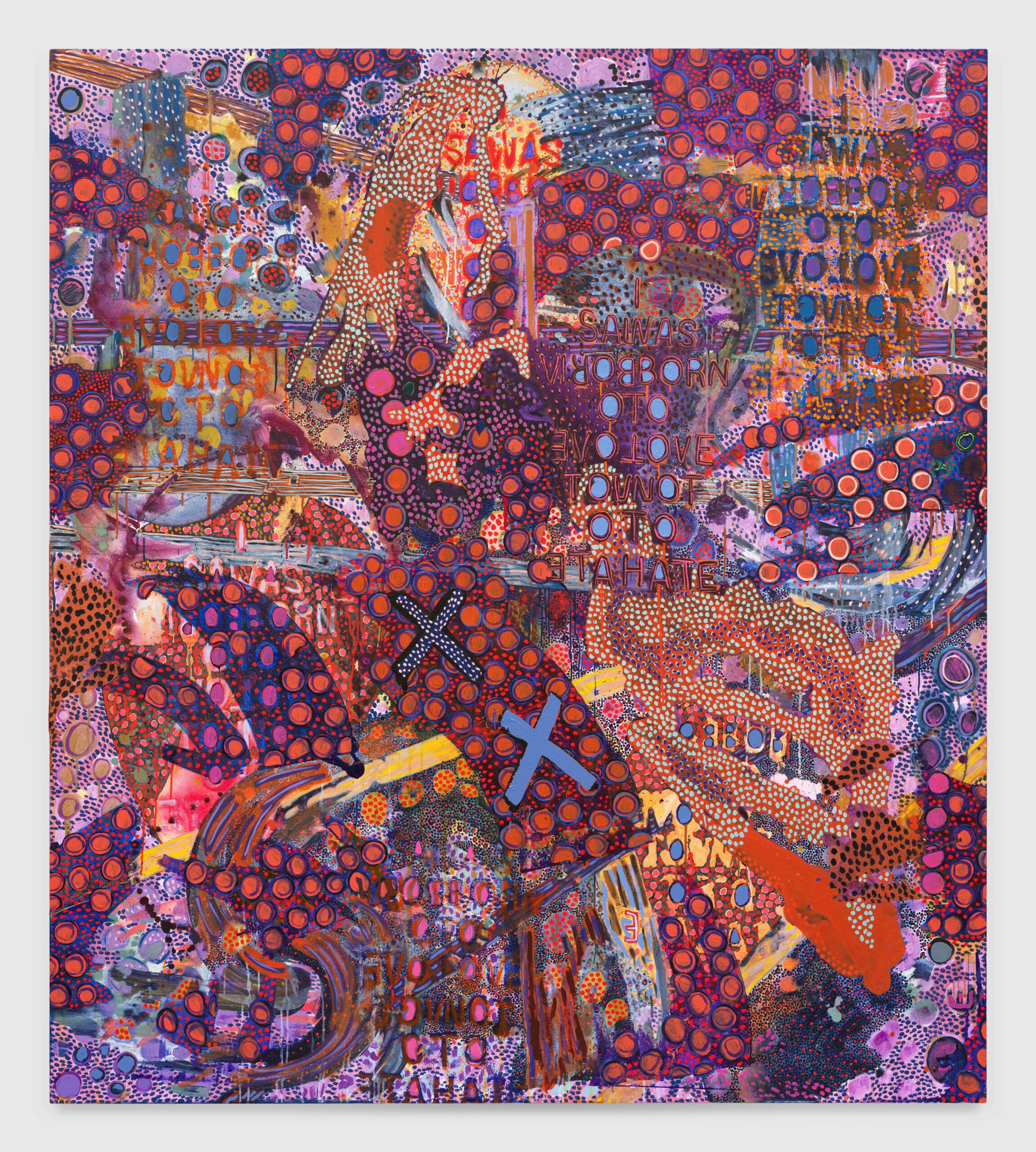
Volcania (2026)

Motherhood (2026)
Grant’s “Antigone” paintings obsess over one excerpt from Sophocles’ play: “I was born to love, not to hate.” The titular Greek heroine shouts these words at the tyrannical Greek king when he refuses to bury her brother; a defiant stance against the king’s state-imposed hatred. You don’t have to wonder long about how Grant landed on this mantra. She first alluded to this scene as the country entered a period of volatile political upheaval, framed by near-constant collective mourning (exacerbated by Trump’s rise in the mid-2010s). But over time, the phrase morphed into her personal mantra as she confronted “curiosity online” about herself, as she calls it (brought on by her career and, likely, although she did not mention it directly, her more public relationship with Keanu Reeves). The incantation sustained her creative process for 12 years. “The idea of overcoming challenges is very much in the work,” she says. “I needed the paintings. I needed to work through what I was living through, through the paintings.”
Grant wielded the phrase in every iteration of the “Antigone” paintings. In 2019, the phrase appeared on amorphous wooden canvases, and by 2022, within hyperactive, increasingly baroque paintings. She dove into more abstract territory, yet the words (though often backward) remained visibly silkscreened atop a hurricane of colors made by gestural brushstrokes (or squeegee marks). The new works, however, push further into abstraction. Here, Grant has embraced illegibility, instead exploring a more emotional “language of painting,” she calls it. In Volcania (2026)—a bright frenzy of orange, red, pink, and yellow paint—the words are nearly all obscured. This work certainly represents how Grant felt when she finished the last series. “It was like going to a fireworks display—it’s over, there’s the umbra of the smoke, and I was a bit breathless,” she says. Grant is channeling the raw power of Antigone’s incantation, where the words themselves don’t seem all that necessary.

Two paintings on view in “Anakainōsis” at Albertz Benda
“This body of work is the letting go of the control of the writing—you can’t read the words,” she says. “When you see them in person, you just feel this volcanic energy, like firecrackers, like explosive, like a natural violence, if that’s possible, a fire. Just like the transmutation, the transformation state that comes after this question is: what if the mantra works?”
Words have always played a tangible part in Grant’s art practice. She started her career in sculpture, translating poems into mobiles, including one hanging beside her in her Berlin studio; a process that she says is essentially “drawing without paper.” From there, she gradually moved to actually drawing on paper work before painting, never letting go of the text-based element of her work. A similar evolution is mirrored in her “Antigone” series.
“The earliest ‘Antigone’ work started out as a sculpture I had made in plaster, and then, [I asked myself] ‘what if I did a rubbing on paper of the text and then drew around it, with the lines being the rule of law and the messiness of life,” she says. “[Then I asked,] what if I took a photo of the rubbing and then learned how to silkscreen. That was a radical shift that took place in 2019—five years in….What that allowed me to do was shift on the canvas and then figure out how to layer the silkscreen on top of and underneath the whole painting.”

Portrait of Alexandra Grant
Grant cherished Antigone and her words as she broke into the public spotlight and as her career underwent a meteoric rise and the world around her experienced seismic shifts. But now, after a few false endings, Grant is confident she’s ready to move on, with the latest paintings representing a bittersweet “graduation from one state to another.”
“For a period of time, Antigone was a heroine for me, and I have interpreted her through this incredible journey, and now, I’m going to go on to another stage of my own life,” she says. “I’m really thrilled that for that period of time, Antigone’s mantra became mine. I did my absolute best to embody her.”
“Anakainōsis” at Albert Benda in New York City will be on view from May 21 to July 3
Naturesweet, Tomato Cherry Cherub Conventional, 10 Ounce | Sweet, Greenhouse Grown Heavenly Snacking Grape (similar to Cherry) Tomatoes, Salads, and Easy Meal Prep for Families
(as of October 11, 2026 03:09 GMT +00:00 - More infoProduct prices and availability are accurate as of the date/time indicated and are subject to change. Any price and availability information displayed on [relevant Amazon Site(s), as applicable] at the time of purchase will apply to the purchase of this product.)
Best Pet Supplies Interactive Squeaky Dog Toy - Crinkle Duck, Yellow | Stuffing Free Body, Soft, Squeaks & Crinkles, No Mess, Perfect for Moderate Chewers, Toss and Fetch Play
$6.79 (as of October 11, 2026 03:11 GMT +00:00 - More infoProduct prices and availability are accurate as of the date/time indicated and are subject to change. Any price and availability information displayed on [relevant Amazon Site(s), as applicable] at the time of purchase will apply to the purchase of this product.)
Benebone Tongue Twister & Peanut Butter Treat Pod Refill 2 Pack, 9 Count | Peanut Butter Flavor, Treat Pod Refills, 9 Count, Puzzle Toy Enrichment, No Prep or Mess, Keeps Dogs Busy
$16.96 (as of October 11, 2026 03:20 GMT +00:00 - More infoProduct prices and availability are accurate as of the date/time indicated and are subject to change. Any price and availability information displayed on [relevant Amazon Site(s), as applicable] at the time of purchase will apply to the purchase of this product.)
Frito-Lay Fun Times Mix Variety Pack, 40 Count
$21.14 (as of October 11, 2026 03:09 GMT +00:00 - More infoProduct prices and availability are accurate as of the date/time indicated and are subject to change. Any price and availability information displayed on [relevant Amazon Site(s), as applicable] at the time of purchase will apply to the purchase of this product.)








Post Comment