
Is House of the Dragon Episode 7 Just Padding the Plot, or Is There a Hidden Power Move Unfolding?
Visions and prophecies — they’re the bread and butter of every epic fantasy tale, right? From the endless quests in The Lord of the Rings to Brandon Sanderson’s grand battles in The Way of Kings, these glimpses of destiny keep us hooked, wondering if fate can be bent or if we’re all just pawns. Now, Game of Thrones did something spectacular here with its terrifying White Walkers — a real looming apocalypse that overshadowed all the power games. But with House of the Dragon, the prequel, it feels like those ominous visions have lost their bite. Sure, they’re plenty, but do they really grip us the way the originals did? Or is it just another “Winter’s coming” that’s lost in the echo? As characters muddle through repetitive angst and questionable negotiations, you gotta ask — are these prophecies stirring the fire or just fanning the flames of our impatience? Let’s dive into why, despite the dragons and drama, the stakes haven’t quite soared this season. LEARN MORE
 5 min read
Visions, prophecies, and fighting against destiny are all staples in the fantasy mythos. You’ll find them in The Lord of the Rings basically everywhere. The Wheel of Time, as a concept, is all about testing one’s fate. Brandon Sanderson’s The Way of Kings features heralds warning our heroes of an eternal battle, and even the Marvel Cinematic Universe made room for Doctor Strange to conjure up millions of future timelines just to find the one scenario in which they defeat their big bad, alien menace.
But among all the fantasy stories about wars between kings, gods, and magical wizards, Game of Thrones captured audiences in such numbers during the HBO TV series’ run because it had one of the best doomsday visions in recent memory. While everyone squabbled over a claim to a fancy chair, a far more threatening and terrifying army of the dead marched to end the world itself. The mysterious White Walkers made “Winter is coming” an even more iconic omen than Heroes’ “Save the cheerleader, save the world.” And though they left us with the flash of a single, controversial knife, the Walkers still gave viewers stakes that House of the Dragon has yet to truly develop.
The prequel series does have visions too. Plenty of them. Most tie directly back to Thrones’s series finale—re-traumatizing viewers and forcing them to remember how such a compelling villain ended in such unceremonious disappointment. What else can they do? They’re tied to the source material just like Bran Stark to that damn tree. But unlike Thrones, the visions of their own series finale that plague House of the Dragon’s characters fail to really hold any weight—regardless of how many bodies stack up when the series ends.

“I saw a gray man,” Helaena says of her last vision. Thanks, that’s very helpful.
In episode 7, Helaena (Phia Saban) has one of the meaningless visions. She dreams of soldiers taking away her son Maelor after giving birth. She sees herself atop her dragon, Dreamfyre, and burning an angry mob storming the castle. Then, she switches to a scene of her and her two children, living out of a cottage somewhere in the fields of Westeros, before snow falls and an eclipse darkens the skies. If any of these omens come to pass in either in season 4 or in the finale next week, I doubt viewers will jump with excitement screaming, “It’s just like what happened in her dreams!”
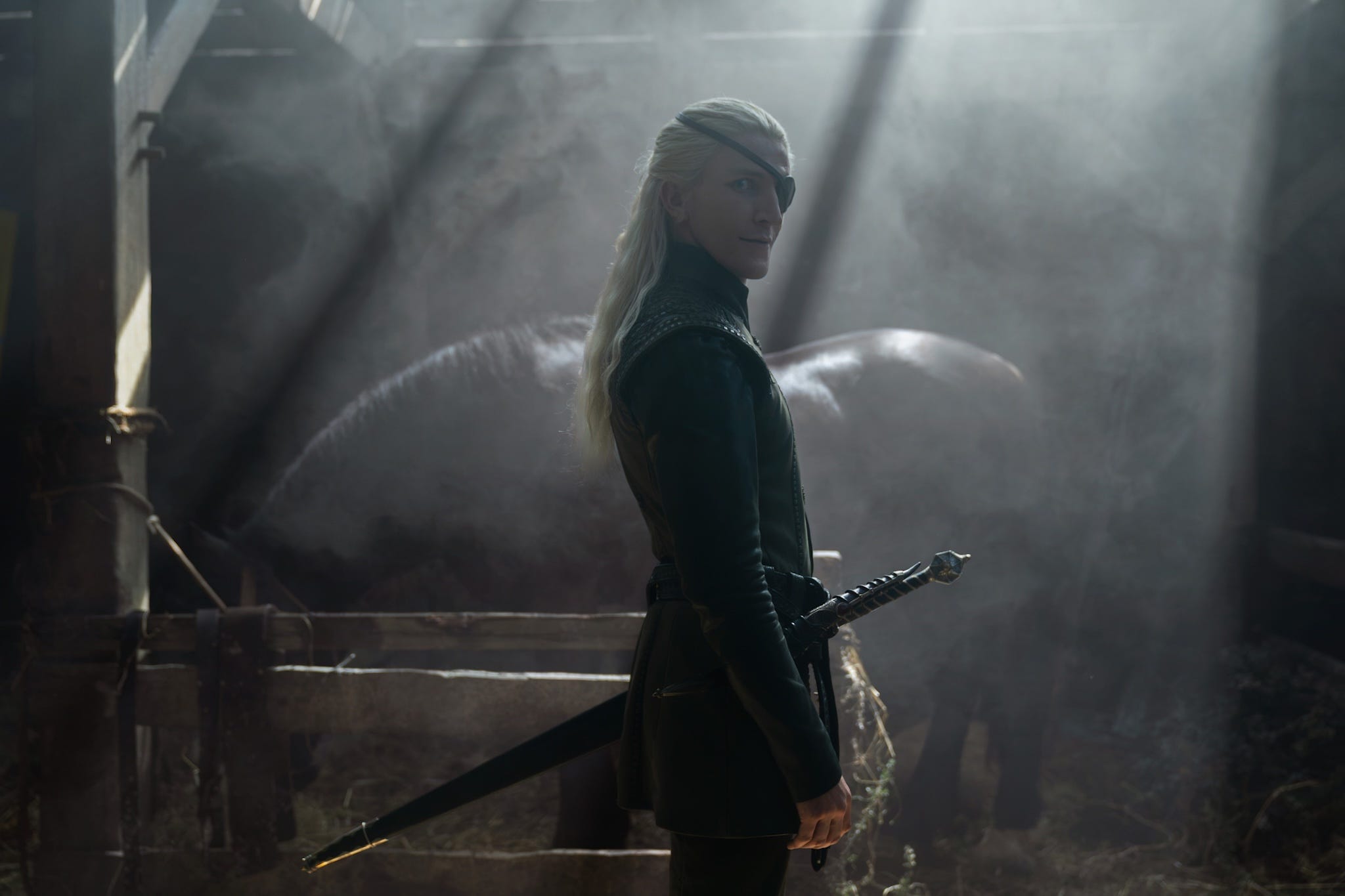
When she wakes, Rhaenyra (Emma D’Arcy) grabs her arms and demands that she reveal the locations of her enemies, as if her visions have GPS tracking like Charles Xavier in the X-Men movies. It doesn’t work like that, my queen. Daemon (Matt Smith) touched a tree outside Harrenhal in the season 2 finale and saw Daenerys. Aemond (Ewan Mitchell), meanwhile, dreams of having sex with his mother (Olivia Cooke).
All that’s for certain in season 3 of the Game of Thrones prequel is that our characters have become uncannily self-aware. They grow tired of their purgatories—spending their scenes rehashing the same conversations in every episode and directly stating that they’re dying for some real action.
“I have long tired of this aimless searching,” Baela (Bethany Antonia) says this week. Her quest to find Aemond has yet to consider Harrenhal for some reason. And back in King’s Landing, Rhaenyra sits at her council begging for answers from deaf ears. “Has there been any word from Lord Corlys? Harrenhal? Daemon?” Well, according to Aemond, he plans to impregnate Alys Rivers (Gayle Rankin) at Harrenhal, where they simply, “need only to bide our time.” Great, more waiting.

Ormund isn’t going to leave this chair until he dies.
It’s the same at Tumbleton, where Ormund Hightower (James Norton) and Daeron (Benjamin Evan Ainsworth) haven’t left the confines of this merchant town’s dining hall for the entire season so far. “Am I to sit by, impotent?” Daeron asks his uncle Gwayne (Freddie Fox) this week. “Rhaenyra may keep her crown, for all I care.”
On the road, the former King Aegon II (Tom Glynn-Carney) asks his companions how much further they have left before they finally reach the port they’ve been traveling to all season. Two more days, says Larys (Matthew Needham). So, Aegon resolves to face his death fighting an approaching enemy’s army instead. He won’t allow the history books to write that he died a fugitive. Ser Criston Cole (Fabien Frankel) also charged into a suicide mission last episode just to end all the idling, and still no one in the story’s even bothered to comment on his death other than Ormund—a man he’s never met.
Here’s another bit from Ormund this episode that doesn’t make much sense. He captures Corlys (Steve Toussaint) and offers the most prominent Black character on the series an alliance even though he refers to an entire people as “savages.” Ormund even dredges up the memory of Corlys’s dead wife and mentions that she was “of their blood” when referring to his disgust with the Targaryens.
I fail to see Ormund’s strengths as a negotiator here—especially after he cuts off one of Corlys’s fingers and delivers it to his son, Alyn (Abubakar Salim). Ormund’s only able to turn possibly the dumbest character on the entire show, Ulf (Tom Bennett). I love the guy, but he’s a drunken idiot. Plus, the spurned dragonrider was struck a few too many times in public by Daemon, which would turn any soldier into a traitor. So, Ormund promises him Corlys’s seat in Driftmark should he turn cloak. “They will laugh at you no more,” Ormund tells him. Ulf responds, “No, they will burn.”

This dragon is still alive somehow.
Any remaining budget from the awe-worthy Battle of the Gullet this season (and whatever else is planned for the finale) went to this week’s CGI fest of a dragon skirmish. Rhaena’s (Phoebe Campbell) purgatory of eating raw meat in a cave with Sheepstealer has finally come to an end. “I cannot live the way I have, cut off,” she tells Daemon. Now, out in the open, her identity as the wild dragon’s rider is uncovered. Rhaenyra’s dragon—alongside Daemons’ Ceraxes and Addam’s Silverwing—faces off against Sheepstealer, who proves to be every bit as formidable as his battle-scarred body would attest. Our real-life actors run around off camera in fright as the Prehistoric Planet scene plays out, before all parties involved (dragons included) escape with their lives intact.
Even more dragons join for a cliff-hanger before the finale next week. Sunfyre, despite lying dead outside Rook’s Rest for months, returns alive. He protects Aegon II against Lord Mooton’s men, reappearing with a deformed face to match his master’s.
It’s not the first time that an episode concluded with a Targaryen declaring “dracarys” to burn their enemy alive, and I doubt it’s the last either. But there’s no better indicator of how the second half of House of the Dragon season 3 played out than Sunfyre literally waiting dead in a ditch, undisturbed, until he was finally allowed back into the story right before the finale. I can think of few characters in this series who haven’t symbolically shared the same fate.

Amazon Echo Show 11 (newest model), Vibrant Full-HD 11" display with more viewing area and spatial audio, Designed for Alexa+, Graphite
$149.99 (as of October 8, 2026 03:10 GMT +00:00 - More infoProduct prices and availability are accurate as of the date/time indicated and are subject to change. Any price and availability information displayed on [relevant Amazon Site(s), as applicable] at the time of purchase will apply to the purchase of this product.)
Apple AirPods 5 Wireless Earbuds with Active Noise Cancellation | Bluetooth Headphones, Personalized Spatial Audio, Live Translation, USB-C Charging Case, H2 Chip
$129.00 (as of October 8, 2026 03:20 GMT +00:00 - More infoProduct prices and availability are accurate as of the date/time indicated and are subject to change. Any price and availability information displayed on [relevant Amazon Site(s), as applicable] at the time of purchase will apply to the purchase of this product.)
Ring Wired Doorbell 2K Plus (Newest Model) — Retinal 2K with wide-angle video, 6x Enhanced Zoom, and Night Vision, Nickel Silver
$89.99 (as of October 8, 2026 03:28 GMT +00:00 - More infoProduct prices and availability are accurate as of the date/time indicated and are subject to change. Any price and availability information displayed on [relevant Amazon Site(s), as applicable] at the time of purchase will apply to the purchase of this product.)
Nutramax Proviable Probiotics + Prebiotics, for Dogs & Cats, Capsules, 80ct | Probiotics and Prebiotics for Cats and Dogs, Daily Gut Health Support Supplement, Multiple Strains, Sprinkle on Food
$33.74 (as of October 8, 2026 03:10 GMT +00:00 - More infoProduct prices and availability are accurate as of the date/time indicated and are subject to change. Any price and availability information displayed on [relevant Amazon Site(s), as applicable] at the time of purchase will apply to the purchase of this product.)













Post Comment