
NZD/USD at Breakpoint: Is the Kiwi’s Slide to 0.5683 the Calm Before a Market Storm?
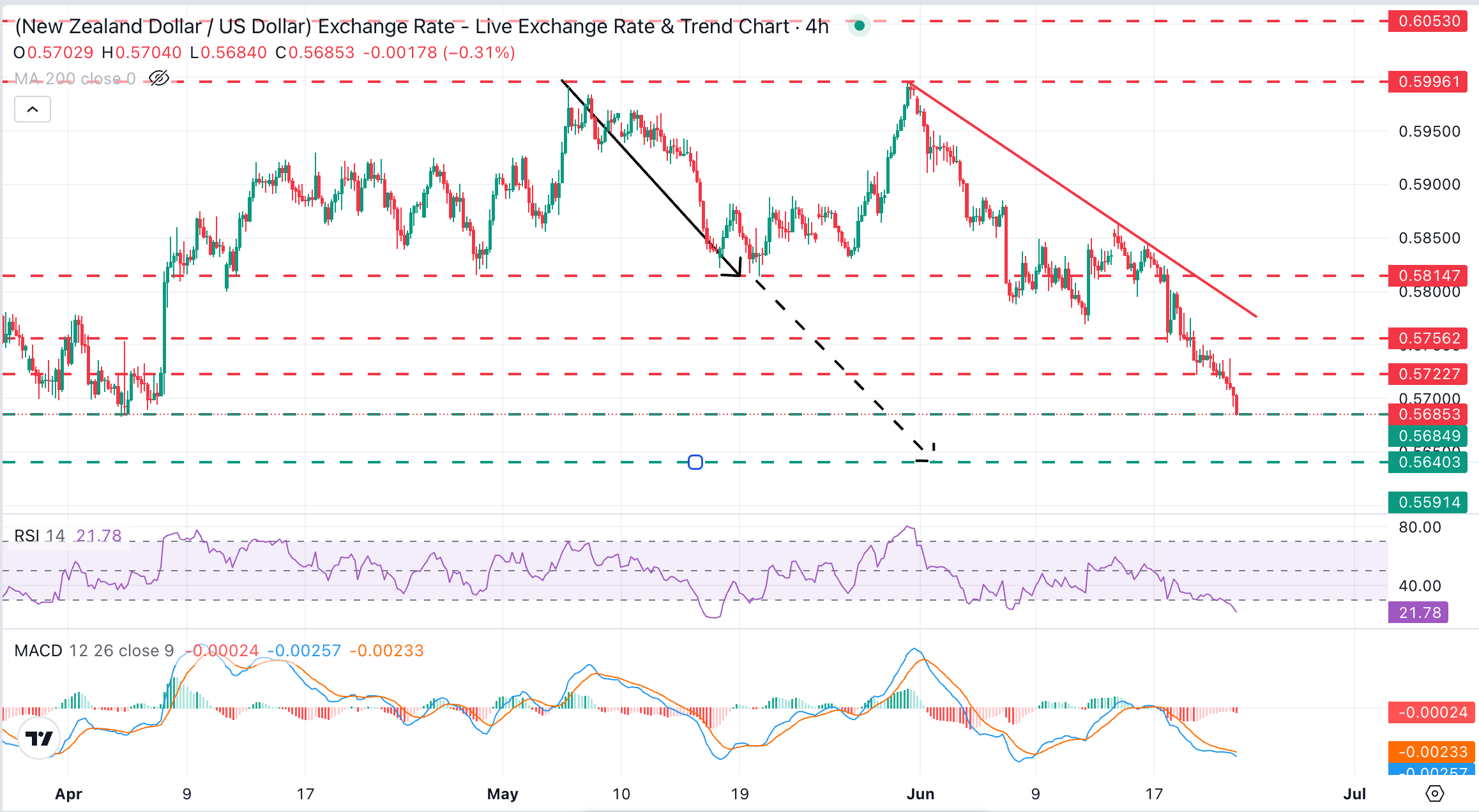
Ever wonder why the New Zealand Dollar just can’t catch a break against the mighty US Dollar? Well, here we are, watching the NZD slide for the fifth day in a row, dipping stubbornly below that 0.5700 mark, and flirting dangerously close to its lowest point this year at 0.5683. It’s like the Kiwi’s caught in a tug-of-war with investor nerves, spooked by shaky progress in the US-Iran peace talks. And just when you think it might stabilize, Iranian negotiators drop the mic by saying the talks are done—no clear plan, no concrete data, and that nagging Strait of Hormuz remains off-limits for now. Now, toss in a US Dollar buoyed by rising Treasury yields and whispers of Fed hikes this year, and you’ve got a recipe for some serious currency drama. So, where’s the NZD headed next—and what does it mean for savvy investors watching these moves like a hawk? Let’s dive into the guts of the market and see what the charts are whispering. LEARN MORE.
The New Zealand Dollar (NZD) extends losses against the US Dollar (USD) for the fifth consecutive day on Tuesday, reaching levels sub-0.5700, and approaching year-to date lows, at 0.5683. The risk-sensitive Kiwi is struggling with markets sceptical about the advances in the US-Iran peace deal.
Iranian negotiators affirmed earlier on Tuesday that the technical talks have concluded, but there is no clear plan or concrete data to reopen the Strait of Hormuz, a critical waterway for approximately 20% of the global Crude Oil supply.
The US Dollar is also drawing support from higher US Treasury yields, as traders brace for Federal Reserve (Fed) rate hikes later in the year. The CME Group’s Fed Watch Tool shows a 70% chance of a hike in September, up from less than 30% a year ago, and is almost fully pricing at least a quarter-point hike before the end of the year.
Technical Analysis: Below 0.5683, the target is the 0.5640 area
NZD/USD trades at 0.5685, extending a bearish tone after breaching the psychological 0.5700 level. Momentum indicators in 4-hour charts endorse the bearish view. The Moving Average Convergence Divergence (MACD) is slightly negative, while the Relative Strength Index (14) has reached oversold conditions, highlighting a stretched cycle, yet with no convincing sign of a reversal on sight.
Initial support is at the mentioned April low, at 0.5680, although bears might be tempted to push the pair all the way to the measured target of May’s Double Top pattern, at the 0.8640 area.
On the upside, previous support levels near 0.5725 (June 19 low) and 0.5755 (June 17 low) are likely to test bulls ahead of the descending trendline, now at the 0.5780 area.
(The technical analysis of this story was written with the help of an AI tool.)
New Zealand Dollar Price Today
The table below shows the percentage change of New Zealand Dollar (NZD) against listed major currencies today. New Zealand Dollar was the strongest against the Australian Dollar.
| USD | EUR | GBP | JPY | CAD | AUD | NZD | CHF | |
|---|---|---|---|---|---|---|---|---|
| USD | 0.05% | 0.15% | 0.06% | 0.19% | 0.74% | 0.48% | 0.06% | |
| EUR | -0.05% | 0.09% | 0.00% | 0.12% | 0.67% | 0.42% | -0.02% | |
| GBP | -0.15% | -0.09% | -0.06% | 0.05% | 0.59% | 0.33% | -0.10% | |
| JPY | -0.06% | 0.00% | 0.06% | 0.13% | 0.68% | 0.43% | -0.03% | |
| CAD | -0.19% | -0.12% | -0.05% | -0.13% | 0.56% | 0.31% | -0.14% | |
| AUD | -0.74% | -0.67% | -0.59% | -0.68% | -0.56% | -0.23% | -0.69% | |
| NZD | -0.48% | -0.42% | -0.33% | -0.43% | -0.31% | 0.23% | -0.46% | |
| CHF | -0.06% | 0.02% | 0.10% | 0.03% | 0.14% | 0.69% | 0.46% |
The heat map shows percentage changes of major currencies against each other. The base currency is picked from the left column, while the quote currency is picked from the top row. For example, if you pick the New Zealand Dollar from the left column and move along the horizontal line to the US Dollar, the percentage change displayed in the box will represent NZD (base)/USD (quote).

Life360 Tile - Bluetooth Tracker, Keys Finder and Item Locator for Keys, Bags and More. Phone Finder. Both iOS and Android Compatible. 1-Pack (Black)
$24.79 (as of October 11, 2026 03:20 GMT +00:00 - More infoProduct prices and availability are accurate as of the date/time indicated and are subject to change. Any price and availability information displayed on [relevant Amazon Site(s), as applicable] at the time of purchase will apply to the purchase of this product.)
Pedigree Dentastix Large Breed Dental Dog Treats, Variety, 51 Count | Original Chicken, Beef, and Fresh flavors, reduces plaque and tartar buildup, cleans teeth, freshens breath, for dogs 40+ lbs
$23.98 (as of October 11, 2026 03:11 GMT +00:00 - More infoProduct prices and availability are accurate as of the date/time indicated and are subject to change. Any price and availability information displayed on [relevant Amazon Site(s), as applicable] at the time of purchase will apply to the purchase of this product.)
Amazon Smart Plug, Works with Alexa, Simple Setup, Endless Possibilities (2-Pack)
$39.98 (as of October 11, 2026 03:20 GMT +00:00 - More infoProduct prices and availability are accurate as of the date/time indicated and are subject to change. Any price and availability information displayed on [relevant Amazon Site(s), as applicable] at the time of purchase will apply to the purchase of this product.)
Sweetcrispy Large Dog Bed for Indoor, Calming Donut Bed for Dogs and Cats | Soothing Raised Rim, Plush Faux Fur, Non-Slip Waterproof Base, Machine Washable, Anti-Anxiety, Keeps Its Shape, Brown, XL
$22.97 (as of October 11, 2026 03:20 GMT +00:00 - More infoProduct prices and availability are accurate as of the date/time indicated and are subject to change. Any price and availability information displayed on [relevant Amazon Site(s), as applicable] at the time of purchase will apply to the purchase of this product.)













Post Comment