
The Shocking Truth Behind New Chemotherapy Drugs: Are They Really Adding Precious Months to Your Life?
Ever wonder what you’re really getting when a new chemotherapy drug hits the market? If you stack up all the shiny new chemo treatments approved over the last dozen years, the sobering truth is the average overall survival bump is a mere 2.1 months. Yep, just about two months—not exactly the “miracle cure” headlines might suggest. And yet, these drugs often parade around as “game changers” or “breakthroughs,” leading patients and families to clutch onto hope, sometimes without the full picture. What’s even more baffling? Many of these costly drugs linger on pharmacy shelves and FDA approval lists long after studies show they barely outperform a sugar pill—and sometimes even make quality of life worse. So why fork out tens or hundreds of thousands of dollars for treatments that, let’s face it, might only give you an extra ten days of life? It’s a tough pill to swallow, but I believe folks deserve the straight scoop on what chemo can—and can’t—do. Ready to dive deeper into the reality behind these “breakthroughs”? LEARN MORE
If you put together all the new chemotherapy drugs approved over a dozen years, the average overall survival benefit is only 2.1 months.
Though we often hear new cancer drugs described as “game changers” or “breakthroughs,” most afford much more modest benefits. In my last blog, I quoted an editorial in the Journal of the National Cancer Institute suggesting that the majority of new cancer drugs don’t deliver clinically meaningful benefits—at all. When they’re later proven to be ineffective, they’re pulled from the market, right? No. “[E]ven when postmarket studies show the new drugs to have no clinically meaningful benefit compared with [a sugar pill] placebo or observation, most drugs retain FDA [U.S. Food and Drug Administration] approval and remain on the market at prices comparable to those of the most expensive cancer drugs,” the same ridiculous prices. In fact, the most expensive drug the authors looked at, the one costing $169,836 a year, did not improve overall survival at all—and actually worsened quality of life. That’s $169,000 just to make you feel worse with no benefit. Why pay a single penny for a treatment that doesn’t actually help?
And even when they do improve survival, what does that actually mean? The current trend is for Big Pharma to design large trials that may find statistically significant, but often trivial, differences in survival endpoints. For example, in a famous trial, adding a second drug, erlotinib, to gemcitabine for advanced pancreatic cancer significantly prolonged participants’ overall survival. They suffered more side effects, but they lived significantly longer; this wasn’t just a matter of tumor shrinkage. The placebo group only lived 5.91 months, whereas the added drug group survived all the way to… 6.24 months, as you can see at 2:02 in my video How Much Does Chemotherapy Improve Survival?.
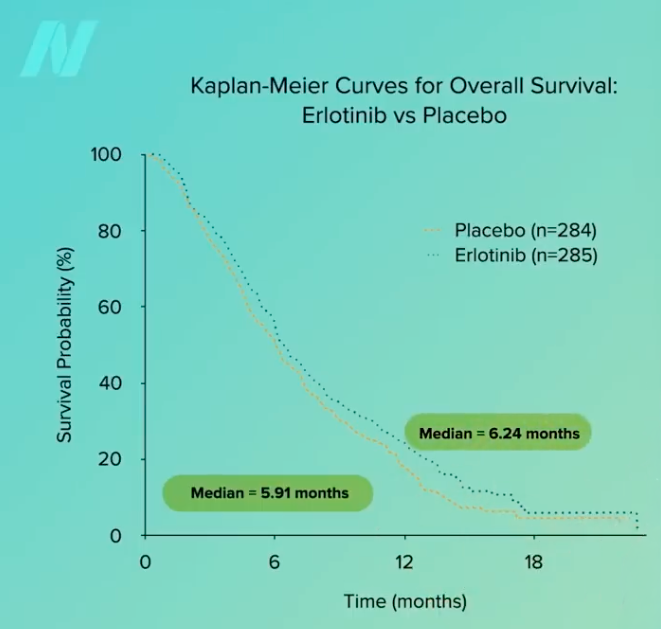
So, they only lived a third of a month longer? That’s just 10 days. All the side effects and expense for an average of just 10 days? That’s why doctors shouldn’t use statistical jargon—like “significant improvement in survival”—while telling patients about the benefits of a new treatment. When patients hear the word “survival,” they’re not thinking about a week and a half.
If you put together all the new chemo drugs approved over a dozen years, the average overall survival benefit is 2.1 months. Now look, two months is two months—I don’t want to downplay that. But time and again, surveys have indicated that the patients expect much more. Incredibly, about three-quarters of patients with metastatic lung cancer or colorectal cancer did not report understanding that their chemo wasn’t at all likely to cure their cancer. Chemo is the primary treatment, but it is not curative; it’s just eking out a few extra weeks or months. Why weren’t the majority of patients told that? It’s not that they were being overly optimistic, explained a researcher. They were under the mistaken belief that the treatment offered a chance of cure when it in fact didn’t. “This deprives…patients of the opportunity to weigh the risks of chemotherapy (including the chance of adverse side effects), against the true benefits (perhaps some symptom relief and a few months longer life, but no chance of cure), and to make their own decisions about their care”—about their own bodies.
If you ask cancer patients, most want at least half a year to stomach the side effects, which suggests that most cancer patients might not choose chemotherapy if they knew how little they’d actually benefit from it. But, everyone’s different. One patient interviewed said living even one week longer would be worth it. Another said they wouldn’t want chemotherapy, even if it offered two extra years of life, because they wouldn’t want anything to interfere with the quality of time they had left. Either way, people deserve to know the truth.
I find it telling that oncologists and cancer nurses themselves express less willingness to accept intensive chemotherapy, given the toxicities associated with it. Most chemo drugs are cytotoxic, meaning they work by killing off cancer cells, but they also kill off some healthy cells as collateral damage, which is why they can damage our nerves, cause irreversible heart failure, slough off the linings of our gut, or damage our immune system.
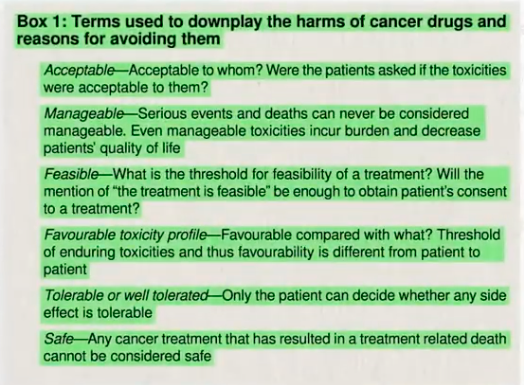
Drug companies frequently downplay the risks, though. For example, they describe the breast cancer drug ribociclib as having an “acceptable” side-effect profile for most patients and the pancreatic cancer drug liposomal irinotecan as having a “manageable and mostly reversible safety profile.” These were studies published in top medical journals. Naturally, readers would accept these statements as true. However, if you actually look at the data, the number of serious—or even life-threatening—side effects was double or even five times higher on the new breast cancer drug. And the “manageable and mostly reversible” side effects evidently weren’t referring to those who were killed by the drug. What do these terms really mean? As you can see below and at 5:19 in my video: “Manageable?” Serious events and deaths will never be considered manageable. “Acceptable” toxicity? Acceptable to whom? And “feasible?” Who would sign up for a drug whose toxicity could only be described as feasible? “Favorable?” Compared to what? “Tolerable?” That’s for the patient to decide. And “safe?” Any drug that kills people can hardly be considered safe.
Still, patients may very well consider it worth the risk. For some cancers, there have been tremendous strides. Testicular cancer is one example, with chemotherapy offering more than a one-in-three chance of surviving to at least the five-year mark. It’s the same with Hodgkin’s disease, a relatively rare form of lymphoma. But even when researchers tried to err on the side of overestimating the benefit, for most common cancers—colon, lung, breast, and prostate—the chances that chemo would enable survival to the five-year mark appear to be more like 1% or 2%.
Doctor’s Note
If you missed the previous blog, see Chemotherapy Is Expensive—Is It Effective?.
How can we help prevent cancer in the first place? See, for example, The Best Diet for Colon Cancer Prevention and others on the cancer topic page.
Smart Watch for Men, 120 Sports Modes Smartwatch with 1.83" HD, Alexa Built-in, Heart Rate/Sleep Monitor, IP67 Waterproof, Bluetooth Call & Music Control Fitness Watch for iPhone/Android (Black)
$20.99 (as of October 20, 2026 03:33 GMT +00:00 - More infoProduct prices and availability are accurate as of the date/time indicated and are subject to change. Any price and availability information displayed on [relevant Amazon Site(s), as applicable] at the time of purchase will apply to the purchase of this product.)
Earth Rated Dog Wipes for Paws & Butt, Deodorizing, Unscented, 100ct | Hypoallergenic, 3-in-1 Cleaning and Hydrating, for Grooming Paws, Body and Butt
$9.99 (as of October 20, 2026 03:12 GMT +00:00 - More infoProduct prices and availability are accurate as of the date/time indicated and are subject to change. Any price and availability information displayed on [relevant Amazon Site(s), as applicable] at the time of purchase will apply to the purchase of this product.)
STRELLALAB Dog Allergy & Itching Relief - Skin&Coat Support Chews w/Omega 3 | Anti Itch, Immune Supplements - Treats for Dogs Health w/Fish Oil for Irritated & Dry Skin - Proven by Science, 60 Ct
$11.98 (as of October 20, 2026 03:22 GMT +00:00 - More infoProduct prices and availability are accurate as of the date/time indicated and are subject to change. Any price and availability information displayed on [relevant Amazon Site(s), as applicable] at the time of purchase will apply to the purchase of this product.)
Amazon Brand - Happy Belly Dark Roast Coffee Pods, Compatible with Keurig 2.0 K-Cup Brewers, 100 Count
$32.39 (as of October 20, 2026 03:12 GMT +00:00 - More infoProduct prices and availability are accurate as of the date/time indicated and are subject to change. Any price and availability information displayed on [relevant Amazon Site(s), as applicable] at the time of purchase will apply to the purchase of this product.)













Post Comment