
Uncover the Untold Story: How Huguette Caland’s Bold Return is Shaking the Art World to Its Core!
Imagine carrying the weight of a nation’s history on your shoulders—and then, at 33, painting through the grief that nearly breaks you. That’s the fire that lit up Huguette Caland’s passion for art, a passion long bottled up by the heavy expectations of being the daughter of Lebanon’s first president. From political daughter to bold artist, Caland’s journey is anything but linear. Her explosive 1964 canvas, Red Sun—once titled Cancer, after the disease that claimed her father—was not just a painting; it was rebellion, release, and resurrection all rolled into one vivid swirl of color. Now, decades later, the Hammer Museum is showcasing “A Life in a Few Lines,” a bittersweet retrospective capturing her five-decade quest for freedom, pleasure, and authenticity. How does one embrace such raw vulnerability and turn it into a lifelong legacy? Let’s dive into the incredible story of a woman who painted her pain to find power, and whose art finally commands the spotlight it’s long deserved. LEARN MORE
 7 min read
Grief propelled Huguette Caland into art. Growing up in 1940s Lebanon, Caland dreamed of becoming an artist, but her political upbringing didn’t allow for it: Her father, Bechara el-Khoury, served as the country’s first president post-independence, from 1943 to 1952. Instead, she upheld the appearance of a cosmopolitan daughter, then wife, giving birth to three children before ever picking up a paintbrush. Then, when Caland was 33, her father died, and she channeled her grief into a blazing red canvas, Red Sun (1964)—originally titled Cancer, after the disease that killed her father.
The explosive painting is a full display of Caland’s control over color, featuring a subtle spiral emitting from the center of a scarlet color field. It’s currently showing at the Hammer Museum as part of the first stateside retrospective of Caland’s work, “A Life in a Few Lines,” on view through February 28, 2027. It hangs alongside work from throughout Caland’s five-decade practice, ranging from kaleidoscopic landscapes to lush renderings of amorphous bodies brimming with sensuality. Altogether, they encapsulate the journey of a woman who continually rejected social expectations to embark on a lifelong study of pleasure and pain.

Huguette Caland, Red Sun, 1964
After her father’s death, Caland left Lebanon and devoted herself entirely to art, finding freedom first in 1970s Paris, then in Los Angeles, where she moved in 1987. Despite her immense output, she was never truly celebrated during her lifetime. But just before passing away, Caland finally received her flowers, when a selection of her work appeared in the Hammer Museum’s “Made in L.A.” exhibition. The inclusion ushered in long-overdue recognition, leading to a 2019 exhibition at England’s Tate St. Ives, a 2026 solo show at New York’s Lisson Gallery, and a massive retrospective that started at Spain’s Reina Sofía Museum before traveling to Germany’s Deichtorhallen Hamburg. Now, the Hammer iteration of the show, comprising some 150 artworks and archival materials, represents a long-awaited homecoming for Caland.
“The complexities of her as a diasporic person rather than just a cosmopolitan were omitted in the narrative; the complexities of her as a person who suffered partly for being a diasporic subject and partly for being a woman in a patriarchal world were also neglected, and a broader history of her way of mark-making—her way of making art, which evolved extraordinarily over the decades that she was working,” the exhibition’s curator Hannah Feldman tells Bazaar, referring to past showings of Caland’s work. “All of those were what I wanted to bring back into the narrative of Huguette: some pathos, some politics.”

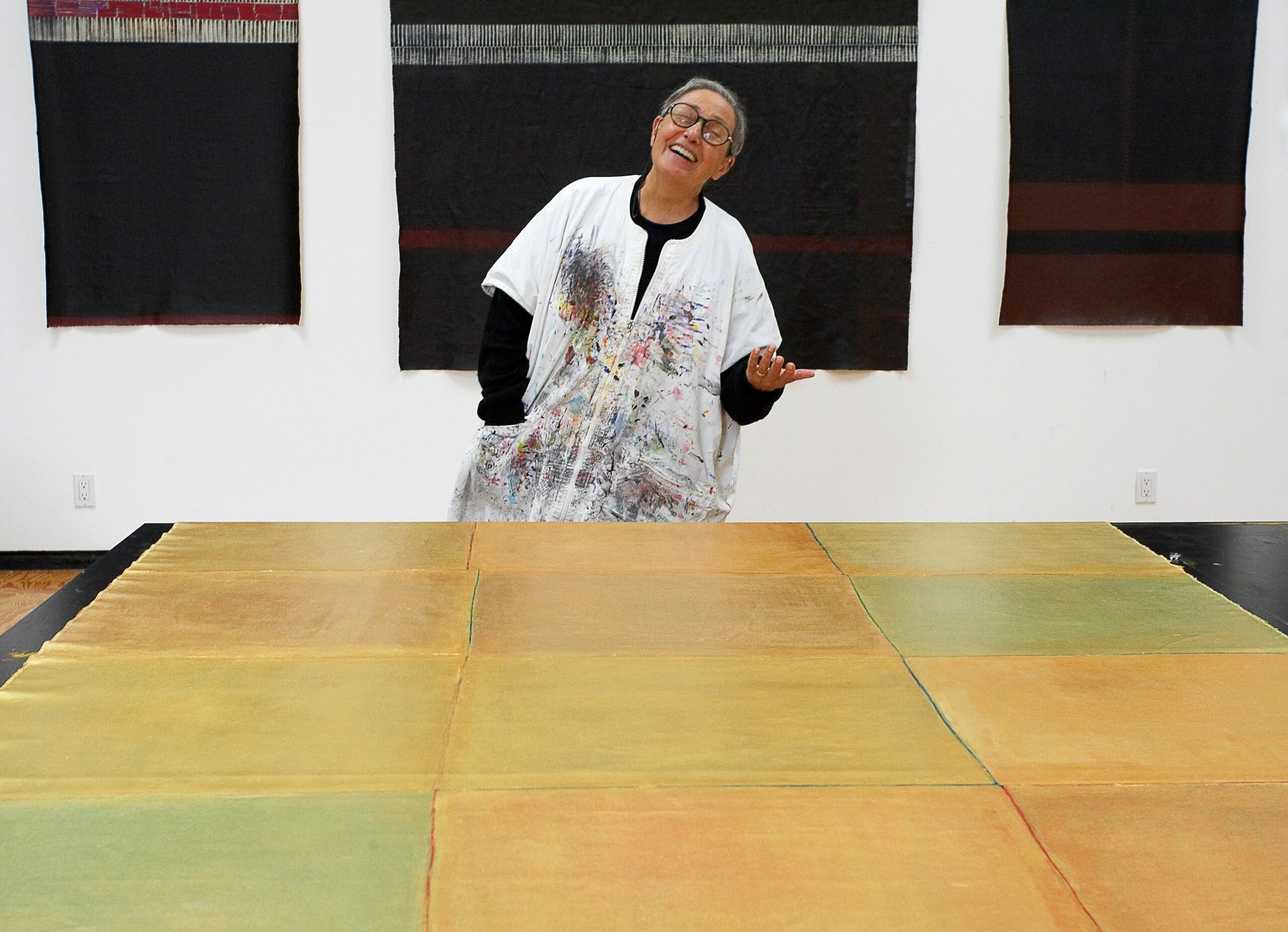
Huguette Caland in her home in 2010
Huguette was born in Beirut in 1931, an era of great social upheaval in Lebanon. As part of a political family, her life was determined by bureaucratic duty, which even extended into her marriage—her husband, Paul Caland, was the son of another politician. Even after her father’s tenure in office, she cared for him until his death, never once considering art as a path. When he died, however, everything changed.
That same year, she enrolled in art school at American University of Beirut, where she began vigorously creating abstract works like Red Sun, filled with color and clashing geometric forms. Consumed by an overwhelming desire to create, she eventually decided to take a leap of faith: leaving her family behind in Beirut to live in Paris. “It wasn’t a need or desire to walk away from us, but it was an absolute passion, which she knew that she could not fulfill in Lebanon,” her son, the filmmaker Philippe Caland shares on a call.
There, Caland blossomed as an artist and autonomous woman, developing her erotic—and at the time, quite subversive—visual language. Her ’70s “Bribes de corps” series, for instance, featured blown-up, bulbous views of bodies—lots of legs and butts—rendered in soft oil paints. Meanwhile, she would often traverse the city in flowing caftans, her own body liberated beneath. One day, French designer Pierre Cardin approached her to compliment her outfit. The two struck up a friendship and eventually collaborated on a line of haute couture caftans, some 30 of which remain in her family archive.

Huguette Caland, Check Point (Bribes de corps), 1974
Caland moved to Venice, California in 1987, following the death of her lover, Romanian sculptor George Apostu. (She remained legally married to her husband, who lived out his life in Beirut, but the two enjoyed an open marriage.) There, the painter found emotional refuge in the California sun. “She liked the freedom that she had here,” Caland’s daughter, Brigitte, tells me in August, gesturing to the open sky from the patio of what was once her mother’s California house. “It was light—the quality of the light.”
Today, Philippe and his daughter, Charley Mae, live in the home, which is flooded with artwork hung on multicolored walls. But they stress that the decor has changed drastically since Huguette lived there. She kept it minimalist, with stark white walls and carefully placed artworks, many of which were her own alongside some by friends such as Ed Moses and Ken Price. Some remnants of her remain, however, including a giant mosaic-like painting that covers one of the kitchen walls.

Huguette Caland, Self-Portrait in Smock, 1992
On the dining table, Brigitte, who has run her mother’s estate since 2019, lays out a display of paintbrushes and markers her mother once used, on the very table where she could be found working nearly constantly. “She could talk, but she would be here painting, and I would get upset, so I would pretend to go, and she’d say, ‘No, no. Come back,’” Brigitte jokes. “And as soon as I was back, she started again. She was a workaholic.”
The resulting artworks were some of Caland’s most assured. Some were provocative, mixed-media drawings of naked women, often inspired by a friend of hers, an L.A.–based model named Christine. Others turned the attention back onto herself, such as Self-Portrait in Smock (1992), which features the artist’s own silhouette against a furious red background. Influenced by the sweeping California views, she also began painting colorful, multimedia landscapes, including one of her final works, Le Grand Bleu (2012). Still, Caland’s focus throughout her career remained on the body.

Huguette Caland, Le Grand Bleu, 2012
That extended to her caftans, 10 of which are one view in the Hammer show. The smocks featured intricate designs, some resembling the same bodily mark-making she used in her paintings. “She was matching her body to her artwork and turning her own body into the support of the artwork, the canvas, as it were,” Feldman says. “These dresses are all scaled to a body like hers—not a standard fashion model. They all emphasize freedom and ease of movement—a woman who’s not just moving but also working. She’s really attached to these very large pockets that often sit on the front of the robes and gowns she designed, where she would put a notebook, but anyone might put any other tools. She always had notebooks and pens in her pockets. The body is always doing something, activated by movement, freedom, comfort, and work.”
At the house, Charley Mae dons some of Caland’s signature caftans, which she continued to make and wear throughout her practice. It’s clear that, from the moment Caland first picked up a paintbrush, life and art were always intertwined. “She lived it all the time,” says Pierre, another of her sons. “She never stopped. It was a constant flow of creative stuff oozing out of her at all times.”

Charley Mae Caland, Huguette’s granddaughter, wearing a dress by her grandmother
The title “A Life in a Few Lines” derives from Caland herself, specifically a 2009 quote in which she says, “The line is beautiful…I’m a line person.” For Caland, this refers to the delicate, meticulous outlines that make up her bulbous figures, and even the patterns on some of her smocks. The Hammer exhibition intends to show how, through this continuous delineation, Caland carved out a sovereign life for herself, with both creative and bodily autonomy.
“Her quest for freedom wasn’t a personal quest or a narcissistic, selfish quest,” Feldman explains. “It was about who and what the subject and the self are in very political ways.”


This is, perhaps, most clear in Caland’s open embrace of female eroticism—something unheard of in midcentury Lebanon. One key example in the show, Homage to Pubic Hair, features a contorted figure adorned with scraggly hair at several joints, resembling pubic areas and armpits. Works like these revel in the joy of a liberated body, but later in her career, Caland also honed in on corporeal discomfort.
“In the later work, that body starts to be less often a source of pleasure and more often a source of pain and anxiety,” says Feldman. “Being trapped in the aging of the body, she’s strong enough by that point in her life and committed to her artistic practice that she doesn’t give in to it. She’s always fighting it and trying to redefine what can become pleasurable and what becomes the self.”

Huguette Caland, Homage to Pubic Hair, 1992
Caland quit painting in 2013. When she learned that Paul was ill and on his deathbed, she suddenly returned to Beirut, ostensibly just for a visit. Brigitte, however, believes her mother always knew she wouldn’t come back. Six years later, Caland died there at 88.
“She was the strongest woman,” Charley Mae says. “She was super cool, super independent. Her art is a strong reflection of her entire life. Her stories were woven throughout, too. They’re very brave. She didn’t care what people would think.”

Charley Mae Caland, Huguette’s granddaughter, wearing a dress by her grandmother
Caland’s greatest hope throughout her life was for her art to reach people, but she was only barely able to witness her work’s profound resonance. Now, seven years after her death, the Calands celebrate the validation that accompanies the Hammer show, holding their mother in their hearts.
“This is Mom’s dream come true,” Pierre says. “Mom really didn’t care about the money. She didn’t know a dollar from a million. … The reality? She always wanted her work to be seen. She was always frustrated that people didn’t give it any time, and her only wish was for people to see the works. That’s why it is so gratifying for us to see the works in museums. I hope she’s watching from above with a big smile on her face.”

Charley Mae Caland, Huguette’s granddaughter, wearing a dress by her grandmother

Charley Mae Caland, Huguette’s granddaughter, wearing a dress by her grandmother
Organic Banana Bunch (4-5 Count)
(as of October 19, 2026 03:10 GMT +00:00 - More infoProduct prices and availability are accurate as of the date/time indicated and are subject to change. Any price and availability information displayed on [relevant Amazon Site(s), as applicable] at the time of purchase will apply to the purchase of this product.)
Core Power Fairlife Elite 42g High Protein Milk Shakes For kosher diet, Ready to Drink for Workout Recovery, Chocolate, 14 Fl Oz (Pack of 12), Liquid, Bottle
$47.98 (as of October 19, 2026 03:10 GMT +00:00 - More infoProduct prices and availability are accurate as of the date/time indicated and are subject to change. Any price and availability information displayed on [relevant Amazon Site(s), as applicable] at the time of purchase will apply to the purchase of this product.)
GOODGROWLIES Dog Allergy Relief Chews - Anti-Itch Skin & Coat Supplement | Itchy Skin Relief w/Omega 3 & Fish Oil - Itching & Paw Licking Support - Dry Skin & Hot Spots Treatment - Vet-Approved, 180Ct
$18.39 (as of October 19, 2026 03:22 GMT +00:00 - More infoProduct prices and availability are accurate as of the date/time indicated and are subject to change. Any price and availability information displayed on [relevant Amazon Site(s), as applicable] at the time of purchase will apply to the purchase of this product.)
Blueberries, 1 Pint
(as of October 19, 2026 03:10 GMT +00:00 - More infoProduct prices and availability are accurate as of the date/time indicated and are subject to change. Any price and availability information displayed on [relevant Amazon Site(s), as applicable] at the time of purchase will apply to the purchase of this product.)











Post Comment