
Unlock the Hidden Power Behind Reinvention: Why Mastering This Skill Separates Winners from the Rest

Ever felt like you’re stuck on a career treadmill, running hard but ending up in the same spot? Well, welcome to the reinvention economy — where winding career paths aren’t just trends, they’re the new normal. If you think reinvention means starting over from scratch, think again. It’s more like a strategic pivot, a skill you can actually build — no daredevil leaps needed. Today, it’s not just about chasing your passions; it’s about adapting because the game has changed. Job security? That old promise has gone the way of dial-up internet. Layoffs, slow hiring, and AI shake-ups mean even the most loyal workers are finding themselves sidelined. But here’s the kicker: the question isn’t “if” you’ll need to reinvent yourself — it’s whether you’ll treat it like a crisis or a craft you can master. Ready to learn how to turn your current skills into a springboard for your next chapter? Let’s dive in. LEARN MORE
Reinvention Is a Skill. Here’s How to Build It.
The reinvention economy is here.
 For more and more people, getting back to work is no longer a straight path. Instead, it often means making a change. People are switching industries, learning new skills, finding different ways to earn money, and more often, starting their own businesses. Journalists now call this the reinvention economy.
What’s different now is the reason behind these changes. In the past, people reinvented themselves because they wanted to, like a mid-career professional finally following a passion. Today, many people do it because they have to. Hiring is slow, layoffs keep happening in industries that once felt safe, and AI is changing job roles faster than most people can update their résumés. The old promise of steady progress for loyalty and consistency is no longer certain.
Even people with the most stable work histories are feeling the impact. A Federal Reserve Bank of Richmond study found that job-finding rates for the most consistently employed workers dropped by 13 percentage points between late 2022 and late 2025. This was the biggest drop among all groups studied and was the opposite of what happened in past downturns, when these workers usually found jobs first. In other words, those who followed all the rules are now having the hardest time finding their next job.
So the real question is not if you will need to reinvent yourself, but whether you see reinvention as a crisis or as a skill you can develop.
What reinvention looked like for one laid-off professional
Bonnie tried the conventional route first. After a layoff, she did what most people do: she polished her résumé, worked her network, and searched for the next job. When that search went nowhere, she made a different move. She founded a market research firm built on the expertise she’d spent her career developing.
She has described the shift from corporate employee to laid-off worker to small-business owner as a large experiment. She went in confident and came out humbled, she said, but it was worth it.
 She didn’t just get a new job title. Her health got better. The stress of always worrying about layoffs in her old corporate job had become too much, and even a new job would have meant waiting for the next round of cuts. Now, as a business owner, she has to make more decisions, but she is in control. She chooses her clients, creates jobs for others in a tough market, and doesn’t have to follow an employer’s schedule for adopting new technology like AI.
Notice what her story is not. It isn’t a story about a lucky break, a wealthy backer, or a total departure from everything she knew. She didn’t become someone else. She took the skills she already had and changed who they worked for. That’s reinvention as a skill in action: a set of moves you can learn, not a leap that requires nerve most of us don’t have.
When our Career Ownership Coaches® help people through career changes, they notice the same abilities appear over and over. These skills can be learned, and most people already have more of them than they realize.
They help you:
 Separate who you are from your job title. Often, the first thing lost during reinvention is confidence, because it was tied to a job, a paycheck, or a company name. When the job goes away, it can feel like your skills are gone too, but they aren’t. Remember, your expertise came before your title. For example, she didn’t start from nothing; she had years of experience in market research. A helpful first step is to write down what you know how to do without mentioning any job titles. You’ll probably find your list is longer than you expect.
- Take stock of the skills you can use in different roles. Reinventing yourself usually doesn’t mean leaving your experience behind; it means using it in new ways. Instead of asking, “What job am I qualified for?” try asking, “What problems can I solve, and who needs those problems solved?” For example, a regional sales manager knows how to build a sales pipeline and lead a team. An operations director knows how to keep things running smoothly and on budget. These skills are yours, not just your last employer’s. Thinking this way can reveal opportunities you won’t find on a job board.
- Think of reinvention as an experiment, not a final judgment. Approach it like a test: have an idea, set a timeline, and be ready to make changes along the way. This way, each decision feels less risky. You don’t have to get it right the first time; you’re learning as you go.
- Focus on gaining control, not just finding safety. Many people look for another job because it seems safer, but a new job can bring the same risks as the last one, like layoffs or changes in technology. The most lasting reinventions help people take charge of their time, clients, income, and future. If your sense of safety depends on someone else’s choices, it’s only temporary.
Reinvention isn’t only for the young
A common myth is that reinvention is only for people in their twenties. In reality, the evidence shows the opposite. Experienced professionals have what reinvention needs: good judgment, strong relationships, a proven track record, and a clear idea of what they don’t want to do again. What they often don’t have is support from employers, who may believe their best years are over.
That bias is real, and many people experience it. According to the TES Generational Career Confidence Survey, 49% of employees said ageism at work keeps them in jobs they don’t enjoy. Learning reinvention as a skill can help. When you create something based on your own expertise, no one else can say you’re too experienced to contribute.
Why so many reinventions point toward ownership
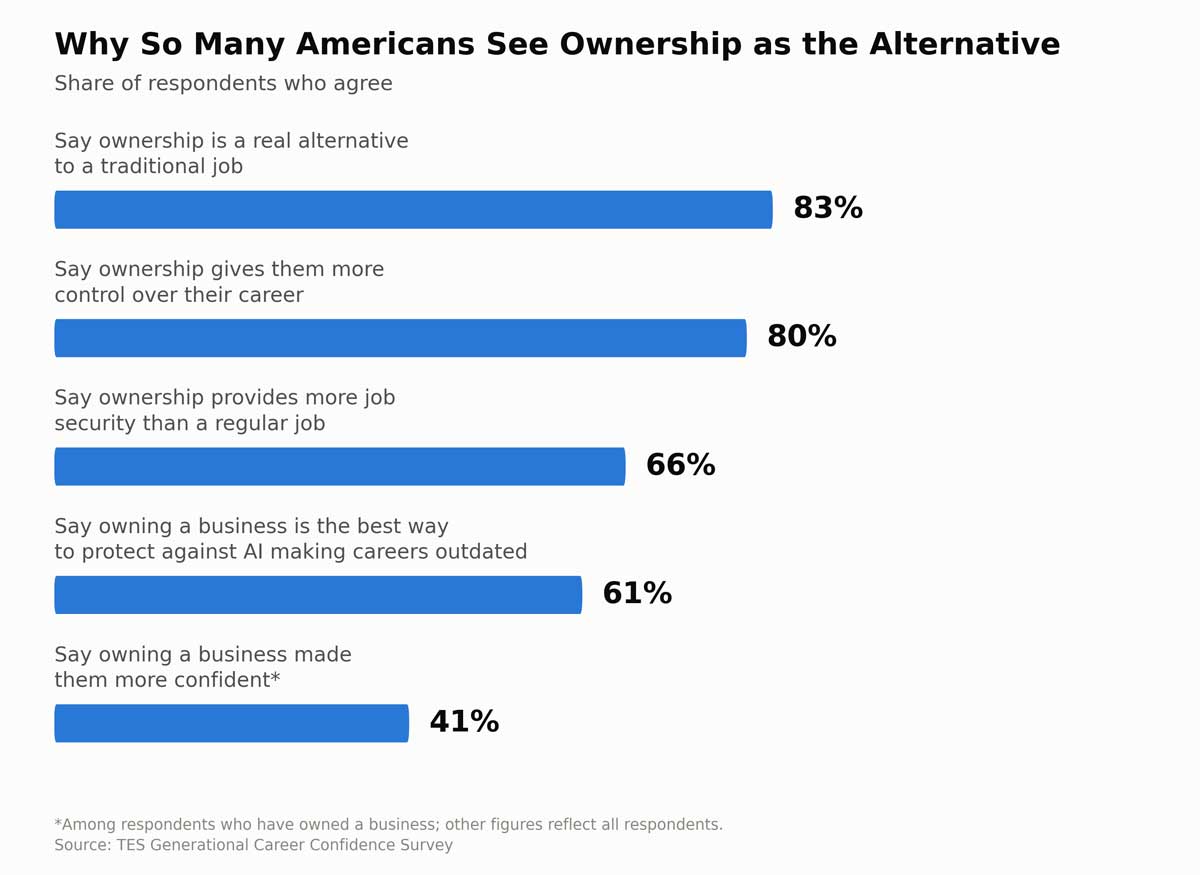
It is about control, and the data supports its importance. In the TES Generational Career Confidence Survey, 83% of Americans said owning a business is a real alternative to a traditional job. Eighty percent said ownership gives them more control over their careers, and 66% said it provides more job security than a regular job. Also, 61% said owning a business is the best way to protect themselves from AI making their careers outdated—a concern many mentioned directly.
One of the most telling findings is that among people who have owned a business, 41% said it made them more confident. Losing a job often takes away confidence, but for many, owning a business helps them regain it.
People aren’t choosing business ownership because it’s easy—it’s not. They’re doing it because waiting for the next decision from an employer no longer feels as safe as it used to.
Reinvention: You can learn the skill of reinvention, but it’s easier with guidance from someone who has helped many others do it. A Career Ownership Coach® won’t give you all the answers or force you in a certain direction. Instead, they help you review your experience, clarify your goals for Income, Lifestyle, Wealth, and Equity™, and explore, at no cost or pressure, if moving from Employment to Empowerment™ is right for you. No matter what, you’ll end up with a plan instead of just waiting.
You might not have chosen this situation, but you can decide what you do with it.
Reinvent! Find out if Your Current Career Aligns with Your Goals! Take our Assessment:
 About Your Career Revolution
Our mission is to help individuals explore self-sufficiency as an alternative career.
We help them define their Income, Lifestyle, Wealth, and Equity goals and provide education on the best ways to achieve them. We don’t sell franchises – we help people achieve their dreams of self-sufficiency through business ownership. The approach is different, the experience is different. And it works.
Order on AMAZON
Learn More About Career Ownership Coaching™

DUMOS Dog Playpen 24 Inch 8 Panels Indoor Outdoor Metal Pet Fence | Foldable Dog Play Pen with Door, Portable Exercise, RV Camping, Puppy Small Medium Dogs
$49.99 (as of October 19, 2026 03:22 GMT +00:00 - More infoProduct prices and availability are accurate as of the date/time indicated and are subject to change. Any price and availability information displayed on [relevant Amazon Site(s), as applicable] at the time of purchase will apply to the purchase of this product.)
Hybrid Active Noise Cancelling Bluetooth Headphones Wireless Headphones | Over Ear, 120H Playtime, Hi-Res Audio, Deep Bass, Memory Foam Ear Cups for Home Office Travel Black
$32.99 (as of October 19, 2026 03:33 GMT +00:00 - More infoProduct prices and availability are accurate as of the date/time indicated and are subject to change. Any price and availability information displayed on [relevant Amazon Site(s), as applicable] at the time of purchase will apply to the purchase of this product.)
Roku TV Remote Control (Official Manufacturer Product) | Simple Setup & Pre-Set App Shortcuts - Replacement Remote Compatible with RokuTV Models ONLY (Not Roku Players)
$9.99 (as of October 19, 2026 03:22 GMT +00:00 - More infoProduct prices and availability are accurate as of the date/time indicated and are subject to change. Any price and availability information displayed on [relevant Amazon Site(s), as applicable] at the time of purchase will apply to the purchase of this product.)
Newly Upgraded Cat Deterrent Spray, Cat Deterrent for Furniture Protection, Pee Spraying, Excessive Chewing & Scratching Everywhere, Cat Repellent Indoor and Outdoor, Pet-Safe Formula, 5.07 Fl Oz
$19.98 (as of October 19, 2026 03:22 GMT +00:00 - More infoProduct prices and availability are accurate as of the date/time indicated and are subject to change. Any price and availability information displayed on [relevant Amazon Site(s), as applicable] at the time of purchase will apply to the purchase of this product.)













Post Comment