
Unlock the Hidden Secrets to Mastering Index Tracker Funds and Multiply Your Wealth Faster Than You Think!
Remember when we walked through the simple steps of opening an online broker account and dipped our toes into the world of buying and selling ETFs? Well, buckle up, because today we’re about to take that knowledge for a spin and dive into purchasing an index tracker fund. Imagine this as your personal passport to the globe—a globally diversified passive portfolio awaits, minus the jet lag! But before you get too giddy, what exactly is an index tracker fund, and how does it differ from the ETFs you just got comfy with? Fear not—I’ll break it down so it feels less like decoding ancient runes and more like unlocking a secret weapon for building wealth. Curious how these funds are priced and why timing your trade matters? Or maybe you’re wondering if there are any sneaky fees lurking beneath the surface? Stick with me, and I’ll walk you through the nuances—from the single published price to those behind-the-scenes adjustments that keep things fair for all investors. By the end, you’ll be ready to shoulder your financial armor and stroll confidently into the arena of index funds. Ready to expand your investment horizon beyond ETFs and toss your hat into the world’s biggest passive portfolio? Let’s make it happen. LEARN MORE
Previously we’ve run through how to open an online broker account and how to buy and sell ETFs.
Today we’re going to look at purchasing an index tracker fund.
Next stop, the world – muhaha!
(Oops, did I say that out loud? I meant to write: ‘Next step, a globally diversified passive portfolio’…)
What is an index tracker fund?
An index tracker fund is typically an Open Ended Investment Company (OEIC).
In normal-person speak, this means a tracker fund is set-up as a company that you can buy and sell shares of.
Index trackers are ‘open-ended’ because the number of shares in the company will rise and fall when investors buy or sell them from the manager of the fund.
Some tracker funds are still set up as Unit Trusts. These are structured as a trust rather than a company, and investors buy and sell units in the trust. Like OEICs these are also ‘open-ended’.
From an everyday investor’s point of view, the two flavours mostly amount to the same thing.
We’ll focus on OEICs, which we’ll refer to simply as index funds from here.
Pricing
Before buying anything, it’s important you know how the market works.
Index funds are priced by a set formula based on the value of their assets.
Unlike ETFs or shares, a single-priced index fund has one published price for buyers and sellers. The price is calculated at a set time – called the valuation point – which for most funds is once each working day.
To complete your trade on a given day, you must do so before a cut-off time:
- If you place an order before the fund’s cut-off time, you’ll normally receive the price calculated at that valuation point.
- If you place your order after the cut-off, then your trade will go through at the next valuation point.
Note this means you might mistakenly think you’re invested before your money has actually gone into your chosen fund. For example, you could put in a buy order on Tuesday afternoon. But it could be executed, say, at midday on Wednesday.
Normally being out of the market for a few hours doesn’t matter much. But if markets are making huge moves up or down, it might!
You can find an index fund’s valuation point in its documentation, or on your investment platform’s research page under ‘fund facts’ or ‘dealing deadlines’.
I’ll trade yer…
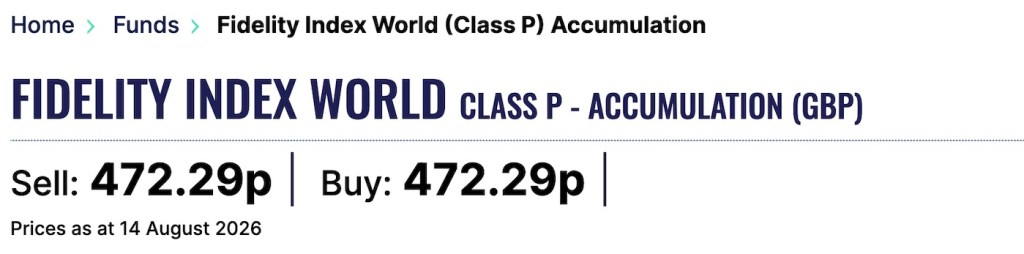
Let’s say you know what fund you want to own. For instance, you want to put £1,000 into the Fidelity Index World (Acc) fund. (Here is its webpage).
You’re ready to put your money to work.
First you need to locate the fund you want to buy into. To find a fund, search for the fund’s name or identifier – such as its ISIN, ticker, or platform fund code – on your platform.
Be persistent! Broker search tools can be shonky. A fund name can often be the easiest way to find a fund, rather than trying to hit on the required code. You might even have to resort to a Google search of your platform to find the fund page on its website, and then go from there. In all cases, triple-check the details to make certain you’ve got the fund you want.
Deal with it
Here’s that Fidelity World Index Fund located at Hargreaves Lansdown:

You can see the Buy and Sell prices are the same. That’s because Fidelity Index World is a single-priced fund . More on that below.
Note that this quoted price is the last traded price – not the price we’ll pay.
As we saw above, an index fund is generally valued once a day, at its valuation point. Hence you’ll only know the exact price you paid when your trade completes.
Having logged into the platform and clicked through to Invest Now, we see this screen:

Notice we’re only confirming the total order value – here it’s £1,000 – and no price. Again, we won’t know the exact price we paid until the deal is done.
Because OEICs have a single published price, there isn’t a conventional bid-ask spread in the way there is with an ETF. The transaction costs are embedded in the fund’s pricing, rather than through a spread.
You’ll also see that Hargreaves Lansdown will charge us £1.95 to do the deal.
Who pays for all the underlying buying and selling?
Here’s some slightly geeky details.
When you buy or sell units in, say, an equity index fund, your fund manager may have to buy or sell the underlying company shares on your behalf. These transactions cost money – racked up by things like dealing spreads, commissions, and the market impact of large trades.
Now, if transaction costs were simply absorbed by the fund, then existing investors could end up paying for the trading activity of other investors.
That’s called dilution, it’s not really cricket, and so fund managers – and regulators – have devised ways to make sure the people who create the costs actually pay them.
For example, a fund might apply an explicit dilution levy.
Or, commonly with a single-priced fund, it can use swing pricing – also known as a dilution adjustment – to nudge the fund’s published price up or down to reflect the estimated costs of dealing in the underlying investments.
The point is that while an OEIC may show one price rather than an ETF-style bid-offer spread, that doesn’t mean buying and selling is costless. The costs of trading the underlying investments must still be paid somewhere.
The swing pricing mechanism is designed to protect long-term investors from subsidising other people’s trading. The FCA’s rules require any dilution adjustment or levy to be operated fairly and solely to reduce dilution – which is nice.
(Incidentally, if you Googled ‘swing pricing’ to read about the cover charges when throwing your keys into a bowl at a certain sort of party in Surbiton, well, each to their own.)
What will the trade cost you?
Many good brokers don’t charge a dealing fee for trading index funds. Historically, this usually made index funds cheaper to buy than ETFs, where dealing fees were levied.
However with today’s zero-commission platforms, ETFs can also be bought without an explicit dealing charge.
Meanwhile some platforms do charge a fee for index fund dealing, as we saw above.
Other investment costs will usually apply either way, so scrutinise fee structures before you pick your platform. Even trivial charges add up over time. Find what’s best for you.
Assuming you’re not getting badly stung some other way – be particularly wary of annual percentage-based charges on large investment pots – then paying no trading fees is a nice benefit, especially when you’re starting out.
Have a look at the Monevator broker comparison table to compare charges.
Doing the deed
Continuing our example, we click along to the final confirmation screen.
Pressing ‘Place a deal now’ will do the deed and commit your cash:

Then it’s just a matter of sitting back and waiting for our order to be fulfilled. The buying bit on our side is done.
As with our ETF purchase in the previous article, we’ll have to wait a while for the trade to settle, but in practice you’ve committed your investment into the fund.
Your broker should supply you with a contract note for your records.
That’s all folks
Buying and selling index funds can feel easier than trading ETFs, if only because there’s not the pressure of a countdown and you don’t need to worry about spreads.
True, you do have to wait to know the exact price you paid with index funds, unlike ETFs.
But for long-term passive investors putting money into broad index funds, that’s no big disadvantage.
Price fluctuations on a day-to-day basis are essentially random. We’re growing our investments for decades.
Inspired? If you’re after ideas about what index tracker funds to buy then check out The Accumulator’s overview of low-cost index trackers. Note that comments below might refer to an older version of this article.

FUJIFILM instax mini 13 Instant Film Camera - Clay White
$89.00 (as of October 21, 2026 03:33 GMT +00:00 - More infoProduct prices and availability are accurate as of the date/time indicated and are subject to change. Any price and availability information displayed on [relevant Amazon Site(s), as applicable] at the time of purchase will apply to the purchase of this product.)
Nespresso Vertuo, Barista Flavored Pack, Medium Roast, 30-Count Coffee Pods | Medium-Roast Coffee Capsules, Caramel, roasted hazelnut and sweet vanilla flavors
$42.00 (as of October 21, 2026 03:12 GMT +00:00 - More infoProduct prices and availability are accurate as of the date/time indicated and are subject to change. Any price and availability information displayed on [relevant Amazon Site(s), as applicable] at the time of purchase will apply to the purchase of this product.)
Earth Rated Dog Poop Bags on Refill Rolls, 270 Bags, Lavender | Guaranteed Leak Proof and Extra Thick Waste Bag Refill Rolls
$14.99 (as of October 21, 2026 03:12 GMT +00:00 - More infoProduct prices and availability are accurate as of the date/time indicated and are subject to change. Any price and availability information displayed on [relevant Amazon Site(s), as applicable] at the time of purchase will apply to the purchase of this product.)
blink plus plan with monthly auto-renewal
$11.99 (as of October 21, 2026 03:22 GMT +00:00 - More infoProduct prices and availability are accurate as of the date/time indicated and are subject to change. Any price and availability information displayed on [relevant Amazon Site(s), as applicable] at the time of purchase will apply to the purchase of this product.)










Post Comment