
Unlock the Secret Korean Skin Treatment Everyone’s Obsessed With—Xerf Could Change Your Glow Forever!
Ever wonder if there’s a skin-tightening treatment out there that actually lives up to the hype without making you look like a tomato for days? Well, buckle up — I’ve tried the usual suspects like chemical peels, RF microneedling, and lasers, and then stumbled upon XERF, the latest buzzword emerging straight from South Korea’s ever-innovative beauty scene. It’s a needle-free, no-downtime radiofrequency treatment that promises a firmer, lifted look without the usual “ouch” factor. Curious how it stacks up, especially with stars like Kim Kardashian and Priyanka Chopra Jonas reportedly giving it a go? I dove in myself and discovered everything from the science behind it to the actual experience—and trust me, it’s got some surprises. Ready to find out if this could be your next skin savior?
 8 min read
I love an in-office treatment. Chemical peels, RF microneedling, lasers—I’ve tried them all. And lately, I’ve been hearing enough chatter around XERF (pronounced “zerf”) to become seriously intrigued. South Korea has become a major source of inspiration for aesthetic treatments, and XERF appears to be its buzziest export. Truthfully, it was only a matter of time. Korean beauty has had a grip on pretty much every beauty lovers’ skincare (and now, haircare) routine for years, so it’s no surprise that our interest has extended beyond toners and sunscreens and into the realm of professional treatments.
Xerf is a non-invasive radiofrequency treatment designed to tighten skin and stimulate collagen without the need for needles or downtime (trust me, there is no downtime). It’s not without its celebrity fans, with stars like Kim Kardashian and Priyanka Chopra Jonas reportedly trying the treatment. And they’re not the only ones. “XERF is rapidly replacing RF-based treatments in Korea,” says board-certified dermatologist David Kim, MD, who expects it’s going to stick around. He even treated six people with the device right before this year’s Met Gala. “They all looked incredible on the red carpet,” he adds. “You can see an immediate difference with no downtime, so you can go right back to your daily routine.”
Meet the experts: David Kim, MD, is a board-certified dermatologist and founder of Soho Dermatology in New York City. Suchismita (Tia) Paul, MD, is a board-certified dermatologist at Balanced Skin Dermatology and Aesthetics in Newport Beach, CA.
But a treatment can sound great on paper and feel very different when you’re actually sitting in the dermatologist’s office So, I tried XERF for myself at Balanced Skin Dermatology and Aesthetics in Newport Beach, CA (all in the name of research, of course).
Here’s everything to know about the science behind the technology, what dermatologists think it’s best for, and, of course, my personal experience.
What is XERF?
XERF “is a non-invasive radio frequency skin tightening treatment designed to improve skin laxity by delivering controlled heat into the deeper layers of the skin,” explains Suchismita (Tia) Paul, MD. “Unlike treatments that injure the skin’s surface, XERF works beneath the skin to stimulate your body’s natural collagen and elastin production, resulting in firmer, tighter-looking skin over time.”
What makes XERF particularly interesting is its use of two frequencies. “It’s the first RF-based anti-aging treatment in the world to use dual frequencies (6.78 Mhz and 2 Mhz),” says Dr. Kim, who notes that it allows the device to target both “superficial tightening and deep lifting.” Studies have shown the potential advantage: Noninvasive monopolar radiofrequency (NMRF) can be effective in delivering controlled dermal heating enhancing collagen synthesis, meaning that XERF’s technology presents a safe skin tightening and dermal remodeling in porcine models. These findings are encouraging, but they’re not the same as clinical trials in humans, so there’s still more to learn. “Although XERF is a newer technology, early clinical studies and physician experience have demonstrated improvements in skin laxity with a favorable safety profile,” says Dr. Paul. “What gives me confidence is the well-established science behind monopolar radiofrequency for collagen remodeling, combined with the device’s sophisticated temperature monitoring and energy delivery system.”
Essentially, XERF is deliberately (and safely) heating tissue beneath the surface to trigger skin to repair itself. Dr. Paul says that controlled heating causes some immediate collagen contraction while stimulating fibroblasts to produce new collagen and elastin over the following weeks and months. This means you’ll likely see immediate but short-term tightening results, but any meaningful changes to your skin will take months.
Its increasingly-growing appeal makes sense. “Patients today want natural-looking results with minimal downtime,” says Dr. Paul. “Many aren’t ready for surgery but are looking for meaningful improvement in skin laxity.” XERF, she says, fills that gap.
What is XERF best for?
When it comes to XERF, think tightening, not transformation. It’s not going to give you the same results as a surgical facelift, but if you want to look a little firmer and more lifted without going under the knife, consider it. “The ideal candidate is someone with mild to moderate skin laxity who wants gradual, natural-looking tightening,” says Dr. Paul. Most of her patients are in their late 30s through 60s, although she emphasizes that skin quality matters more than age. “It’s also a great option for younger patients interested in collagen preservation before more significant laxity develops,” she adds.
On the face, “common treatment areas include the cheeks, jawline, lower face, neck, and under the chin,” says Dr. Paul. “It can also be used on the abdomen, arms, above the knees, and other areas where patients are concerned about mild skin laxity.”
As with any treatment, XERF isn’t for everyone. “If you have significant skin laxity, a surgical intervention may be better,” says Dr. Kim. “If you have a significant cardiac history (pacemaker, defibrillator) you’re also not a good candidate.”
Skin tone, however, isn’t necessarily a limiting factor, which can sometimes be the case with other professional treatments. Because radiofrequency technology “targets tissue through electrical resistance rather than melanin,” Dr. Paul says XERF can be used across a wide range of skin tones when administered by an experienced provider. She does urge caution for people with melasma, however: Because the device heats the skin during use, “Patients with melasma need to be careful since any technology with heat could potentially worsen hyperpigmentation,” notes Dr. Paul.
Does XERF hurt?
This is where XERF really surprised me: It felt hot, but it didn’t feel like I was being poked, pinched, or stamped. If you’ve experienced treatments that combine microneedling with radiofrequency or tried lasers, you know what a difference that makes. On a scale of one to 10, with 10 being the most painful, I’d rank it at about a three, simply because the heat would get a little uncomfortable (full disclosure: Dr. Paul’s team numbed my face before starting, though it’s not necessary to get a numbing treatment).
“One of the biggest differences is that XERF is completely non-invasive—it doesn’t use needles to penetrate the skin,” says Dr. Paul. “Treatments like Morpheus8 combine radiofrequency with microneedling, which intentionally creates controlled injury within the skin and therefore typically requires topical numbing and more downtime.”
XERF also incorporates technology to make the heat more manageable. The tip of the device “is very cold to cool down the skin, so it prevents excessive delivery of the heat,” says Dr. Kim. Dr. Paul adds that its “advanced cooling and real-time temperature monitoring” contribute to a more comfortable experience for patients.
For me, the heat was noticeable but manageable. There were moments of significant warmth, and in those moments, my provider paused for a few moments to give my skin time to rest (I’d tell her my skin was feeling a little spicy), but I didn’t have a fan or any separate cooling device. Throughout the whole experience, I truly couldn’t believe that there was no sharp pinching or stamping sensation, as I’ve experienced with other devices. It was significantly less painful than RF microneedling treatments I’ve tried, but I had never felt this warmth before. I was sweating by the end, so make sure to wear a lightweight, comfortable outfit to your appointment.

Writer Catharine Malzahn mid-treatment with XERF.
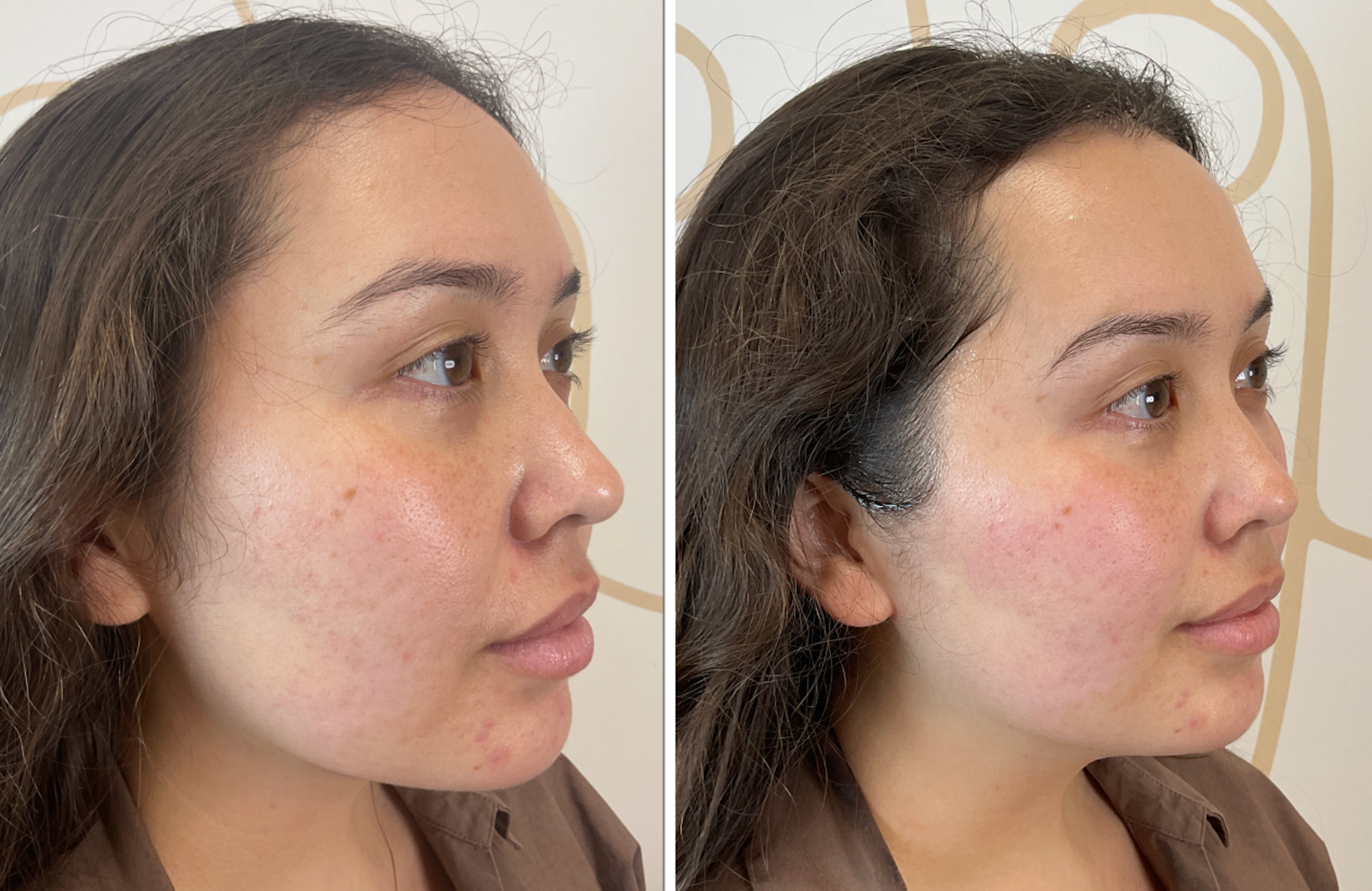
My XERF results.
I am, simply put, absolutely thrilled with my XERF results. It’s been a little over a month since I got my treatment, and while I noticed my skin both looked and felt tighter right after treatment, I’ve seen improvements over the past several weeks as well.
A couple weeks after my treatment, my personal trainer—who, quite frankly, sees me at my worst—stopped me in the middle of a workout to ask about my skin. I was sweaty, red, and exhausted from throwing down medicine balls and lifting weights when she said, “Wow, your skin looks amazing. Did you do anything different?” She had no idea I’d tried XERF. She just thought my skin looked tighter, glowier, and smoother. After I told her about the treatment, she even wanted to try it herself.
She wasn’t the only person who noticed, either. I also had people describe my complexion as looking almost airbrushed about three and a half weeks after treatment. My skin did look pretty smooth and glowy—we’re talking almost glass skin-level results. And yes, XERF did feel spicy in some areas (for me, the cheeks and jawline were the least comfortable), but it was nothing compared to other treatments I’ve tried.
Technically, I’m still waiting for the final result. If XERF continues stimulating collagen for several months as the doctors describe, what I saw during those first few weeks may represent only part of the outcome. “The most meaningful improvements typically develop over two to six months as new collagen forms,” says Dr. Paul. “Results vary based on age and skin quality but commonly last around 12 months, especially with maintenance treatments.”
The biggest commitment was the time. My treatment took more than an hour, which is much longer than any other treatment I’ve done in the past. Make sure to ask your provider how long you should expect the appointment to last when booking.

Writer Catharine Malzahn before (right) and immediately after (left) her treatment with XERF.
Afterward, my skin was slightly pink, but it wasn’t red or irritated at all. I look more red leaving my Pilates class than I did leaving this aesthetic procedure. That experience seems pretty typical: “Temporary redness and mild swelling are the most common side effects and usually resolve within hours to a day,” says Dr. Paul. “Occasionally patients experience mild tenderness or warmth.”
I didn’t experience any serious complications, and both dermatologists agree that they are uncommon with this treatment. “The most common side effects are temporary redness and swelling,” says Dr. Paul. “As with any energy-based device, improper technique could increase the risk of burns or uneven results, which highlights the importance of choosing an experienced physician who understands facial anatomy and energy-based devices.”
The bottom line: Don’t sleep on this one.
So, the million dollar question: Would I get XERF again? Based on my experience, yes. I went in intrigued by the idea of a Korean tightening treatment that promised minimal downtime and was curious if I’d see any noticeable results, given that I am under the target age for the treatment. I left pleasantly surprised by how pain-free the experience was—and, of course, by how quickly other people noticed a difference. I’ve since recommended XERF to multiple people.
The one thing that may be prohibitive is the cost. While pricing varies significantly depending on where you live, your provider, the area being treated, and more, Dr. Paul says patients can generally expect to spend around $1,500 to $2,500 to treat the face. Larger treatment areas can cost more. Dr. Kim puts the range slightly higher, at approximately $2,000 to $3,500. “Many patients achieve excellent results with one to three initial treatments, followed by maintenance every 6 months to continue stimulating collagen as the natural aging process continues,” adds Dr. Paul.
That said, XERF isn’t a facelift in disguise, which is why it’s a great option for the pre-facelift demographic. I categorize XERF not as a dramatic transformation, but as a treatment for someone who wants subtle tightening, essentially no downtime, and less pain. If the compliments I received while red-faced and sweating through a workout are any indication, I’d say that subtle can sometimes be pretty convincing.
Catharine Malzahn is a contributing beauty writer at Cosmopolitan and was previously the beauty assistant at Good Housekeeping, Woman’s Day, and Prevention.
Brian Underwood is beauty director at Women’s Health, where he oversees content strategy for the brand across all platforms, including digital, print, and social. Underwood previously served as beauty and wellness director at Oprah Daily and O, The Oprah Magazine. During his tenure leading beauty content for the Oprah brand at Hearst, stories Underwood commissioned were awarded the Skin Cancer Foundation Media Award and a Fragrance Award for Editorial Excellence (his second). He was the launch Beauty Director of Dr. Oz THE GOOD LIFE, and has held additional editorial positions at Fitness, Organic Style, Good Housekeeping, Life & Style Weekly, and Woman’s Day and has written for Self, Shape, Seventeen, Redbook, Cosmopolitan, and many more. Underwood previously served on the Skin Cancer Foundation’s gala committee and as partnerships director of the Trans Beauty Clinic, a New York-based charitable organization that provided beauty services and workshops to the city’s trans community.

Purina Pro Plan Veterinary Supplements FortiFlora Dog Probiotic Supplement | FortiFlora Probiotic Supplement with strain of probiotics promotes intestinal health and can help management of diarrhea
$30.99 (as of October 18, 2026 03:12 GMT +00:00 - More infoProduct prices and availability are accurate as of the date/time indicated and are subject to change. Any price and availability information displayed on [relevant Amazon Site(s), as applicable] at the time of purchase will apply to the purchase of this product.)
Hisense 55" Class E6SR Series Hi-QLED 4K UHD Smart Roku TV (55E6SR, 2026 Model) - Dolby Vision, Game Mode Plus, VRR, ALLM, DTS Virtual:X, Apple AirPlay, Compatible with Alexa and Google Assistant
$277.99 (as of October 18, 2026 03:33 GMT +00:00 - More infoProduct prices and availability are accurate as of the date/time indicated and are subject to change. Any price and availability information displayed on [relevant Amazon Site(s), as applicable] at the time of purchase will apply to the purchase of this product.)
Apple AirPods Pro 3 Wireless Earbuds with Active Noise Cancellation | Live Translation, Heart Rate Sensing, Hearing Aid Feature, Bluetooth Headphones, Spatial Audio, USB-C Charging
$199.00 (as of October 18, 2026 03:22 GMT +00:00 - More infoProduct prices and availability are accurate as of the date/time indicated and are subject to change. Any price and availability information displayed on [relevant Amazon Site(s), as applicable] at the time of purchase will apply to the purchase of this product.)
Blue Buffalo Life Protection Formula Chicken Adult Dry Dog Food, 5 lb | Real Chicken #1 Ingredient, Supports Immunity with Antioxidant-Rich LifeSource Bits, Promotes Healthy Muscle Development
$14.97 (as of October 18, 2026 03:12 GMT +00:00 - More infoProduct prices and availability are accurate as of the date/time indicated and are subject to change. Any price and availability information displayed on [relevant Amazon Site(s), as applicable] at the time of purchase will apply to the purchase of this product.)













Post Comment