Unlock the Surprising Power of Prunes: The Natural Gut Fix Doctors Don’t Always Tell You About
Let’s talk about something that’s as inevitable as taxes but way less discussed: constipation. Ever wonder why this not-so-glamorous topic barely gets a mention at the dinner table or even in most medical offices? Yet, it’s a real heavyweight—in the U.S. alone, constipation prompts three million doctor visits and hundreds of thousands of emergency room trips annually. Could it be that many of us are quietly suffering, misdiagnosed, or just brushing off what might be a chronic irritation? Before you reach for the pills—with their laundry list of side effects—what if nature had some simpler, tastier answers? Prunes, those sweet little wrinkled fruits, figs with their ancient medicinal reputation, and good old-fashioned exercise might just pack the punch we need to get things moving again. Curious how these natural remedies stack up against conventional treatments and whether they really deliver the goods? Let’s unpack the science, the stories, and the surprising findings that might just change how you tackle your next bathroom visit. LEARN MORE
Prunes, figs, and exercise are put to the test as natural home remedies for constipation.
The act of defecation is very private and the object of cultural taboos, so much so that it’s rarely thought of, even by physicians—but it should be. Constipation accounts for three million annual visits to doctors in the United States and 800,000 emergency room visits. Depending on how you define it, up to 80% of the population may be suffering. Even people who don’t think they’re constipated may very well be clinically constipated. A quarter of so-called healthy study participants reported experiencing “incomplete emptying,” and about half “indicated increased straining.” In fact, more than half had found blood on their toilet paper within the past year. In severe cases, the blood pressure spike associated with straining while passing stool can even trigger a heart attack or a stroke.
There are drugs for it. There are always drugs, resulting in side effects like nausea, diarrhea, headache, and abdominal pain, leaving most patients unsatisfied. So why not instead just try to treat the cause? Common causes of chronic constipation include a lack of whole plant foods containing fiber or insufficient water intake, so changing one’s diet and lifestyle is the preferred method for constipation relief. Such nonpharmacological, clinically effective interventions include engaging in physical activity for about 30 minutes a day.
A systematic review and meta-analysis found that aerobic exercise interventions help, starting at about 140 minutes a week. And then, of course, a diet centered around whole plant foods—the only naturally concentrated sources of fiber—helps as well. Any plants in particular?
When elderly women with severe constipation were given about a dozen prunes a day, they experienced significant improvement within the first week. The control group in the study wasn’t told to do anything, though. When one group does something while the other does nothing at all, you can’t discount the placebo effect. And, indeed, the placebo effect for constipation trials can range up to 44%, meaning up to nearly half of the people given a sugar pill claimed to experience an improvement.
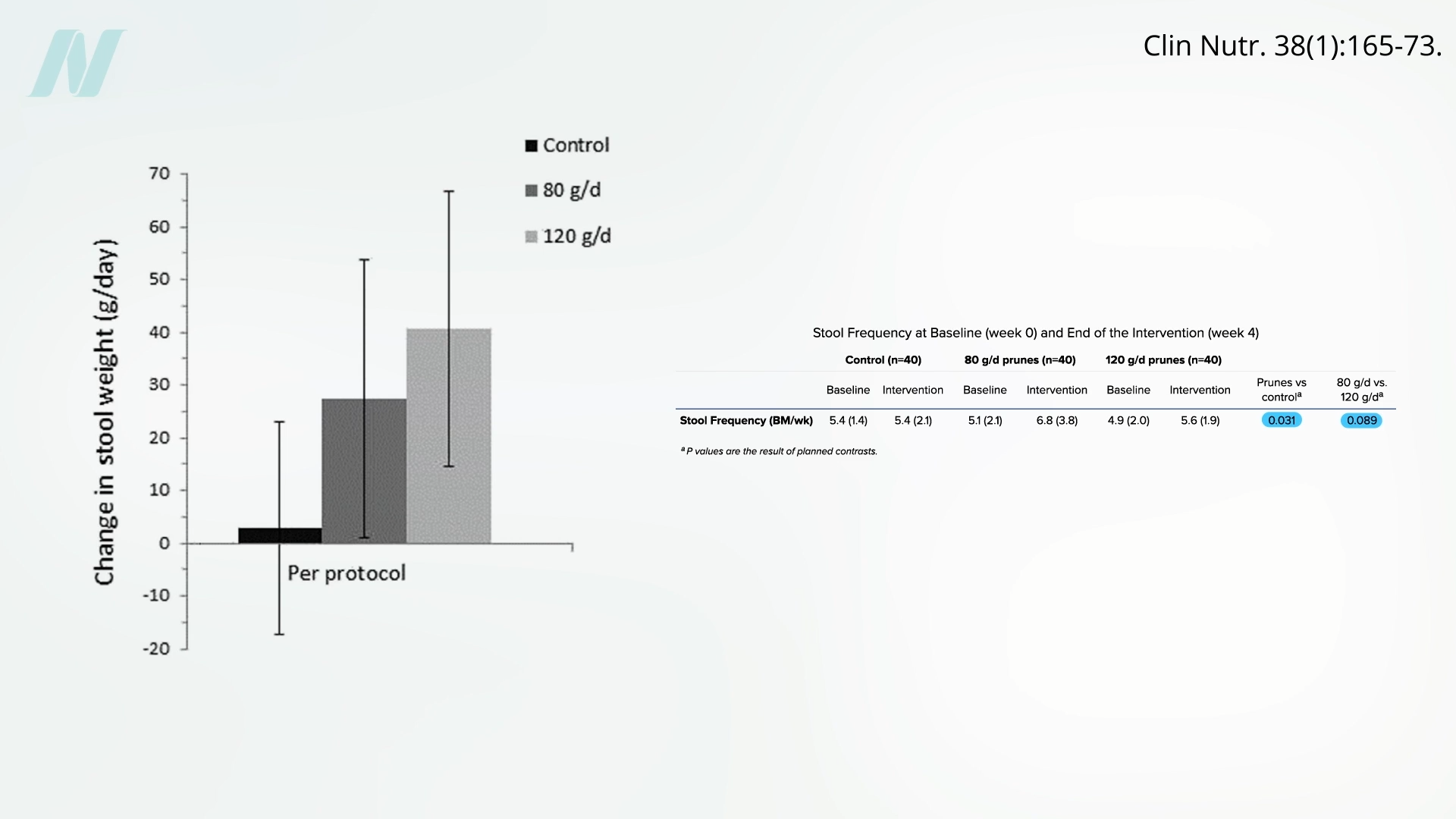
That’s why we need studies like this: Participants were randomized to about 8 prunes a day plus a large glass of water, 12 prunes and water, or just the water alone. So, even the control group got an intervention (the water), which might help with constipation. Previous studies mostly assigned about 10 prunes a day, so the researchers wanted to see if more prunes provided greater benefit or whether fewer would work just as well. They found a significant improvement in stool bulk on the prunes and a significant increase in bowel movement frequency, as you can see below and at 2:45 in my video Prunes: A Natural Remedy for Constipation, though there was no real difference between 8 and 12 prunes. So, 8 a day seems sufficient.
Prunes even seem superior to psyllium, sold as Metamucil, beating it out in terms of improved stool frequency and consistency.
We used to think it was just all the fiber in prunes that was helping, but prune juice evidently works too, which, like most juices, has had the fiber removed. Other potential active components include a natural sugar alcohol known as sorbitol that’s used in some sugar-free gums. Once you eat more than a dozen or so large prunes a day, however, the dose of sorbitol could start reaching laxative levels in susceptible individuals. So, be careful.
If you don’t have constipation, should you avoid prunes? That question has been put to the test, and the answer appears to be no—most people should be able to eat a dozen or so a day without any issues. In fact, it’s interesting to note that prunes have been traditionally used as a laxative and an antidiarrheal remedy.
What about dried figs, one of the few medicinal plants mentioned explicitly in the Bible? Researchers took patients with the type of irritable bowel syndrome (IBS) characterized by constipation and randomized them to one fig with breakfast and one fig with lunch, each with a glass of water, and there was a significant improvement in frequency of defecation and a significant drop in the frequency of hard stools, compared to the control. But what was the control? The control group was just asked to continue their normal diet. In other words, do nothing special. The placebo response for irritable bowel is infamous. Give people with IBS a fake sugar pill, and sometimes 72% say they magically feel better.
That’s why we need this kind of study: a randomized, double-blind, placebo-controlled trial. Researchers made a gross-sounding fake fig paste placebo that supposedly had the same taste, smell, and appearance as the real deal. Those who got the real figs, about six a day, seemed to experience “a significant reduction in colon transit time and a significant improvement in stool type [consistency] and abdominal discomfort,” compared to the placebo. Researchers measured transit time by having people swallow little beads that would show up on X-rays so they could track the progress through their digestive system. They found that those eating the real figs sped up their gut movement by a full 24 hours. Defecation frequency per week didn’t beat out placebo, though. In fact, they tested so many different outcomes, even the stool consistency and abdominal discomfort results may have been statistical flukes. So, it looks like prunes would be the better treatment choice.
Doctor’s Note
What about carbonated drinks? See Club Soda for Stomach Pain and Constipation.
I previously discussed prunes and constipation in Prunes vs. Metamucil vs. Vegan Diet.
What else can prunes do? See Prunes for Osteoporosis.
Can we do anything else for IBS? Check out the related posts below.

Purina Friskies Gravy Wet Cat Food Variety Pack, Savory Shreds With Beef, Turkey and Cheese Dinner, Chicken and Salmon Dinner, With Ocean Whitefish and Tuna - (Pack of 32) 5.5 oz. Cans
$26.47 (as of March 26, 2026 02:13 GMT +00:00 - More infoProduct prices and availability are accurate as of the date/time indicated and are subject to change. Any price and availability information displayed on [relevant Amazon Site(s), as applicable] at the time of purchase will apply to the purchase of this product.)
Amazon Fire TV Stick 4K Max streaming device, with AI-powered Fire TV Search, supports Wi-Fi 6E, free & live TV without cable or satellite, find shows faster with Alexa+
$34.99 (as of March 26, 2026 02:13 GMT +00:00 - More infoProduct prices and availability are accurate as of the date/time indicated and are subject to change. Any price and availability information displayed on [relevant Amazon Site(s), as applicable] at the time of purchase will apply to the purchase of this product.)
Supet Inflatable Dog Cone Collar for Small Dogs Puppies Cats, Soft Dog Cone Alternative After Surgery for Puppies Cats to Stop Licking
$16.98 (as of March 26, 2026 02:13 GMT +00:00 - More infoProduct prices and availability are accurate as of the date/time indicated and are subject to change. Any price and availability information displayed on [relevant Amazon Site(s), as applicable] at the time of purchase will apply to the purchase of this product.)
Life360 Tile - Bluetooth Tracker, Keys Finder and Item Locator for Keys, Bags and More. Phone Finder. Both iOS and Android Compatible. 1-Pack (Aqua Lemon)
$27.99 (as of March 26, 2026 02:17 GMT +00:00 - More infoProduct prices and availability are accurate as of the date/time indicated and are subject to change. Any price and availability information displayed on [relevant Amazon Site(s), as applicable] at the time of purchase will apply to the purchase of this product.)











Post Comment