
Unlocking Industrial Gold: How Germany’s Non-contact Pyrometer is Revolutionizing Safety and Saving Millions in High-Heat Zones
Ever wondered how industries in Germany handle the scorching heat of steel mills, glass factories, and ceramics production without turning their thermometers into expensive molten blobs? It’s not just about sticking a sensor into the fire and hoping for the best—that would be a fiery disaster waiting to happen! Instead, these heroes of high-temperature measurement rely on a clever little gadget called a non-contact pyrometer. Picture this: measuring blistering surfaces safely from a distance by capturing invisible infrared radiation—and voilà, you get accurate readings without breaking a sweat or risking a burnt finger. This nifty technology not only keeps workers safe but also ensures that manufacturing processes run seamlessly under some of the most intense heat conditions on earth. Intrigued? You should be. Let’s dive into how this infrared marvel is revolutionizing temperature measurement across Germany’s heat-heavy industries. LEARN MORE
High-temperature processes are common across Germany’s steel, glass, ceramics, foundry, forging, heat treatment, and manufacturing sectors. The challenge isn’t simply measuring temperature. It’s getting dependable readings without putting people or sensors in direct contact with a hot surface.
That’s where a non-contact pyrometer becomes useful. It measures infrared radiation emitted by an object and converts that radiation into a temperature reading. The operator can monitor a billet at a furnace exit, a ceramic component inside a kiln, or a heated metal surface from a safer distance.
Germany’s Physikalisch-Technische Bundesanstalt (PTB), the country’s national metrology institute, recognises radiation thermometry as a method for non-contact temperature measurement and supports calibration and traceability for industrial applications.[a]
What is a Non-contact Pyrometer and its Role in Temperature Measurement?
A non-contact pyrometer measures surface heat from a distance by reading the thermal radiation coming off an object. Unlike standard thermocouples or RTD probes, it doesn’t touch the target material at all, which saves your instrument from melting when taking readings on red-hot metal sheets or fast-moving conveyor lines.
The way it works is actually pretty simple.
Anything hotter than absolute zero throws off invisible thermal energy. The pyrometer focuses that infrared light through an optical lens, captures specific wavelengths on an internal detector, and converts that light energy straight into a clear temperature readout on your control panel screen.
This approach is particularly useful when contact measurement is impractical. The target may be moving, inaccessible, extremely hot, contaminated, or capable of damaging a conventional sensor.
PTB’s radiation thermometry department covers non-contact temperature measurements from approximately -170°C to 3000°C and identifies applications across metal, glass, plastics, food processing, and energy production.[b]
One point engineers shouldn’t overlook is emissivity. Different surfaces emit infrared radiation differently. A polished metal surface, oxidised steel surface, ceramic, and painted component won’t necessarily produce the same measurement response at the same actual temperature. That’s why emissivity adjustment and correct wavelength selection matter.
Benefits of a Non-contact Pyrometer in Germany’s High-temperature Industrial Surroundings
1. Operators can measure from a safer position
This matters around furnaces, reheating lines, casting equipment, and hot metal handling areas. Germany’s Federal Institute for Occupational Safety and Health (BAuA) identifies technologically generated heat and high thermal radiation as workplace hazards in industries such as metal, glass, ceramics, and rubber manufacturing.
A remote temperature measurement point can therefore support safer operating procedures, although a pyrometer isn’t itself a complete workplace heat-stress control.
2. No sensor is exposed to the process
A contact probe can suffer mechanical wear, oxidation, contamination, or thermal shock. A non-contact instrument avoids direct contact with the product.
That can be especially useful where the material is moving quickly or where contact could disturb the process.
3. Fast temperature feedback
High-speed processes need quick measurements. Some industrial infrared pyrometers provide response times in milliseconds. Fast feedback can help identify temperature excursions before they become quality or equipment problems.
4. Useful for very high temperatures
Contact sensors have practical limits depending on their construction and installation. Radiation thermometry can cover much higher ranges. PTB maintains radiation-temperature capabilities extending to 3000°C and describes applications involving glass, ceramics, refractory metals, and other high-temperature materials.
5. Better visibility into moving processes
A pyrometer can measure billets, strips, forgings, or other moving products while they remain on the production line. That allows engineers to check temperature at specific process stages rather than relying only on furnace setpoints.
How to Select the Right Non-contact Pyrometer?
Choosing a pyrometer isn’t just about selecting the highest temperature range. The measurement environment determines whether the instrument will produce useful data.
Check the temperature range
Start with the actual minimum and maximum target temperature. Don’t select an instrument solely because its upper limit looks impressive. A suitable operating range should match the process and provide useful resolution around the normal measurement point.
Consider the target material and emissivity
Surface condition matters. Oxidation, scale, coatings, and changing material composition can affect emissivity. Choose a pyrometer with suitable emissivity adjustment and, where necessary, a wavelength suited to the target.
Check distance-to-spot ratio
A pyrometer doesn’t measure an infinitely small point. Its optics define a measurement spot. If the target is smaller than the spot, surrounding surfaces can influence the reading.
For example, a 15:1 distance-to-spot ratio means that, under the specified optical conditions, a 1500 mm measuring distance corresponds to an approximately 100 mm spot. Always check the manufacturer’s actual optical specification before installation.
Match the response time to the process
A slowly changing furnace wall doesn’t need the same response characteristics as a rapidly moving hot billet. Fast-moving processes generally call for a faster response and suitable signal processing.
Consider the installation environment
Dust, steam, smoke, vibration, ambient temperature, and electromagnetic interference can all affect measurement reliability. Check the required housing, cooling arrangement, sighting method, communication interface, and mounting accessories before installation.
Don’t overlook calibration and traceability
For quality-critical processes, calibration should be part of the measurement plan. A useful field practice is to document the measurement point, target material, emissivity setting, working distance, and calibration status. That makes troubleshooting much easier when readings suddenly change.
Final Words
Temperature measurement and workplace safety are closely connected in high-temperature production, but the instrument must be selected for the actual process rather than simply the headline temperature range.
A properly specified non-contact pyrometer gives engineers a way to monitor hot surfaces while keeping measurement equipment and personnel away from direct contact. That’s valuable around furnaces, metal-processing lines, kilns, glass production, and other demanding applications.
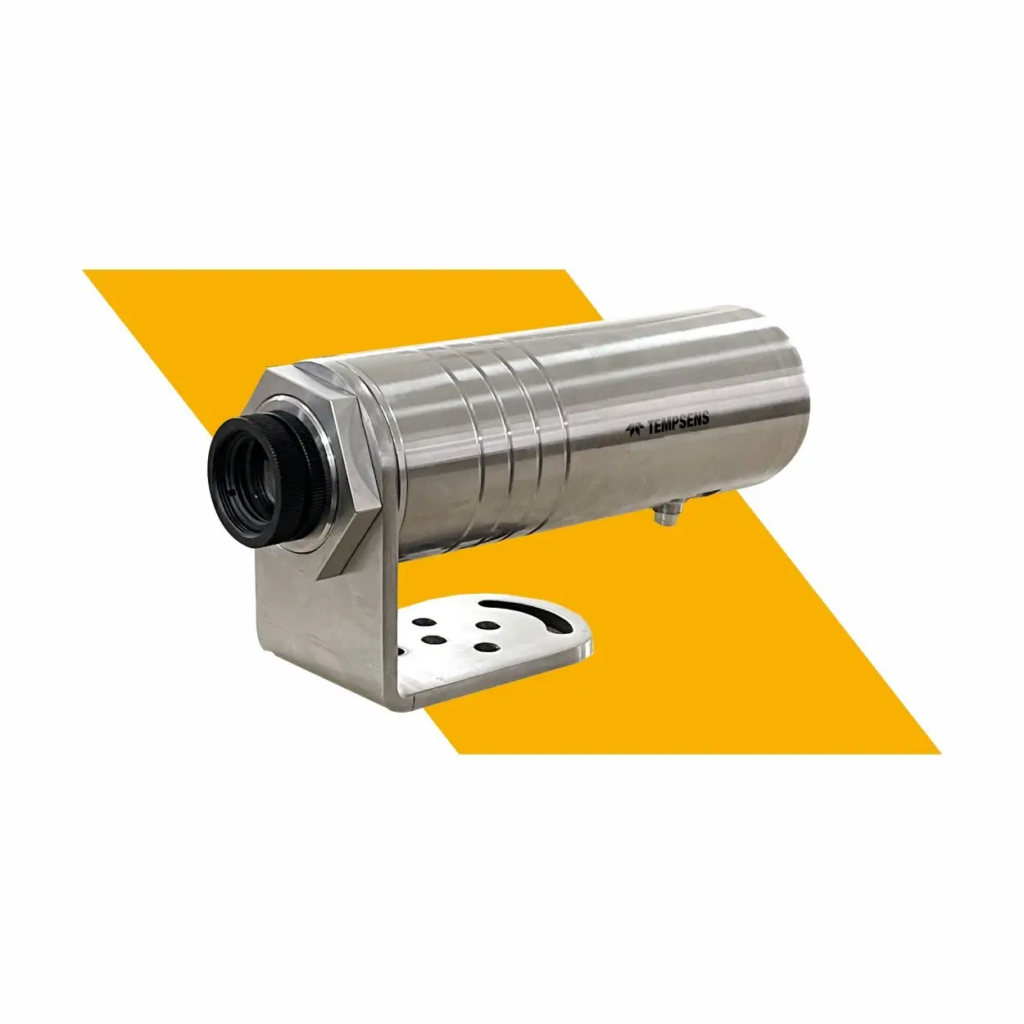
Tempsens develops industrial temperature measurement solutions for high-temperature and critical process applications, including infrared pyrometers designed for demanding industrial environments. Its A250 range, for example, covers 210°C to 3000°C, while its T3-250 PL is specified for 250°C to 2500°C.
For German plants, the practical question isn’t simply, “Can this pyrometer measure 1,500°C?” It’s “Can it measure our actual target accurately, repeatedly, and safely under our operating conditions?” That’s the question that leads to a better measurement system.
[a]https://www.ptb.de/cms/en/ptb/fachabteilungen/abt7/fb-73/ag-736.html
[b]https://www.ptb.de/cms/en/ptb/fachabteilungen/abt7/fb-73.html
<!–
–>

Medium Hass Avocado
(as of October 19, 2026 03:10 GMT +00:00 - More infoProduct prices and availability are accurate as of the date/time indicated and are subject to change. Any price and availability information displayed on [relevant Amazon Site(s), as applicable] at the time of purchase will apply to the purchase of this product.)
Pure Life Purified Bottled Water - 15 Pack, 16.9 Fl Oz | Still Drinking Water Enhanced with Minerals for a Crisp Taste
$4.95 (as of October 19, 2026 03:10 GMT +00:00 - More infoProduct prices and availability are accurate as of the date/time indicated and are subject to change. Any price and availability information displayed on [relevant Amazon Site(s), as applicable] at the time of purchase will apply to the purchase of this product.)
TAGRY Hybrid Active Noise Cancelling Headphones 100H Playtime Wireless Over Ear Bluetooth Headphone with Fast Charging Hi-Res Audio Comfort Earcups Headsets for Travel Home Office Phone PC Black
$79.98 (as of October 19, 2026 03:33 GMT +00:00 - More infoProduct prices and availability are accurate as of the date/time indicated and are subject to change. Any price and availability information displayed on [relevant Amazon Site(s), as applicable] at the time of purchase will apply to the purchase of this product.)
Coca-Cola Zero Sugar Soda Soft Drink Fridge Pack Cans, 12 fl oz, 12 Pack | Carbonated cola soda pop with zero calories
$7.68 (as of October 19, 2026 03:10 GMT +00:00 - More infoProduct prices and availability are accurate as of the date/time indicated and are subject to change. Any price and availability information displayed on [relevant Amazon Site(s), as applicable] at the time of purchase will apply to the purchase of this product.)













Post Comment