
Unlocking the Mystery Behind the Rolex Daytona: Why This Iconic Timepiece Commands Obsession and Skyrockets in Value
Is a watch just a timekeeper, or could it also be your passport to a $13.7 million turquoise fantasy? September’s charity auction in London certainly made me pause—four Rolex Daytonas fetching a staggering £37.3 million ($49.5 million) altogether, with the priciest boasting a pink sapphire halo. Meanwhile, Rolex teased us with a steel-and-platinum Daytona that winked retro with its 1963-style enamel dial. It’s wild to think the humble steel Daytona, retailing at $16,900 if you’re lucky enough to grab one, once sat dusty on shelves, discounted to clear out stock. How did this icon transcend its modest beginnings to become the crown jewel of collectors and auction houses? Buckle up as we zoom through the fascinating history, quirks, and rare gems of the Daytona — a watch that’s raced its way into legend. LEARN MORE
 4 min read
In September, four Rolex Daytonas sold at a charity auction in London for a combined £37.3 million (about $49.5 million). The most expensive, at £10.3 ($13.7) million, had a turquoise dial and a ring of pink sapphires. That same month, Rolex unveiled a steel-and-platinum Daytona with a white enamel dial and a speed scale that recalled the original from 1963.
The regular steel Daytona with a white dial costs $16,900 from Rolex, if you can get one. In September, WatchCharts put its secondary-market value around $35,000. It wasn’t always like this. In its early years, according to Sotheby’s, retailers discounted Daytonas to clear stock.
The first Daytona
Rolex launched the Cosmograph in 1963. An early advert called it the “Le Mans,” after the French endurance race. The name that stuck came from Daytona, Florida, where cars raced on hard-packed sand before the city had a speedway.

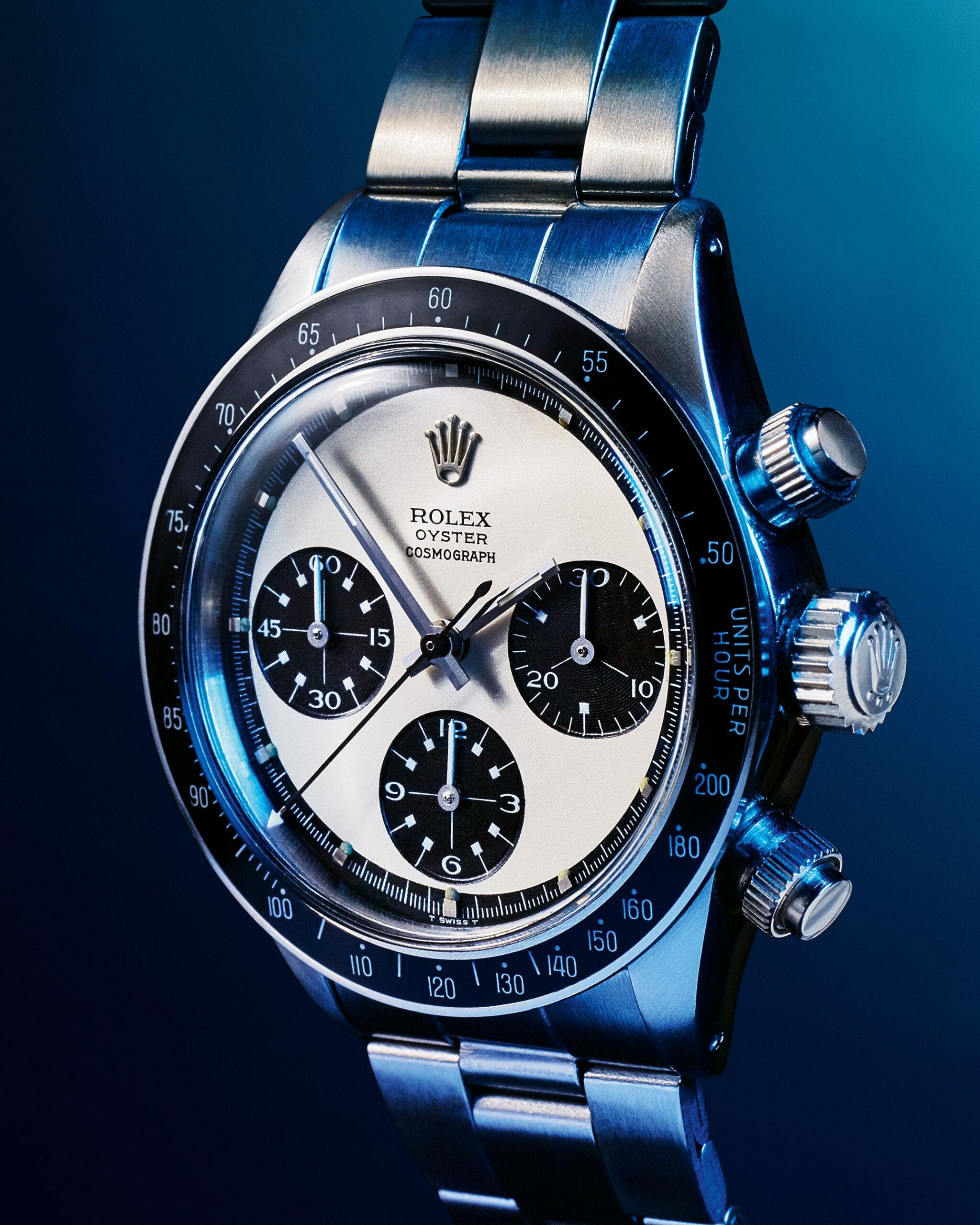
The original Rolex Cosmograph ref. 6239, launched in 1963, featured a hand-wound movement and a tachymeter scale engraved on its steel bezel.
The first model, reference 6239, had a movement you wound by hand and two buttons to operate the stopwatch. Rolex put the speed scale on the steel bezel, where a driver could read it at a glance. The three small counters stood out against the dial, black on a light face or light on a black one.
By the 1970s, two models had emerged that collectors still prize today. The 6263 had a black acrylic bezel, and the 6265 had a metal one. Both had screw-down collars around the stopwatch buttons. On some, the word Daytona curves in red above the bottom counter. Collectors call these “Big Reds.”

The Rolex Daytona ref. 6263, with its black acrylic bezel, screw-down chronograph pushers, and distinctive red Daytona lettering.
The Paul Newman
Joanne Woodward gave Newman a 6239 around the time he made Winning, the 1969 film that sparked his interest in racing. She had “DRIVE CAREFULLY ME” engraved on the back. “There’s something almost magical about it,” James Cox, who later owned the watch, told Phillips. In 2017 it sold for $17.75 million, then an auction record for a wristwatch.

Paul Newman’s own Rolex Daytona ref. 6239, a gift from his wife Joanne Woodward, sold for $17.75 million in 2017.
A “Paul Newman” usually refers to a type of dial. Look for the unusual numerals and small square-ended markers in the counters. The dials were unpopular when new. By 2013, Christie’s could sell 50 Daytonas in a single Geneva auction for $13.2 million. The top lot was a steel watch with a Paul Newman dial. It fetched $1.09 million, four years before the actor’s own watch went to auction.
On one particularly rare black-dial 6263, the word Oyster appears below Rolex Cosmograph. Collectors call it the Oyster Sotto, from the Italian for under. Phillips sold one in 2025 for 1.39 million Swiss francs (approximately $1.67 million). “One mistake people make is that they expect everything to fit neatly into a specific set of rules,” Geoff Hess, global head of watches at Sotheby’s, once explained. A dial can be genuine Rolex and still have come from a different watch.
The Zenith Daytona
In 1988 the steel Daytona became the 16520. It grew to 40mm, gained raised gold hour markers and a glossier dial, and wound itself as you wore it. Rolex extensively reworked Zenith’s El Primero movement for the watch. It was the first automatic Daytona and the model that established the basic dimensions of the watch Rolex still makes today.

Introduced in 1988, the Rolex Daytona ref. 16520 was the first automatic Daytona, powered by a heavily modified Zenith El Primero movement.
On some early examples, a gap makes the word Cosmograph appear to float beneath the rest of the lettering. On certain black dials, the rings around the counters have turned brown with age. Those are known as Patrizzi dials, after the auctioneer Osvaldo Patrizzi, who noticed the change.
The modern Daytona
Three steel references are worth knowing. The 116520, introduced in 2000, has a steel bezel and the first chronograph movement Rolex developed and made itself. The 116500LN, from 2016, brought back the look of the black acrylic bezel in ceramic. The current 126500LN, introduced in 2023, has a slim steel rim around that ceramic bezel, a revised dial, and a new movement that runs for about three days when fully wound. The two ceramic models can look remarkably similar in listing photographs.

The Rolex Daytona ref. 116500LN, introduced in 2016, brought the black bezel back in scratch-resistant ceramic.
The rarest Daytonas
The unicorn is a hand-wound 6265 that Phillips described in 2018 as the only known vintage Daytona in white gold. It sold for 5.94 million Swiss francs (about $7.1 million). The Rainbow gets its name from the graduated sapphires around its bezel. A white-gold example made around 1994, nearly two decades before the production versions appeared, sold in 2024 for 5.505 million Swiss francs (approximately $6.1 million).

The Rolex Daytona Rainbow, with a bezel set with graduated colored sapphires, is among the most extravagant versions of the chronograph.
Sixty years after that early advertisement, Rolex returned to Le Mans. Its 2023 watch for the race’s centenary has a stopwatch that counts the full 24 hours. The regular Daytona counts to 12.
Buying a Daytona
An official Rolex retailer is the place to start if you want a new one at list price. Retailers manage their own allocations, so availability varies. Rolex addressed the shortage in 2021. “The scarcity of our products is not a strategy on our part,” it said, explaining that it could not meet demand without compromising quality.
On the secondary market, compare the same reference and dial. The WatchCharts September estimate for the current black-dial steel model was about $29,000, roughly $6,000 less than the white. If you’re buying vintage, ask a specialist dealer or auction house for a condition report. Find out whether the case has been heavily polished, which parts have been replaced, and whether the dial is correct for that particular watch. On a Daytona, those details can explain more about the price than the reference number.

Apple iPad 11-inch: A16 chip, 11-inch Model, Liquid Retina Display, 128GB, Wi-Fi 6, 12MP Front/12MP Back Camera, Touch ID, All-Day Battery Life — Blue
$399.99 (as of November 12, 2026 03:26 GMT +00:00 - More infoProduct prices and availability are accurate as of the date/time indicated and are subject to change. Any price and availability information displayed on [relevant Amazon Site(s), as applicable] at the time of purchase will apply to the purchase of this product.)
Greenies Pill Pockets Large Size Dog Treats, Peanut Butter, 15.8 oz | Vet-recommended, masks pill smell & taste, moldable texture, capsule size, natural ingredients, no fillers, 15.8 oz. pouch
$19.96 (as of November 12, 2026 03:23 GMT +00:00 - More infoProduct prices and availability are accurate as of the date/time indicated and are subject to change. Any price and availability information displayed on [relevant Amazon Site(s), as applicable] at the time of purchase will apply to the purchase of this product.)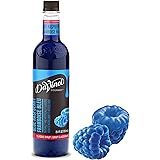
DaVinci Gourmet Classic Blue Raspberry, 25.4 Fluid Ounces (Pack of 1)
$5.99 (as of November 12, 2026 03:23 GMT +00:00 - More infoProduct prices and availability are accurate as of the date/time indicated and are subject to change. Any price and availability information displayed on [relevant Amazon Site(s), as applicable] at the time of purchase will apply to the purchase of this product.)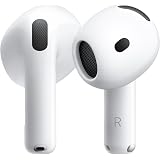
Apple AirPods 5 Wireless Earbuds with Active Noise Cancellation | Bluetooth Headphones, Personalized Spatial Audio, Live Translation, USB-C Charging Case, H2 Chip
$129.00 (as of November 12, 2026 03:26 GMT +00:00 - More infoProduct prices and availability are accurate as of the date/time indicated and are subject to change. Any price and availability information displayed on [relevant Amazon Site(s), as applicable] at the time of purchase will apply to the purchase of this product.)












Post Comment