
USD/CHF Surges Amid US-Iran Tensions—but Here’s Why the Bears Aren’t Ready to Back Down Just Yet
Ever noticed how the forex market sometimes feels like a high-stakes game of chess? Just when you think one side has the upper hand, a sudden move can flip the entire board. Take the USD/CHF pair, for instance — it’s just nudged higher to around 0.7830, breaking free from a stubborn four-day losing streak. What’s driving this twist? Well, amidst the murky backdrop of US-Iran peace talks and military skirmishes, the US Dollar finds itself clinging to a bit of newfound strength against the Swiss Franc. Now, here’s the kicker: with the US military’s cautious strikes in southern Iran adding fuel to the uncertainty, traders are also fixated on the upcoming US Personal Consumption Expenditures Price Index. Could persistent inflation data shove the Greenback even higher? Or is this just a temporary blip before the bears reclaim control? Buckle up, because the next few days promise to be anything but dull. LEARN MORE
The USD/CHF pair edges higher to near 0.7830, snapping the four-day losing streak, during the early European session on Tuesday. Uncertainty surrounding the US-Iran peace negotiations provides some support to the US Dollar (USD) against the Swiss Franc (CHF).
The US military’s Central Command said US forces have carried out strikes on southern Iran in “self-defence,” the Guardian reported on Monday. It said that the military will defend US forces “while using restraint” during the ongoing ceasefire.
Traders will keep an eye on the US April Personal Consumption Expenditures (PCE) Price Index report, which is due later on Thursday. Any signs of persistent inflation in the US could shift market expectations away from rate cuts and lift the Greenback in the near term.
Technical Analysis:
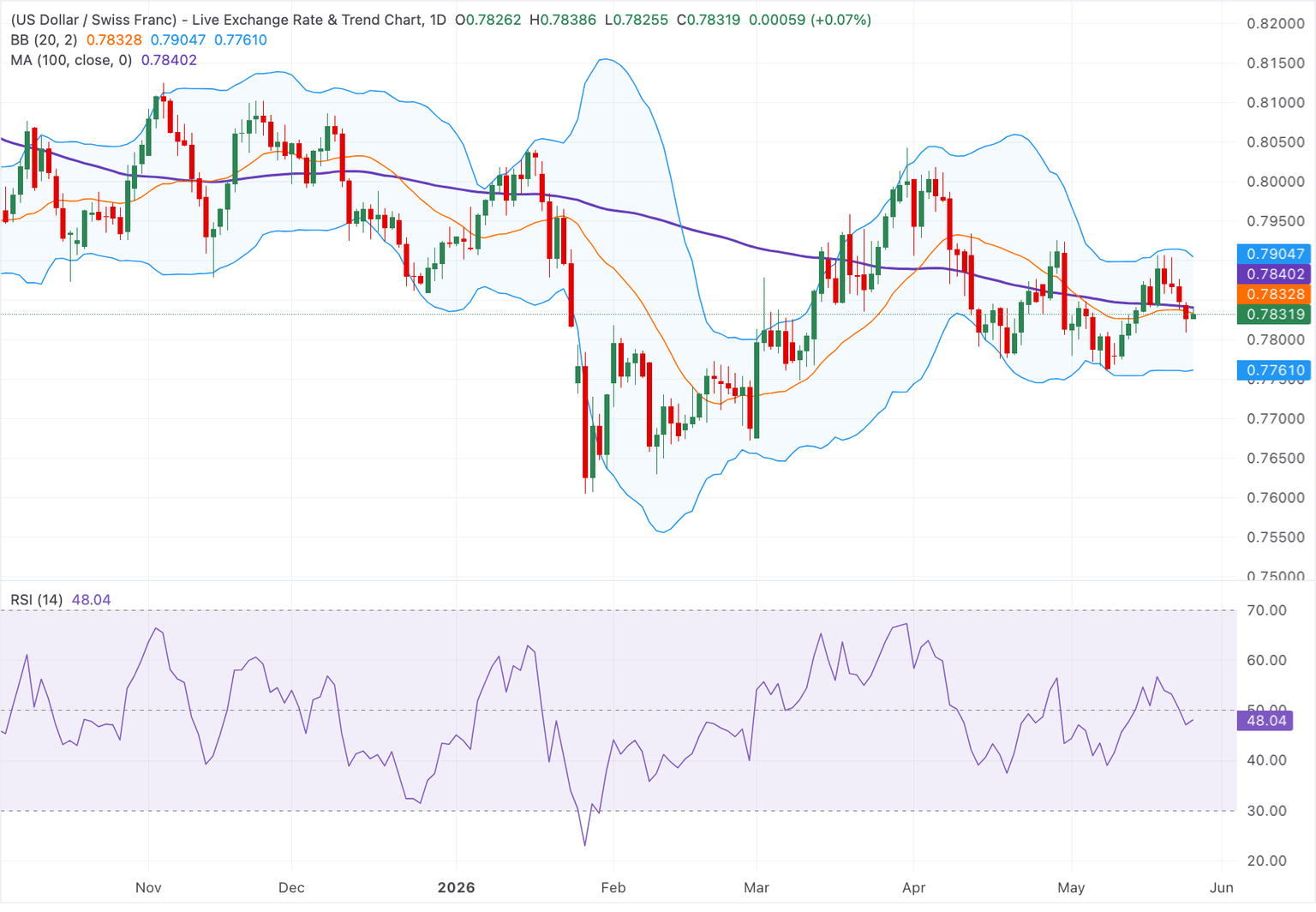
In the daily chart, USD/CHF maintains a bearish near-term tone as the spot holds beneath the 100-day moving average (MA). Price is also trading just under the 20-day Bollinger middle band, underscoring persistent topside pressure despite a modest recovery from recent lows. The Relative Strength Index (14) at 48 remains slightly below the neutral 50 mark, hinting that downside momentum has eased but not yet shifted in favor of the bulls.
On the topside, initial resistance emerges at the 100-day MA at 0.7840. A daily close above this cluster would be needed to alleviate immediate downside pressure and open the way toward the Bollinger upper band near 0.7905. On the downside, the first notable support is seen at the May 26 low of 0.7808. The next contention level is located at the 20-day Bollinger lower band around 0.7760, where failure would suggest a resumption of the broader decline and expose lower lows on the daily chart.
(The technical analysis of this story was written with the help of an AI tool.)
Swiss Franc FAQs
The Swiss Franc (CHF) is Switzerland’s official currency. It is among the top ten most traded currencies globally, reaching volumes that well exceed the size of the Swiss economy. Its value is determined by the broad market sentiment, the country’s economic health or action taken by the Swiss National Bank (SNB), among other factors. Between 2011 and 2015, the Swiss Franc was pegged to the Euro (EUR). The peg was abruptly removed, resulting in a more than 20% increase in the Franc’s value, causing a turmoil in markets. Even though the peg isn’t in force anymore, CHF fortunes tend to be highly correlated with the Euro ones due to the high dependency of the Swiss economy on the neighboring Eurozone.
The Swiss Franc (CHF) is considered a safe-haven asset, or a currency that investors tend to buy in times of market stress. This is due to the perceived status of Switzerland in the world: a stable economy, a strong export sector, big central bank reserves or a longstanding political stance towards neutrality in global conflicts make the country’s currency a good choice for investors fleeing from risks. Turbulent times are likely to strengthen CHF value against other currencies that are seen as more risky to invest in.
The Swiss National Bank (SNB) meets four times a year – once every quarter, less than other major central banks – to decide on monetary policy. The bank aims for an annual inflation rate of less than 2%. When inflation is above target or forecasted to be above target in the foreseeable future, the bank will attempt to tame price growth by raising its policy rate. Higher interest rates are generally positive for the Swiss Franc (CHF) as they lead to higher yields, making the country a more attractive place for investors. On the contrary, lower interest rates tend to weaken CHF.
Macroeconomic data releases in Switzerland are key to assessing the state of the economy and can impact the Swiss Franc’s (CHF) valuation. The Swiss economy is broadly stable, but any sudden change in economic growth, inflation, current account or the central bank’s currency reserves have the potential to trigger moves in CHF. Generally, high economic growth, low unemployment and high confidence are good for CHF. Conversely, if economic data points to weakening momentum, CHF is likely to depreciate.
As a small and open economy, Switzerland is heavily dependent on the health of the neighboring Eurozone economies. The broader European Union is Switzerland’s main economic partner and a key political ally, so macroeconomic and monetary policy stability in the Eurozone is essential for Switzerland and, thus, for the Swiss Franc (CHF). With such dependency, some models suggest that the correlation between the fortunes of the Euro (EUR) and the CHF is more than 90%, or close to perfect.

Roku TV Remote Control (Official Manufacturer Product) | Simple Setup & Pre-Set App Shortcuts - Replacement Remote Compatible with RokuTV Models ONLY (Not Roku Players)
$9.99 (as of October 11, 2026 03:20 GMT +00:00 - More infoProduct prices and availability are accurate as of the date/time indicated and are subject to change. Any price and availability information displayed on [relevant Amazon Site(s), as applicable] at the time of purchase will apply to the purchase of this product.)
Amazon Basics Dog Poop Leak Proof Bags with Dispenser and Leash Clip, Unscented, 13" x 9" Large Size, 300 Count
$11.24 (as of October 11, 2026 03:11 GMT +00:00 - More infoProduct prices and availability are accurate as of the date/time indicated and are subject to change. Any price and availability information displayed on [relevant Amazon Site(s), as applicable] at the time of purchase will apply to the purchase of this product.)
SHOKZ OpenRun Air 2 Bone Conduction Open-Ear Bluetooth Headphones,Black | Bundle with Hair Band;26.4g lightweight; Secure fit; PremiumPitch 3.0 sound; IP67; 10H battery; Running/cycling/hiking
$129.95 (as of October 11, 2026 03:30 GMT +00:00 - More infoProduct prices and availability are accurate as of the date/time indicated and are subject to change. Any price and availability information displayed on [relevant Amazon Site(s), as applicable] at the time of purchase will apply to the purchase of this product.)
Amazon Fire TV Stick 4K (newest model), simple 4K streaming, new Fire TV Remote, all your apps in one place, free & live TV, find shows faster with Alexa+
$59.99 (as of October 11, 2026 03:30 GMT +00:00 - More infoProduct prices and availability are accurate as of the date/time indicated and are subject to change. Any price and availability information displayed on [relevant Amazon Site(s), as applicable] at the time of purchase will apply to the purchase of this product.)













Post Comment