
Why Singapore’s Future Hangs on an Unexpected Workforce You’ve Been Overlooking All Along
Ever wondered why singles should even care about a baby boom when they’re not the ones changing diapers or attending PTA meetings? After Prime Minister Lawrence Wong’s National Day Rally speech set the stage for Singapore’s ambitious baby-making redesign, the spotlight surprisingly shifts to singles—not the usual suspects in parenting conversations. It’s easy to feel like outsiders looking in, especially when the perks seem reserved only for parents. But here’s the kicker: investing in the future of our nation’s children isn’t just a “nice-to-have” for couples—it’s a lifeline for singles too. Think about it—without a steady stream of young workers and caregivers, who’s going to keep the MRT running or look after us in our golden years? On the flip side, with family-friendly policies expanding, singles find themselves juggling workload gaps and the sneaky sting of “childless-unfriendly” workplaces. So how do we navigate this tangled web of responsibility, fairness, and headspace when the office feels less like a team and more like a juggling act? Let’s dive into the nitty-gritty where demographics, work dynamics, and personal space collide in today’s Singapore. LEARN MORE
img#mv-trellis-img-1::before{padding-top:70.60546875%; }img#mv-trellis-img-1{display:block;}
After Prime Minister Lawrence Wong’s National Day Rally speech, which heavily focus on the redesign of how to encourage more couples to have kids, a couple of news pieces focus more on the singles.
Bhavan Jaipragas’ piece in the Straits Times [Why Singapore’s singles have a stake in its new baby push] argues singles aren’t bystanders to the new parenthood push. We [I am single btw] are stakeholders who should actively support it, even though we get nothing direct from it.
Some of his reasoning:
- “Investing in Human infrastructure”: just as the state invests in MRT lines, roads, and the power grid, investing in children today is investing in the workers, taxpayers, and caregivers society will need tomorrow. This includes the doctors and nurses who’ll look after aging singles later.
- Insurance against demographic collapse: if birth rates don’t recover, the “eventual result is the extinction of the native Singaporean,” so today’s singles are told to see funding parenthood as protecting their own future rather than subsidizing someone else’s lifestyle choice.
Trevor Yu asks in the Straits Times who picks up the slack at work [More childcare leave is good. But who picks up the slack at work?]. Trevor argument is more about the childless co-workers, not exactly singles.
If you increase the leave days of parents then who do the work?
Trevor warns that if the burden of covering for parents on leave keeps falling on childless colleagues, “resentment can develop”.
The more you make policies “family-friendly”, it means implicitly “childless-unfriendly.”
Most people who are thinking about this would come to different conclusions. If you are younger, you might identify with Trevor’s piece because they echo what you feel in the work place. The needs of singles (that are likely to eventually come) is so far from you to feel strongly about. Resentment before rationality.
For the older singles like myself, we are more thoughtful about the risks singles face and the stuff we enjoy that may not be so apparent to us. We can quite easily miss the point that Singapore is a great place to live and that may not be for long if we don’t have healthy human replenishment.
I can understand the resentment as a single.
Not all singles accumulate well such that paying for 3-5 room resale HDB flats is easy. We don’t get the same degree of dips into BTO as couples, or the degree of subsidies. We do have to fund and support $400,000 to $700,000 flat all by ourselves.
After spending a large chunk of that on our flats, what’s left for our retirement among other things?
This seems unfair when we realize that if the government make this just as conducive for singles to not have a problem with our housing situation, things would have got a lot worse.
I identified a lot of things that Trevor wrote about, viewing from a single working in Providend and Havend. The main C-suites all have children but they are much older children already. The next generation of leaders all have children but need the parents more. We have many colleagues with young kids.
For the longest time, we have less workers that are child-less.
I don’t know if we are a growth company, but my colleague Nataly say Providend is “in a growth phase”. I always wonder which company will say we are in a “maintenance phase and don’t need so much growth.”
Whichever organization, a lot of work requires execution and if more people go on leave, then naturally things slow down. If you want to prevent slowdown, you need to higher more to “do the work in a timely manner”.
I am not sure when, but I develop a habit of looking at our Infotech HR app of who is on leave. You can really feel like you are “missing out” as a single because you will see parental leave, medical leave, official leave.
It also hits me when coworkers need to rush off to pick up their kids, which means we cannot extend the discussion.
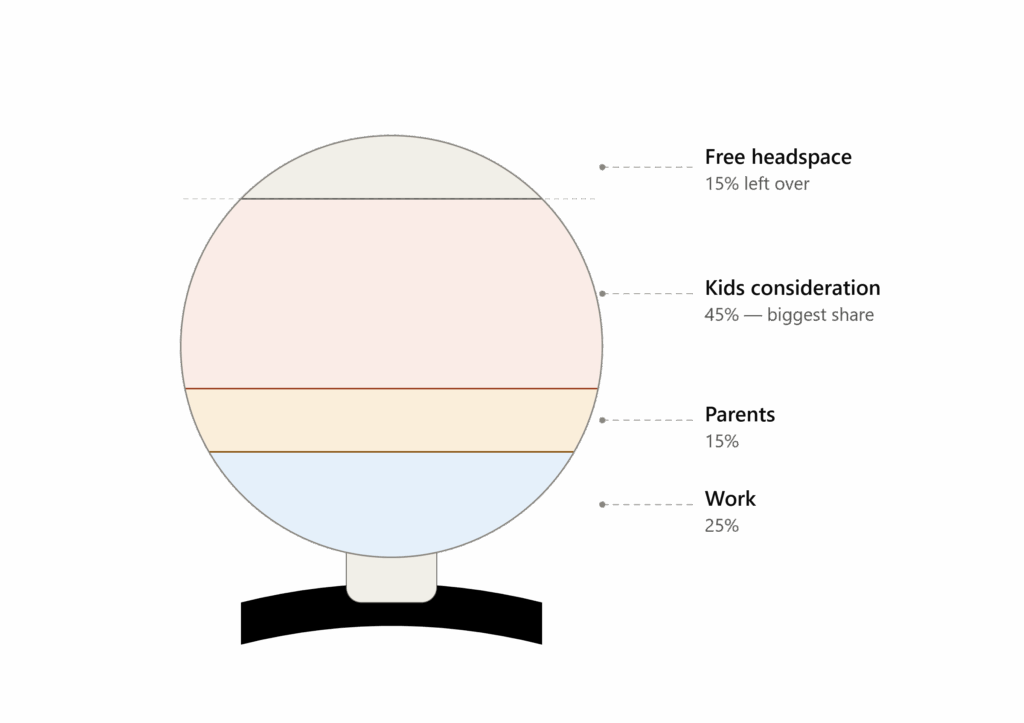
But I guess the biggest difference naturally is the headspace:

If you imagine what you need to think about in your mind, an adult’s brain would look like this. The more you use it the less free headspace.
It is not always kid’s consideration is a large chunk. There are husbands that think about their kids less, so they can think of work more. Some couples do this pretty well and so a spouse can focus better. If you are 40 plus, your parent’s health and disability now takes up another chunk of your headspace.
I do think free headspace for the knowledge workers, may be the difference between childless and those with children. Not all jobs require a lot of headspace. In my old IT support job, its rather operational. A lot of headspace allows me to wander about other stuff.
It is especially necessary if your job requires you to come up with quality decisions so that everyone can execute.
Parents need to especially efficient in this.
How you manage your mind comes with practice as well and I think sometimes singles like me are especially poor at this because we seldom are constrain with so, so, so much balls to juggle.
If you want to hire someone efficient (if you equalize the domain knowledge needs), who would you hire?
Its a tough choice between an efficient ball juggler and someone with a lot of space to think about things.
Tougher because not every parent manages these things well and not every singles want to commit their headspace to think about work so much.
There are the extremes as well.
My ex-colleague Elton tells us the tale of this senior manager in one of his old workplace who is an older single female. She got everyone to move to her beat. And if all your headspace is used for work, wah liew, you imagine the people below you.
Whichever way, I think management need to see the reality.
If you want to scale, you keep hiring people who have little “free headspace” for you, is there enough for “growth”?
How likely is it for you to higher that less common parent with 3 kids who is a great critical thinker and life ball juggler?
Is your salary enough to attract such a person?
What is the base rate here? If you think about it, for some companies, they cannot pay so well and they would have to accept they might need to have enough of the childless people.
If not even those singles, DINKs who resonate with your long term goals, gets compensated reasonably well will feel the heat of the responsibility and inefficiency of work interruptions and leave as well.

Kyith is the Owner and Sole Writer behind Investment Moats. Readers tune in to Investment Moats to learn and build stronger, firmer wealth foundations, how to have a Passive investment strategy, know more about investing in REITs and the nuts and bolts of Active Investing.
Readers also follow Kyith to learn how to plan well for Financial Security and Financial Independence.
Kyith worked as an IT operations engineer from 2004 to 2019. Currently, he works as a Senior Solutions Specialist in Fee-only Wealth Advisory Firm Providend. All opinions on Investment Moats are his own and does not represent the views of Providend.
You can view Kyith’s current portfolio here, which uses his Free Google Stock Portfolio Tracker.
His investment broker of choice is Interactive Brokers, which allows him to invest in securities from different exchanges all over the world, at very low commission rates, without custodian fees, near spot currency rates.
You can read more about Kyith here.

Monster Energy Zero Ultra, Sugar Free Energy Drink, 16 Ounce | Pack of 15
$26.98 (as of October 14, 2026 03:09 GMT +00:00 - More infoProduct prices and availability are accurate as of the date/time indicated and are subject to change. Any price and availability information displayed on [relevant Amazon Site(s), as applicable] at the time of purchase will apply to the purchase of this product.)
Purina ONE Lamb and Rice Formula Dry Dog Food for Digestive Support | Dog food with real lamb as first ingredient, Microbiome Balanced and prebiotic fiber, supports digestive health
$48.98 (as of October 14, 2026 03:11 GMT +00:00 - More infoProduct prices and availability are accurate as of the date/time indicated and are subject to change. Any price and availability information displayed on [relevant Amazon Site(s), as applicable] at the time of purchase will apply to the purchase of this product.)
Banana Bunch (4-5 Count)
(as of October 14, 2026 03:09 GMT +00:00 - More infoProduct prices and availability are accurate as of the date/time indicated and are subject to change. Any price and availability information displayed on [relevant Amazon Site(s), as applicable] at the time of purchase will apply to the purchase of this product.)
Bloom Nutrition Zero Sugar Energy Drink, Apple Crisp, 12oz 12pk | 180mg natural caffeine with prebiotics, green tea extract & lychee for energy, focus and feel-good refreshment.
$24.99 (as of October 14, 2026 03:09 GMT +00:00 - More infoProduct prices and availability are accurate as of the date/time indicated and are subject to change. Any price and availability information displayed on [relevant Amazon Site(s), as applicable] at the time of purchase will apply to the purchase of this product.)











Post Comment