
Why “Where You Work” Is the Old Question—Here’s What Every Entrepreneur Should Be Obsessing Over Instead
For half a decade now, we’ve been caught in this tug-of-war: Should we log in from our cozy couches or shuffle into the office grind? At first glance, it feels like the battle for where we clock our hours is the headline of our lifetime. But here’s a curveball — maybe we’ve been chasing the wrong question all along. The real drama isn’t about the ‘where’; it’s about who’s got the reins on your time, your space, and ultimately, your destiny. And just when you think you’ve wrapped your head around that, artificial intelligence rolls in, turning up the heat and making that question impossible to sidestep. So, before you decide whether to set up your workspace at home or hit the office again, let’s peel back the layers on what’s really at stake — because this debate is less about geography and way more about control, power, and your future on your own terms. LEARN MORE
— It’s Who Decides!
The debate over remote work is really about control, and AI is about to make that even harder to overlook.
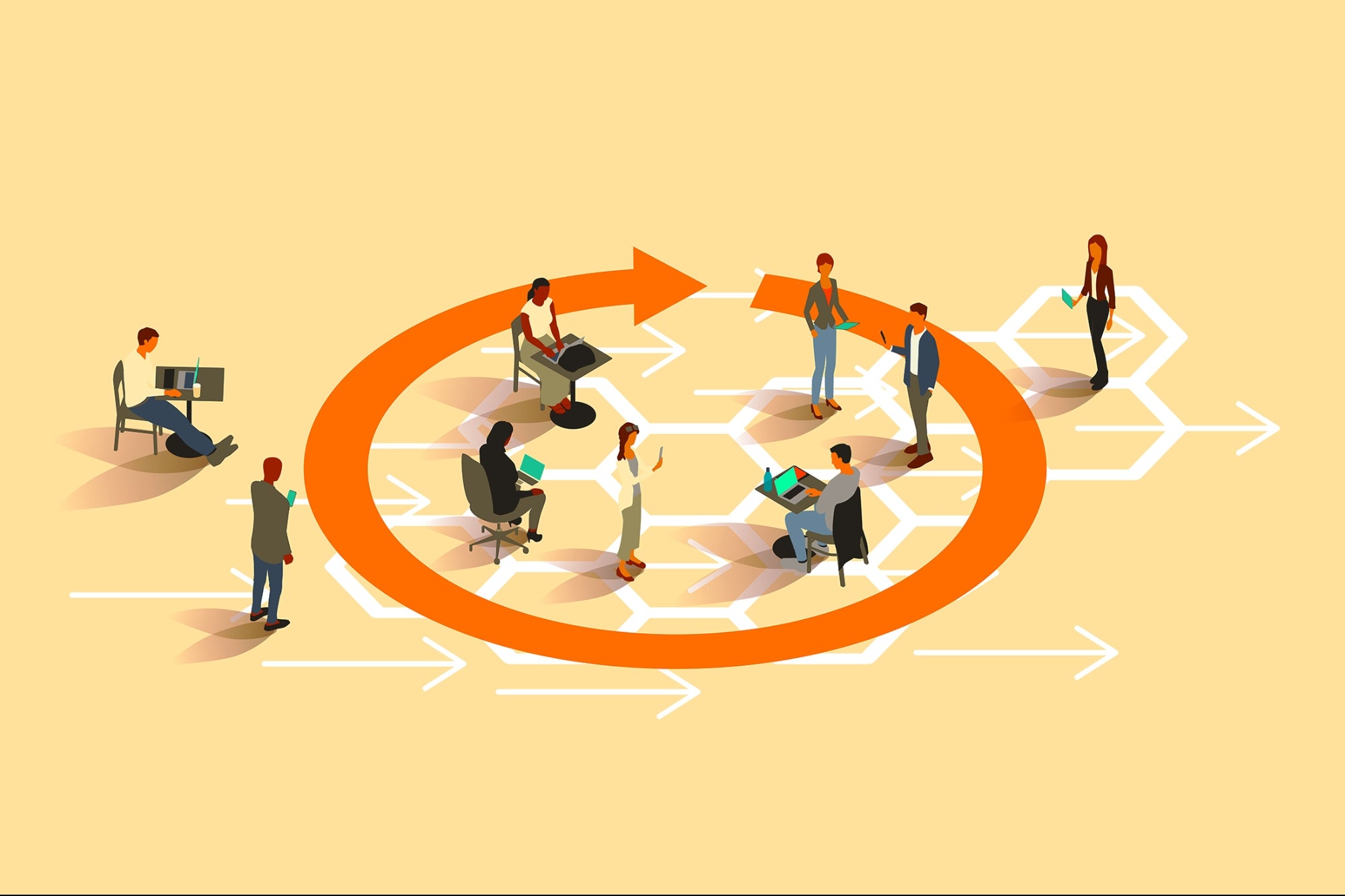
For five years, we have debated whether people should work from home or go back to the office. It seems like the main issue of our time, but maybe we are asking the wrong question. The real concern is about who controls your time, your location, and your future. Artificial intelligence is about to make this question even clearer.
Let’s look at where things stand right now.
Remote work is here to stay, but things are changing.
Working from home is still common. In early 2026, about a quarter of all paid workdays in the U.S. were remote (Stanford WFH Research, 2026). That is much higher than the 5 to 6 percent before 2020. Hybrid schedules are now normal for millions of office workers.
People also enjoy remote work. In a 2026 survey, 69% of remote workers said their work-life balance got better over the past year, with Gen X most likely to “unplug” after work (CoworkingCafe Remote Work Well-Being Survey, 2026). Many now say their ideal work setup is very different from before the pandemic.
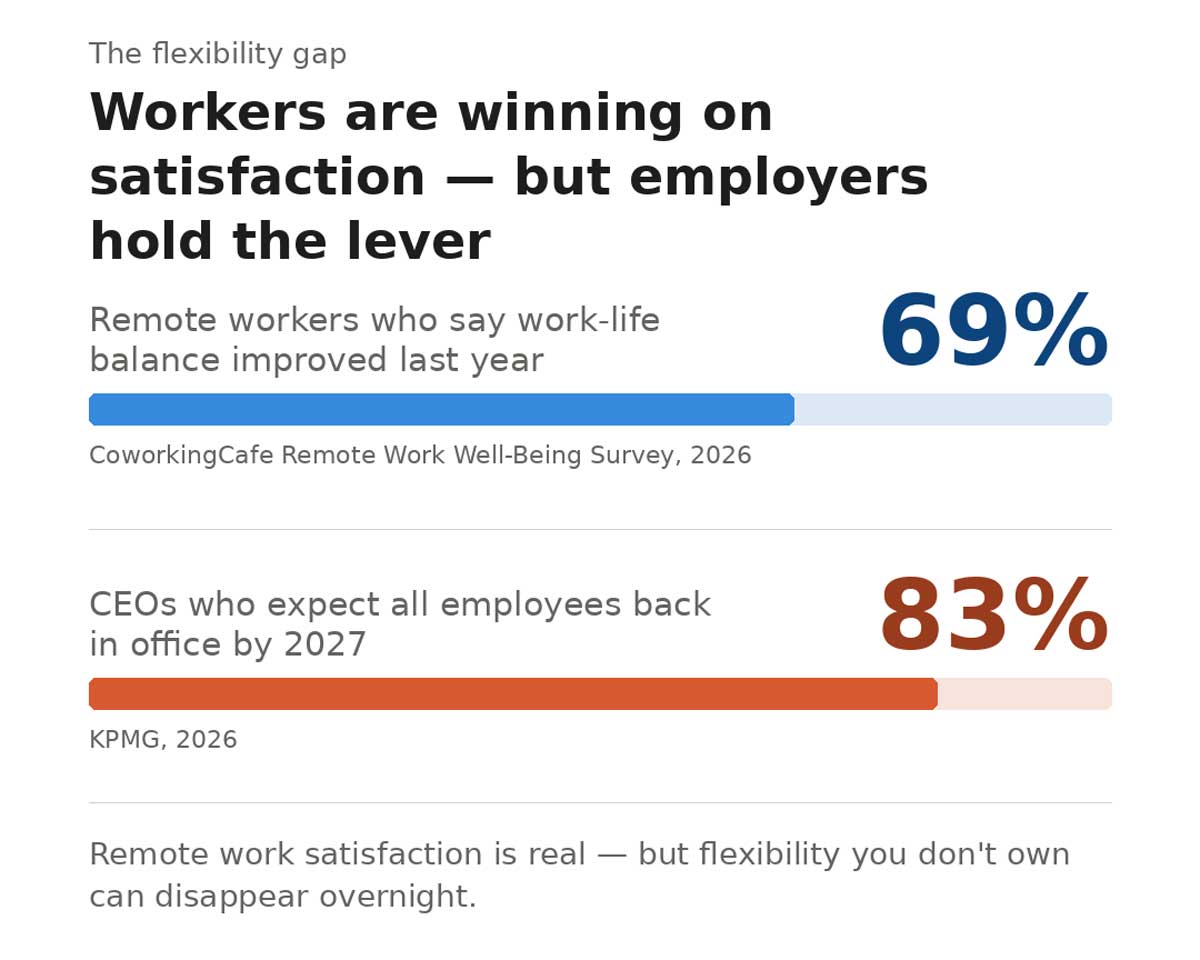
But there is a catch. More employers are enforcing return-to-office rules. One estimate says 83% of CEOs expect everyone back in the office by 2027 (KPMG, 2026), even though badge swipes and phone data show workers are not coming in as often as expected. The flexibility you have now is not really yours. It is a perk your employer can give or take away at any time. That fact is important, and AI is about to make it even more so.
AI shifts the question from ‘where’ you work to ‘whether’ your work is needed.
For a long time, people worried about where they worked. Now, the concern is about the work itself.
AI is very good at routine, repeatable tasks like data entry, basic coding, simple reports, and everyday office work. More than half of U.S. workers (54%) already use AI tools at work (2026). A 2026 study found that about 5.1% of U.S. jobs, or roughly 7.9 million, are at high risk of automation (SHRM, 2026). The jobs most at risk are ‘execution only’ roles based on predictable tasks.
Here is what changes everything: AI does not care where you work. Working from home does not save a job that software can do, and coming back to the office does not protect it either. Location was never the real protection. Value is.
 This is the quiet change AI is bringing to everyone. The safest jobs are those that need judgment, trust, and ownership—the things a machine cannot copy. Tasks can be automated, but direction cannot. So the question is not just ‘Where do I want to work?’ It is becoming, ‘Am I doing something a machine can replace, or something only I can lead?’
That is why many workers feel uneasy. In The Entrepreneur’s Source® Generational Career Confidence Survey, 61% of Americans said owning a business is the best way to protect their career from being replaced by AI. They are not just seeking comfort. They want control.
Three paths, three very different choices.
So what are your real options? Let’s compare three, using a simple lens called ILWE: Income, Lifestyle, Wealth, and Equity.
- The in-office employee: Your income is steady, but it has a limit. Your location and hours are set by company policy. Your lifestyle fits around a commute and a schedule you do not control. You build wealth slowly through your salary, and you do not build your own equity—the value you create goes to someone else. If your job is only about execution, AI increases the risk.
- The remote employee: This path often improves your lifestyle. You skip the commute and get back time. Many people feel real relief. But your income, wealth, and equity are much the same as in the in-office path. Your flexibility is temporary. A new policy could send you back to the office at any time. You may feel freer, but you do not have more control.
- The business owner: This path changes everything. You choose your hours, your location, and your pace. Your income is not limited by a pay grade. You build wealth and equity that you own and can pass on. AI becomes a tool you use, not a threat to your job. The risk is real, but it is a risk you choose and manage, not one given to you.
 Notice what truly separates these paths. The first two leave your biggest decisions—your time, your location, your flexibility—in someone else’s hands. These arrangements can change as soon as a new policy is announced. Only the third path lets you make those decisions and keep control.
None of these paths is right for everyone. The point is that they are different choices, and most people only ever see the first two.
Let your goals guide you, not a corporate memo.
Here is the main point. Too many people let their employer’s policy decide their time, location, and freedom. When a return-to-office email arrives, their whole life can change. That is a lot of power to give away.
There is another way to make decisions. You can begin with what you truly want.
A Career Ownership Coach® helps you clarify your personal goals first. What income do you really need? What lifestyle do you want? What wealth and equity do you hope to build? Then you can compare every path to those answers, including options you may not have considered before. The experience, relationships, and judgment you have built over the years are not baggage. They are your greatest assets.
 With Career Ownership Coaching™, you move forward step by step. You look at your skills, your goals, and how much risk you are comfortable with. You explore your options without pressure and at no cost to start. The goal is not to push you toward any answer, but to make sure the answer is truly yours.
The real question.
The debate about office versus home will keep making headlines. AI will continue to change which jobs last. But the deeper question is not where you work. It is about who makes the decisions.
You can let a policy decide how you spend your time, or you can decide for yourself.
When you are ready to look at the full range of options — on your terms — a Career Ownership Coach® is here to help.
Take the AI Impact Assessment to learn more.
 About Your Career Revolution
Our mission is to help individuals explore self-sufficiency as an alternative career.
We help them define their Income, Lifestyle, Wealth, and Equity goals and provide education on the best ways to achieve them. We don’t sell franchises – we help people achieve their dreams of self-sufficiency through business ownership. The approach is different, the experience is different. And it works.
Order on AMAZON
Learn More About Career Ownership Coaching™

Bloom Nutrition Zero Sugar Energy Drink, Apple Crisp, 12oz 12pk | 180mg natural caffeine with prebiotics, green tea extract & lychee for energy, focus and feel-good refreshment.
$24.99 (as of October 11, 2026 03:09 GMT +00:00 - More infoProduct prices and availability are accurate as of the date/time indicated and are subject to change. Any price and availability information displayed on [relevant Amazon Site(s), as applicable] at the time of purchase will apply to the purchase of this product.)
Rocco & Roxie Enzyme Stain & Odor Eliminator, 32 Fl Oz | Bio-enzymatic urine destroyer; CRI Certified Safe; made in USA; for carpets, bedding, litter boxes, crates & cars
$23.92 (as of October 11, 2026 03:11 GMT +00:00 - More infoProduct prices and availability are accurate as of the date/time indicated and are subject to change. Any price and availability information displayed on [relevant Amazon Site(s), as applicable] at the time of purchase will apply to the purchase of this product.)
Best Pet Supplies Interactive Squeaky Dog Toy - Crinkle Duck, Yellow | Stuffing Free Body, Soft, Squeaks & Crinkles, No Mess, Perfect for Moderate Chewers, Toss and Fetch Play
$6.79 (as of October 11, 2026 03:11 GMT +00:00 - More infoProduct prices and availability are accurate as of the date/time indicated and are subject to change. Any price and availability information displayed on [relevant Amazon Site(s), as applicable] at the time of purchase will apply to the purchase of this product.)
Apple iPad 11-inch: A16 chip, 11-inch Model, Liquid Retina Display, 128GB, Wi-Fi 6, 12MP Front/12MP Back Camera, Touch ID, All-Day Battery Life — Blue
$399.00 (as of October 11, 2026 03:20 GMT +00:00 - More infoProduct prices and availability are accurate as of the date/time indicated and are subject to change. Any price and availability information displayed on [relevant Amazon Site(s), as applicable] at the time of purchase will apply to the purchase of this product.)













Post Comment