
Unlock the Hidden Power—and Dangerous Pitfalls—of Tracking Everything in Your Life: What the Experts Won’t Tell You!
Ever caught yourself obsessively checking your fitness tracker only to wonder—what’s next? Tracking your pace after a jog or counting steps on holiday is old hat. But now, we’re diving deep into uncharted territory, where tech gadgets monitor everything from your orgasms to bowel movements (yes, really) and even menstrual flow. Welcome to the era of ‘datafication-of-the-self,’ where wellness and performance blur together, promising unprecedented insights into our bodies. It’s fascinating, a tad bizarre, and a bit eye-opening. But as these trackers become more intimate, offering personalized revelations, it begs the question: how much tracking is too much—and what does it mean for our health and privacy? Let’s unpack the latest in health tech, the pros and cons, and how to ride this wave thoughtfully without getting overwhelmed. LEARN MORE
 7 min read
Tracking health metrics has become increasingly common in our day-to-day lives. So common in fact that nearly one in three Americans uses a health or fitness wearable, according to a 2023 survey published in JAMA Network Open.
You might be used to checking your pace after a run—like your distance, average heart rate, or stride length. You probably look at your phone on vacation to see how many miles you’ve walked during a day of sightseeing. And a quick glance around the gym might have you noticing how many people are wearing Oura rings to track their stress levels and sleep. But now, there’s a whole new class of tech that wants to give you data on your orgasms, bowel movements, and even menstrual flow.
“We’re living in a datafication-of-the-self era,” says Sarah Sarkis, PsyD, a performance and executive coach. Sarkis adds that these days, wellness and “performance” are no longer disparate categories.
This proliferation of trackers “reflects a broader push to medicalize and quantify aspects of life that we previously didn’t measure,” says Anna Wexler, PhD, assistant professor of medical ethics and health policy at the University of Pennsylvania Perelman School of Medicine. Even before smartwatches and pedometers built into our phones, the first generation of trackers were household objects like bathroom scales and thermometers, which allowed us to quantify aspects of our bodies and wellness that we couldn’t measure precisely before, Wexler explains.
Here’s what to know about the latest influx of health trackers—and what they say about wellness culture, the future, and of course, ourselves.
The Next Frontier of Health Tracking
Consider a few of the latest health tracking devices to get a sense of just how much data it’s possible to gather:
- The Lioness is a vibrator with sensors that measure pelvic floor movement while you use it. Since those muscles squeeze and relax during orgasm, the device aims to give you data on the strength and duration of those contractions to “make your pleasure better and better,” connecting the dots between orgasms and lifestyle factors like stress, sleep, alcohol consumption, and more.
- Emm is the first smart menstrual cup with biosensors designed to measure your flow, giving you insights on your average daily blood loss—which could be useful if you have a particularly heavy flow or a lot of variability.
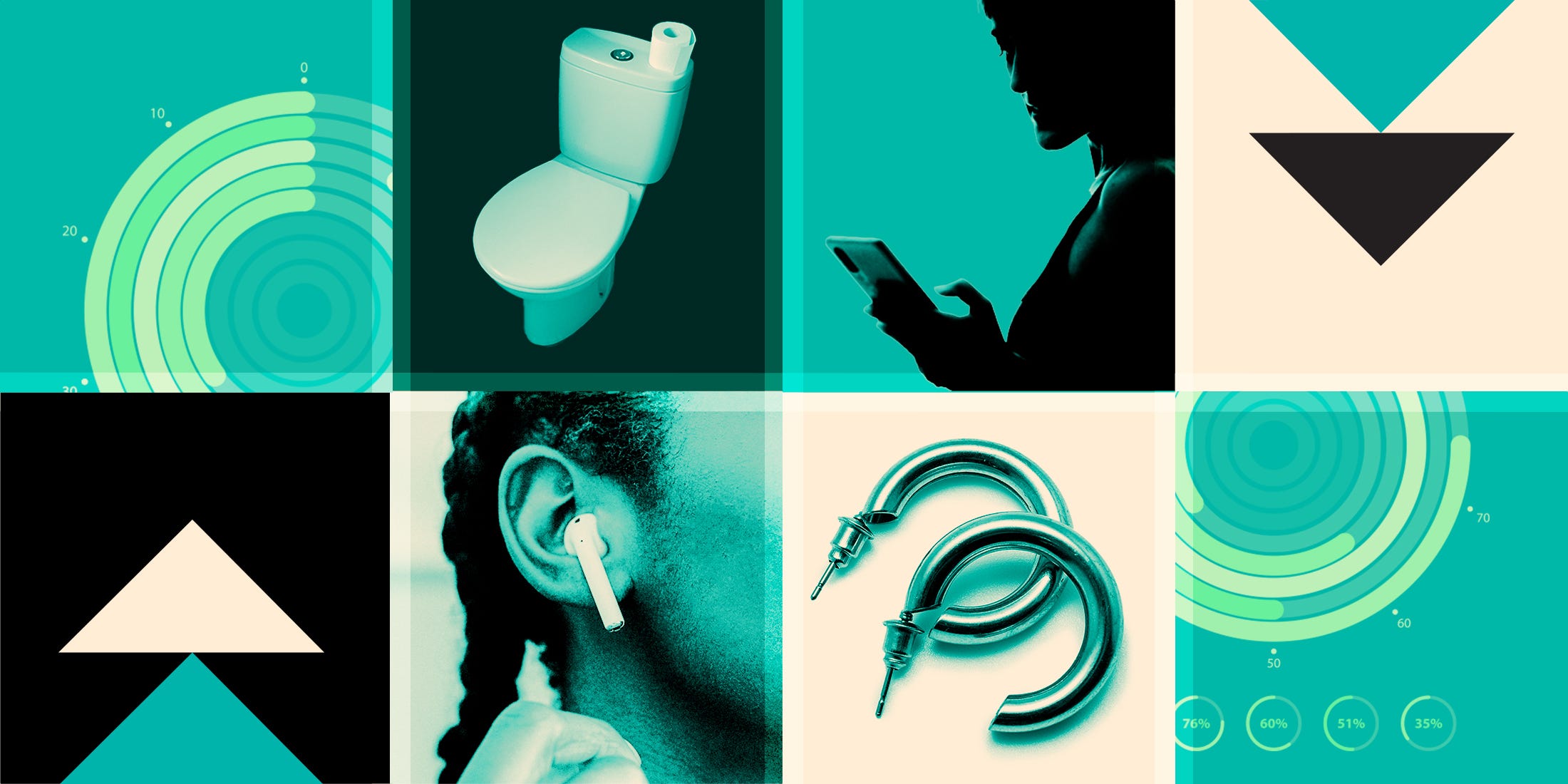
- Throne is a camera that hooks onto your toilet to “watch” the bowl and notice patterns between what you eat and what’s in your stool. It then gives you a “gut health” score based on that.
- Lumia makes smart earrings that are essentially like an Oura ring but for your ears. By sensing blood flow to your head, the earrings can track your heart rate, HRV, sleep, and more.
- Athena is a headband that uses electroencephalography (EEG) and functional near-infrared spectroscopy (fNIRS) to monitor brain blood flow and oxygenation for data that offers insight into sleep, meditation, and cognitive effort.
The Upside of Tracking…Everything
At the individual level, these trackers can provide highly personalized insights. “We are an N-of-1,” Sarkis adds, referencing how in scientific studies, N denotes study size. “So what your body does and my body does is unique.” Keeping an eye on your stats can build self-awareness, empowering you to make more personalized decisions that fit how you want to feel.
Wexler says that making our lifestyle more quantifiable could ultimately lead to improvements in health—if the data is both accurate and actionable. And Sarkis notes that some people find data helps motivate them to stick to healthy habits, which could mean prioritizing sleep, exercise, or sexual health.
There are a lot of pros here, Sarkis says, especially for women’s health at large. For one, it’s great that more dollars are being invested in women’s health-focused technology. “Fem tech has been very underrepresented, and a lot of the norms that we’ve been tracked on were actually for men.”
The boom of wearable trackers could help address gaps for women and transgender individuals who have historically been understudied and underrepresented in medical literature and policymaking, per a 2025 review in Nature Communications. These tools can “break down barriers to health care access and management that have affected generations of women around the world” through health biomonitoring and earlier disease diagnosis.
And while some of the women’s health-specific inventions may not have been built purely altruistically (they are businesses, after all), they are not necessarily exploitative either, says Wexler. “Companies see an unmet need (i.e., for better tracking devices) and want to make money while selling their products as ‘empowering’ or promoting health.”
Asma Sifaoui, a Ph.D. student at the University of Texas at Austin, whose research focuses on the intersection of technology and privacy, agrees that there are pros and cons: these devices can provide genuinely useful tools and datasets that help contribute to women’s health research. But at the same time, she notes, this tech collects some of the most intimate categories of personal data, including reproductive health information, mood, sexual activity, and hormonal patterns. “That kind of data is extremely sensitive and also commercially valuable.”
Can You Overtrack Your Health?
While many people use trackers without issue, experts have a few concerns as tracking extends beyond fitness into new realms of wellness. For one, there’s the risk of developing compulsive behaviors around wellness, says Sarkis. “It’s a fine line…on one side is empowerment and motivation, and on the other is feeling really bad about yourself, or getting addicted to the feeling of being perfect or ‘in range.’”
She also points out that it’s unclear what the long-term ramifications of “outsourcing intuition to technology” might be. Allowing tech to recognize patterns for us might dampen our ability to trust ourselves. Prior to sleep tracking, you might’ve had a poor night’s sleep but not even realize it the next day. But if your device tells you you had bad sleep, that could lead you to feel like your day is shot even before you have a chance to intuit that, she says. This can be particularly concerning if the data is inaccurate, Wexler adds. If a device tells you you’re ‘stressed’ when you’re actually not, that can actually create stress.
Potential Privacy Problems
Beyond psychological trade-offs, there are also serious questions about what happens to all this data. While the Health Insurance Portability and Accountability Act (HIPAA) protects sensitive health information, consumer trackers are not automatically covered under HIPAA just because they collect health-related data.
“People sometimes assume these products have stricter protections because they involve ‘health’ data, but that’s not necessarily true,” Wexler explains.
That said, not all companies handle data the same way, and some may even offer robust privacy controls—another reason why it’s so important to do your research.
“These platforms often generate highly detailed behavioral and health profiles that can be combined with other datasets,” adds Sifaoui. “That information can potentially be shared with advertisers, analytics firms, or data brokers.”
Wexler notes there could also be concerns about downstream decisions made by employers or insurance companies based on that data, such as hiring or coverage decisions. “Maybe a period tracker wouldn’t inform that, but as these devices increasingly collect all kinds of health data, they can be aggregated and used to paint a portrait of someone’s overall health.”
So what can you do? Wexler suggests reading the privacy policy and paying attention to exactly what is being collected and where the data goes. If you’re not up for reading the whole thing (we get it), she recommends skipping straight to the sections on data sharing and collection. “What is the company collecting, who is it sharing that data with, and can you delete your data if you stop using the product?” Sifaoui also recommends looking for “meaningful user controls,” such as the ability to opt out of certain types of data sharing.
How to Track Mindfully
If you’re curious about tracking something new, experts say the key is to be intentional. Here, Sarkis shares some tips on how to do just that.
- Consider tracking temporarily: Just as nutritionists often recommend short-term food logs, you can also apply that same mindset to other health metrics. Maybe you track your orgasms for a few weeks to spot overarching trends—but it doesn’t need to become a permanent habit.
- Track to understand, not judge: This is Sarkis’s own mantra, even though she admits it’s difficult to stand by all the time. “It’s a practice,” she says. Remember, the goal is to use data as information, not a measure of your self-worth or success.
- Prioritize what you track: Focus on one or two metrics at a time rather than adding every new tracker to your virtual cart at once. (For what it’s worth, if Sarkis were to choose just one, she’d start with good old-fashioned sleep tracking.)
- Set boundaries: Decide when you’ll check your data—and when you won’t. If seeing a bad sleep score or stress metric could sabotage an upcoming meeting or important day for you, it’s okay to skip it.
- Reconnect with your intuition: When you review your data, take the time to check in with how you actually feel. Maybe you find that one “bad” night of sleep actually doesn’t have too much of an impact on your energy levels the next day, but multiple nights in a row of poor sleep do. Use that information accordingly, and try not to let the data dictate how you feel.
The Future of Health Tracking
“The trend towards increased tracking will likely only continue,” Wexler says. “What we’ll likely see more of is companies partnering and combining datasets across platforms,” she says, citing the Oura and Quest Diagnostics partnership as an example.
We’ll also probably keep seeing medical-grade monitoring technologies, like continuous glucose monitors, move into the consumer space, she says. Sarkis adds that more employers may start offering some of these devices through wellness programs.
At the end of the day, there’s a lot of upside to all of this—both for individuals interested in a deeper look at their health and researchers interested in studying women’s health. But as technology evolves and regulation catches up, the takeaway remains the same: track thoughtfully and use the data at hand to support—not override—your health and well-being.

Caitlin is a health and fitness journalist based in New York City. In addition to Women’s Health, she writes for publications including The Wall Street Journal and Runner’s World. She’s completed 12 marathons, including the six World Marathon Majors, is semi-fluent in French, and volunteers as a greeter on The High Line. Follow her on Instagram or LinkedIn.
STRELLALAB Dog Allergy & Itching Relief - Skin&Coat Support Chews w/Omega 3 | Anti Itch, Immune Supplements - Treats for Dogs Health w/Fish Oil for Irritated & Dry Skin - Proven by Science, 60 Ct
$11.98 (as of October 22, 2026 03:22 GMT +00:00 - More infoProduct prices and availability are accurate as of the date/time indicated and are subject to change. Any price and availability information displayed on [relevant Amazon Site(s), as applicable] at the time of purchase will apply to the purchase of this product.)
Hint Flavored Water Zero Sugar 0 Calories - Best Sellers Variety (12 pack) | Crisp, refreshing water, fruit flavors. 0 calories, 0 sugar, 0 sweeteners. Hydration for wellness. Gluten-free, Kosher, Vegan
$13.46 (as of October 22, 2026 03:12 GMT +00:00 - More infoProduct prices and availability are accurate as of the date/time indicated and are subject to change. Any price and availability information displayed on [relevant Amazon Site(s), as applicable] at the time of purchase will apply to the purchase of this product.)
Open Ear Wireless Earbuds Bluetooth Headphones, 80H Playtime Stereo Ear Buds with ENC Noise Cancelling, Fast Charging, IPX7 Waterproof Sports Earphones with Earhook for Running/Workouts (Black)
$25.63 (as of October 22, 2026 03:33 GMT +00:00 - More infoProduct prices and availability are accurate as of the date/time indicated and are subject to change. Any price and availability information displayed on [relevant Amazon Site(s), as applicable] at the time of purchase will apply to the purchase of this product.)
Amazon Fire HD 10 tablet, built for relaxation, 10.1" vibrant Full HD screen, octa-core processor, 4 GB RAM, 32 GB, Black
$72.99 (as of October 22, 2026 03:23 GMT +00:00 - More infoProduct prices and availability are accurate as of the date/time indicated and are subject to change. Any price and availability information displayed on [relevant Amazon Site(s), as applicable] at the time of purchase will apply to the purchase of this product.)













Post Comment