Why Everything Seemed to Collapse — But a Hidden Opportunity Just Exploded Behind the Scenes
Ever feel like the market’s doing its own version of the cha-cha—two steps back, one step forward—just when you thought you had the rhythm down? Last night’s sharp sell-off was a hard slap of reality for advisers and associates tuning in, shaking up expectations with some surprising moves. Sure, economic indicators like government payrolls and weekly hours suggest the Fed’s got more rate hikes in store—fueling fears of overheating rather than cool-downs. But here’s the kicker: while major indexes plunged hard, some sectors barely blinked, and certain stocks even danced upwards. How do you square that circle when traditional wisdom says rising rates crush the whole market? If your clients are asking whether the music’s about to stop and leave their dreams shattered on the floor, this post’s for you. Because, believe me, the story’s a lot more nuanced—and understanding it could just be the edge you need right now. LEARN MORE
img#mv-trellis-img-1::before{padding-top:67.28515625%; }img#mv-trellis-img-1{display:block;}img#mv-trellis-img-2::before{padding-top:141.63208852006%; }img#mv-trellis-img-2{display:block;}img#mv-trellis-img-3::before{padding-top:67.28515625%; }img#mv-trellis-img-3{display:block;}img#mv-trellis-img-4::before{padding-top:24.043715846995%; }img#mv-trellis-img-4{display:block;}
This post is more for the advisers and associates reading among my readers.
The market had some pretty significant fall last night.
The economic metrics such as average weekly hours, government payrolls we so positive that they all point to rates needing to be hike, because the prospects of market overheating is high than the prospects of rates being lowered.
The 2-year, 10-year, and 30-year US government yields all head up after this.
USD actually went up 0.50%. Its at $1.2908 to the SGD now. Wonder what those fearing the USD collapse would say. In contrast Gold went down 3.3% to $4,329.
The markets does not like this.
Futures turned lower but last night’s price action was interesting.
- S&P 500 dropped 2.6% for the night.
- Nasdaq 100 dropped 4.8%.
- Russell 2000 dropped 3.6%.
- MSCI Emerging Market dropped 6.5% (and 8.6% since the top) due to how heavy TSMC, Samsung and SK Hynix is currently in Emerging Market weightings.
- Vanguard International Total Stock Market ETF (VXUS) dropped 3.7% probably due to USD strength. We seen how international stocks and ETF benefited more from USD weakness and with USD showing strength, they look poorer.
What is more interesting is what did not drop so much:
- S&P 500 Equal Weight dropped 1.4%
- Dimensional US Large Cap Value (DFLV) dropped 1.7%
- Dimensional International Value ( DFIV) dropped 2.3%
- Avantis US Small Cap Value (AVUV) dropped 1.4%
- Avantis International Small Cap Value (AVDV) dropped 3.2%
- S&P 600 Small Cap (IJR) dropped 1.8%
- S&P 400 Mid Cap (MDY) dropped 1.95%
The crux is that
- There are areas of the US market that are less affected.
- The surprising thing is that they have heavier weightage to the main economy which should want lower rates but with rates staying high, it should be WORSE for them but they actually did better.
The AI “too-much-demand” plays corrected:
- Seagate down 8.5% and 1.7% post market close
- Sandisk down 11.4% and 2.7% post market close
- Micron down 13% and 1.3% post market close
- Taiwan Semi Conductor down 6.7% and 1.0% post market close.
- Broadcom down 7.9%
- Texas Instruments down 6.7%
- Nokia down 13%
- Arm holdings down 13%
- Qualcomm down 11%
- Nvidia down 6%
- Applied Optoelectronics (AAOI | AI data center build out play) down 12.8%
- Babcock and Wilcox (BW | AI data center build out play) down 12%
- Caterpillar down 3.9%
- Corning (GLW | yes that Corning it is a AI demand play) down 10%
The market is not liking the outlook that Broadcom was painting about the demand for the AI equipments.
Here are the main MAGs that your clients would likely be invested personally:
- Microsoft down 2.7%
- Apple down 1.3%
- Google down 0.95%
- Amazon down 3%
- Meta Platforms down 5.5%
The software as a service companies that were slaughtered by AI:
- Salesforce down 1.6%
- Service Now down 5.8%
- Monday.com down 1.8%
- Elastic NV down 5%
- Atlassian down 2%
- WIX down 2.4%
The oil indicators:
- Energy select sector (XLE) down 1.8%
- Small Cap energy (PSCE) down 4.2%
- Oil services (OIH) down 5.5%
So oil isn’t doing well as well.
So what is up yesterday:
- S&P Global (SPGI): up 1%
- Mastercard up 1.9%
- Visa up 1%
- Copart up 0.6%
- Berkshire Hathaway is up 2%
- Autozone (AZO) is up 1%
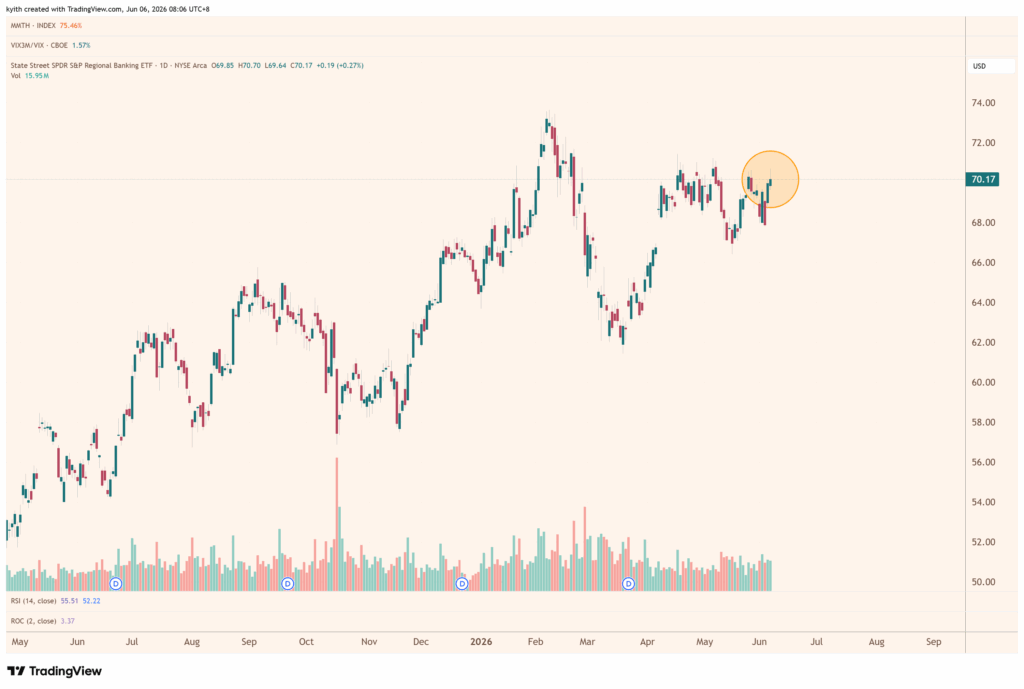
The most surprising part for me was the US Regional Banks Index (KRE). its up 0.27% and could be up by as much as 0.97%.

It is surprising because with all this talk that they need the short end interest rate to go down just for small banks to do better, and if all rates go up, shouldn’t the small banks weaken as much as the others?
There are strengths in the market.
What makes investors fear is that “when the music stops playing” then all their hopes and dreams will crash together with it.
That is not always the case and we can see that there is some sort of rebalancing taking place. There are stocks that do well.
I am not the only one who observe this. Here is John Huber of Saber Capital:

John points out that when money flows into some securities they may take away money from other securities. Some stocks does less well.
When the stuff that you own, such as the S&P 500 does so well, then you fear for your hope and dreams will collapse once the music stop.
But earlier in the year, we saw the music stopped playing and investors forgot the rest of the S&P 500 held the S&P 500 up pretty well.
The small caps also did pretty well.
At the end of the day, if you manage to benefit from something, your hopes and dreams also gets concentrated. You wonder if it is time to sell, or when to sell because your hopes and dreams are concentrated.
It is important to remind your clients, that markets are unique that not everything moved in lock step.
We have the S&P 500, Nasdaq and S&P 400 mid-cap ETFs that took place before the dot-com bust and the charts tell an interesting story:

This starts in Jun/Jul 1999 before the dot com bust. S&P 500 in dark blue, S&P 400 in green and QQQ is in red.
I always see these “gaps or areas” below charts as when clients feel the most uncomfortable or euphoric.
When QQQ is up 134%, how would you feel when your S&P 500 only did 18%? even if you are in Mid Caps and did better at 34%, you felt like you are missing out.
Fast forward 3 years later in the depths of 2003, you would look so stupid pivoting out from smaller companies into the hot thing. The mid cap turn out to be the only one positive.
And this is an important point: Investors have a choice of not being in hot things.
Of course they would miss out on gains, but what if those gains, when viewed over the longer term time frame is fleeting?
When we revisit this in 2007, the Mid Caps were the one doing 124% the S&P 500 only doing 19% and the investors in QQQ now has to suffer.
We all know how these 3 did today (but actually some of you might not), but I would like to stress: It is not the hindsight performance.
It is what you lived through.
What your clients feel today as they missed out on these AI plays and wonder if they are making a mistake not investing.
Its good to remind clients why we don’t go giddy by concentrating into something because we don’t know 20 years later how things will turn out.
And that the markets are not made up of just these few companies that do well. They are also made up of companies that didn’t do well.
What clients find it struggle to deal with is if something that didn’t do well for a while would eventually do well. You might need to give them examples. I think the clearest example was energy. It hasn’t been doing well for 2-3 years.
I don’t have to explain whether energy did recover because you all are living through it. What I like to remind you is that energy started doing well before the Iran conflict.
Hopefully this provides some talking point to your clients if needed.

Do Like Me on Facebook. I share some tidbits that are not on the blog post there often. You can also choose to subscribe to my content via the email below.
If you’re thinking of opening an Interactive Brokers account, my referral link is here.
As the new account holder, you’ll receive USD 1 in IBKR stock for every USD 100 you deposit, up to USD 1,000 in shares — so a USD 10,000 deposit gets you USD 100 in IBKR stock, and the bonus is capped at USD 1,000 for deposits of USD 100,000 or more. A few other things to know: the minimum deposit to qualify is USD 10,000, done within 30 days of opening, and the bonus shares are locked up for one year from the award date. The promotion is currently active, and using the link costs you nothing extra. On a separate note, if you haven’t already, it’s worth taking a look at how IBKR’s share price has performed over the past five years — the stock you receive as a bonus isn’t just a token; it’s a stake in a company that has done quite well for its shareholders.
I break down my resources according to these topics:
- All my personal notes about how my philosophy behind my own money and how I manage it.
- Building Your Wealth Foundation – If you know and apply these simple financial concepts, your long term wealth should be pretty well managed. Find out what they are
- Active Investing – For active stock investors. My deeper thoughts from my stock investing experience
- Learning about REITs – My Free “Course” on REIT Investing for Beginners and Seasoned Investors
- Dividend Stock Tracker – Track all the common 4-10% yielding dividend stocks in SG
- Free Stock Portfolio Tracking Google Sheets that many love
- Retirement Planning, Financial Independence and Spending down money – My deep dive into how much you need to achieve these, and the different ways you can be financially free
- Providend – Where I work and do research. Fee-Only Advisory. No Commissions. Financial Independence Advisers and Retirement Specialists. No charge for the first meeting to understand how it works

Kyith is the Owner and Sole Writer behind Investment Moats. Readers tune in to Investment Moats to learn and build stronger, firmer wealth foundations, how to have a Passive investment strategy, know more about investing in REITs and the nuts and bolts of Active Investing.
Readers also follow Kyith to learn how to plan well for Financial Security and Financial Independence.
Kyith worked as an IT operations engineer from 2004 to 2019. Currently, he works as a Senior Solutions Specialist in Fee-only Wealth Advisory Firm Providend. All opinions on Investment Moats are his own and does not represent the views of Providend.
You can view Kyith’s current portfolio here, which uses his Free Google Stock Portfolio Tracker.
His investment broker of choice is Interactive Brokers, which allows him to invest in securities from different exchanges all over the world, at very low commission rates, without custodian fees, near spot currency rates.
You can read more about Kyith here.
Ring Battery Doorbell (newest model), Speckled Gray with Indoor Cam Plus, White
$59.99 (as of September 24, 2026 03:24 GMT +00:00 - More infoProduct prices and availability are accurate as of the date/time indicated and are subject to change. Any price and availability information displayed on [relevant Amazon Site(s), as applicable] at the time of purchase will apply to the purchase of this product.)
JBL Tune 530BT - On-Ear Bluetooth Headphones - Black | JBL Pure Bass Sound, Customize your sound with the JBL Headphones App, 2 beamforming mics for perfect calls
$39.95 (as of September 24, 2026 03:24 GMT +00:00 - More infoProduct prices and availability are accurate as of the date/time indicated and are subject to change. Any price and availability information displayed on [relevant Amazon Site(s), as applicable] at the time of purchase will apply to the purchase of this product.)
Amazon Fire HD 10 tablet, built for relaxation, 10.1" vibrant Full HD screen, octa-core processor, 4 GB RAM, 32 GB, Black
$72.99 (as of September 24, 2026 03:24 GMT +00:00 - More infoProduct prices and availability are accurate as of the date/time indicated and are subject to change. Any price and availability information displayed on [relevant Amazon Site(s), as applicable] at the time of purchase will apply to the purchase of this product.)
Wireless Earbuds, Bluetooth 5.4 Headphones HIFI Stereo/Crystal clear, White | Noise Cancelling Mic Ear buds with 50H Playback, LED Digital Display, IPX7 Waterproof Earphones for Office/Running/Workout
$18.99 (as of September 24, 2026 03:24 GMT +00:00 - More infoProduct prices and availability are accurate as of the date/time indicated and are subject to change. Any price and availability information displayed on [relevant Amazon Site(s), as applicable] at the time of purchase will apply to the purchase of this product.)











Post Comment