
Hublot’s First Watch Reborn: The Untold Story Carlo Crocco Reveals That Will Change Your View on Time Forever!
Ever wonder what happens when bold vision meets stubborn tradition? Well, picture this: a time when the watch world was a stiff, leather-and-gold affair—until one Italian entrepreneur decided to shake things up with a splash of rubber. Sounds almost like a bedtime fable, right? But this isn’t your typical fairy tale. Carlo Crocco didn’t just dream up a watch; he threw the rulebook out the porthole and sparked a revolution that’s still ticking strong nearly half a century later. If you think watches are just about telling time, think again. This is about daring to mix the humble with the high-end, flipping the industry upside down—and coming out on top. Intrigued? Let’s dive into how a rubber strap changed the game forever. LEARN MORE
 4 min read
If you spend a lot of time following the world of watches, Hublot’s origin story might feel as familiar as one of the fairytales you heard at bedtime as a child. If you don’t, though, it might feel just as fantastical as some yarn about a princess who feels a pea under a stack of mattresses or a prince who slays a fire-breathing dragon.
You start with an unlikely hero. This time around, it’s an Italian entrepreneur with a big, bold, brazen idea. He wants to make a watch, something unlike anyone has ever seen. It’ll be gold, with an angular case shaped like the porthole on a ship. Not so crazy yet. But wait. Because, breaking entirely with the conventions of the day, the strap won’t be made of exotic leather or precious metal but rubber. Humble, industrial rubber.

This is exactly what Hublot founder Carlo Crocco envisioned nearly half a century ago, and what he brought to the Basel Watch Fair—pretty much the place to be if you wanted to be a part of the business of timekeeping—in 1980. He spent three years developing the idea, all without doing a bit of market research. He just believed in his vision. And then the fair began.
“I was very anxious, because for the first two days, no one came into our booth,” he says. But the anxiety didn’t have long to fester. Word was spreading. And then? People galore. “On the third day, we realized that everyone was speaking about us because it was really something different from all the other watches.”
That first watch—36mm in diameter, with a quartz movement and a black rubber strap—quickly became a hit. Industry buzz gave way to the kind of clientele most brands can only imagine. The King of Greece bought one in Gstaad for himself and another for his brother-in-law, the King of Spain. More royals followed. (“By the way, they’re all related,” Crocco quips.)

But the biggest thing wasn’t getting insiders to a booth at a trade fair or convincing kings to strap Hublot watches—named, if you’re curious, for the French word for porthole—on their wrists. It was changing how the industry thought about the way watches are made.
“At that time, the mentality of watchmaking was very classical,” Crocco says. “They couldn’t think, normal people, of putting together rubber and gold. I personally thought it was a really good idea because it was against the current. It was very risky, but if you don’t risk, you have no result.”
The result was a watch industry that completely recalibrated itself. Crocco says that within four or five years of the original Hublot’s release, the brand was already dealing with imitators. Now, the idea of combining disparate materials is firmly embedded in the minds of both consumers and designers. You can see it on watches from brands that sell at the local department store and brands that only sell to folks who haven’t seen the inside of one of those since the first time their private jet took off. Crocco’s big idea changed the whole game.

A design sketch of the new Tributo.
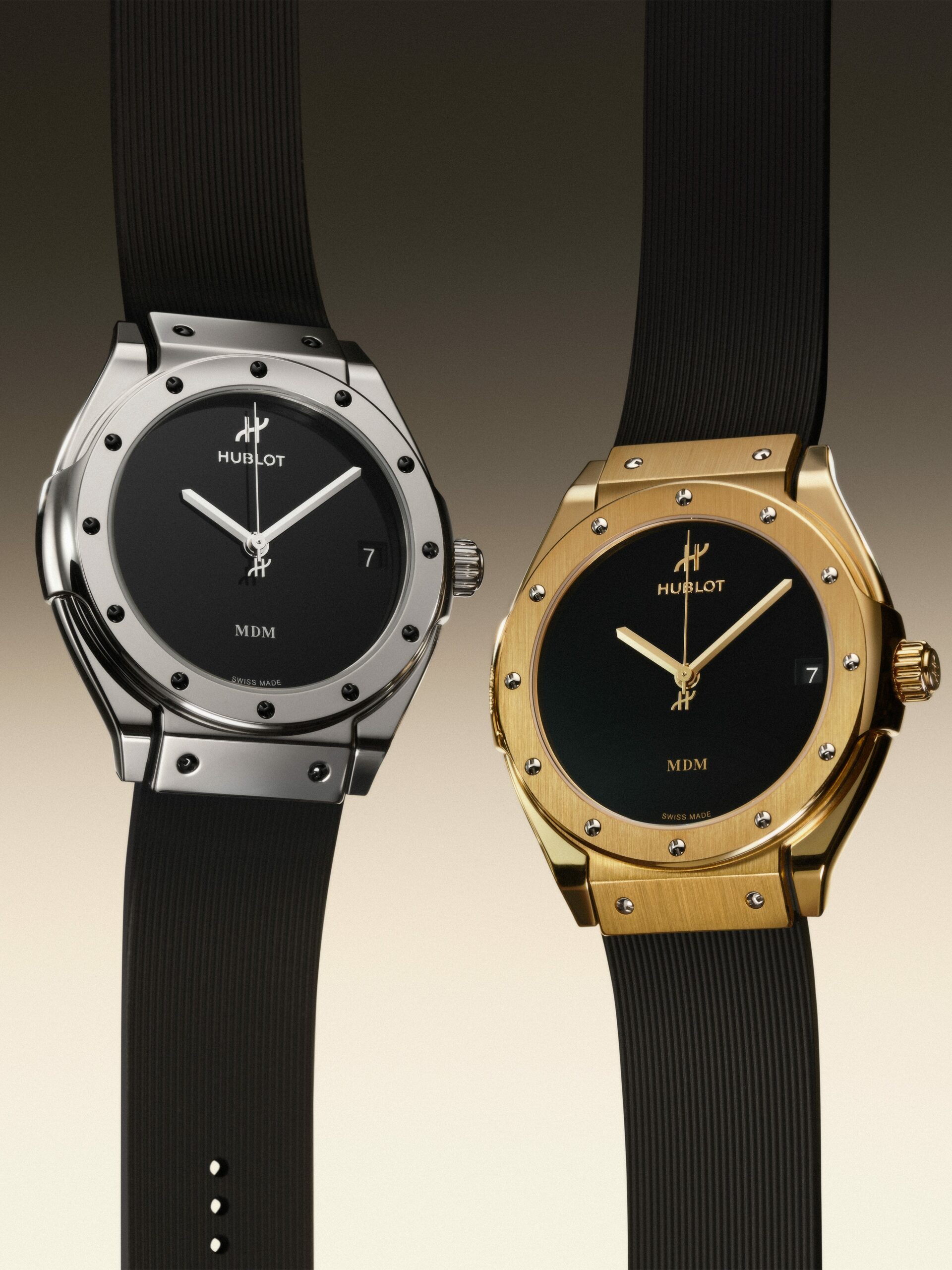
Which means it’s a pretty good time to go back to the beginning of this thing. Last month in Milan, Hublot debuted a new take on that first, groundbreaking watch. Dubbed the Hublot Classic Fusion Tributo, it’s an homage but not a nuts-and-bolts recreation. Instead of the original 36mm case, it’s been upsized to a more 2026-appropriate 38mm. And instead of a quartz movement—Crocco thought it was “more practical” at the time but has come around to the enduring appeal of mechanical construction—a self-winding HUB1711 movement with a 50-hour power reserve keeps things ticking along. Oh, and now you can get it in white gold, too.
Then there’s that rubber strap. When Crocco designed the original Hublot, he was insistent that the strap was entirely straight; he felt it was crucial to the aesthetic proposition. On the Tributo, it’s ever-so-slightly, almost imperceptibly tapered, a necessary concession to keep the proportions intact after increasing the case size (which, handily, lets that automatic movement sit comfortably inside).

But, as with the first Hublot, it’s not all about tech specs and watch-nerd particulars. It’s about the spirit of the thing. And the spirit of this watch stays true to that pioneering design. There are twelve screws around the bezel, so you can keep an eye on the hour despite the dial’s lack of indices—something Crocco says was a non-negotiable when he started consulting on the new release. The yellow gold version keeps the abyss-like black lacquer dial and the white gold throws us a tiny (and welcome) curveball by using onyx. The combo of precious metal and rubber still hits, 46 years later.
If you prod him how he feels about the way that he shifted the watch industry, Crocco won’t brag. He left Hublot nearly 20 years ago, when it sold to LVMH. He knows his idea changed things; he’s happy about it. But this isn’t his day job anymore. Still, when he’s asked if he could be considered the godfather of fusing high and low in watchmaking—and you give him a minute to ponder it—he’ll tell you the truth.
“Yes, yes!” Hear, hear to that.
Fhumsh Wireless Earbuds, Bluetooth 6.0 Headphones HiFi Stereo 50H Playback LED Digital Display Ear Buds with ENC Noise Canceling Headset, IPX7 Waterproof Earphones for Gym/Running/Work(Rose Gold)
$19.97 (as of November 5, 2026 03:36 GMT +00:00 - More infoProduct prices and availability are accurate as of the date/time indicated and are subject to change. Any price and availability information displayed on [relevant Amazon Site(s), as applicable] at the time of purchase will apply to the purchase of this product.)
Purina Pro Plan Sensitive Skin & Stomach Dry Dog Food, Salmon, 30 lb Bag | Real Salmon & Rice Formula, with prebiotic fiber, easily digestible with omega-6 fatty acids for a healthy skin and coat
$77.48 (as of November 5, 2026 03:21 GMT +00:00 - More infoProduct prices and availability are accurate as of the date/time indicated and are subject to change. Any price and availability information displayed on [relevant Amazon Site(s), as applicable] at the time of purchase will apply to the purchase of this product.)
Coca-Cola Soda Soft Drink Fridge Pack Cans, 12 fl oz, 12 Pack | Carbonated drink with classic cola flavor
$7.68 (as of November 5, 2026 03:21 GMT +00:00 - More infoProduct prices and availability are accurate as of the date/time indicated and are subject to change. Any price and availability information displayed on [relevant Amazon Site(s), as applicable] at the time of purchase will apply to the purchase of this product.)
PRUNUS J-166 Portable Radio AM FM, Battery Operated Radio | Tuning Light, Back Clip, Layard, Excellent Reception, AM FM Radios Portable, Transistor Radios
$18.99 (as of November 5, 2026 03:26 GMT +00:00 - More infoProduct prices and availability are accurate as of the date/time indicated and are subject to change. Any price and availability information displayed on [relevant Amazon Site(s), as applicable] at the time of purchase will apply to the purchase of this product.)














Post Comment