
Quit Like a Pro or Burn Bridges? The Brutal Truth About Revenge Quitting vs. Strategic Exiting That Every Entrepreneur Must Know!
Ever catch yourself dreaming of that mic-drop moment—the one where you storm out, slam the door, or hit “send” on that email that finally lets your boss know exactly what you think? Yeah, me too. It’s like therapy for the soul after being overlooked, overworked, or just plain made to feel invisible. That fire in your belly? Totally justified—because frustration doesn’t come from nowhere; it’s born from caring deeply and repeatedly being let down.
But here’s the kicker: that impulsive exit might feel amazing for a hot second… then suddenly—boom—you’re face to face with a brutal job market that’s got way more candidates than gigs. And without a plan? You’re just jumping from the frying pan into another kitchen that might be just as smoky. That’s why “revenge quitting” might get all the hype these days, but it’s rarely the smartest move.
What if you could channel that fiery energy into something that actually sets you free—without burning bridges or losing control? Enter the “strategic exit.” It’s like taking your frustration, flipping the script, and building a bridge toward your own vision of success—where your hustle grows your income, lifestyle, and equity, not someone else’s bottom line.
So before you draft that dramatic resignation, let’s talk about owning your next chapter like a boss. Because your frustration? It’s powerful—but it’s even more powerful when it fuels a plan YOU control.
Strategic Exiting: Turn Your Frustration Into a Plan You Own
You’ve probably felt like walking out. Here’s how to make your exit work for you, not against you.
We’ve all imagined it: the dramatic walkout, the bold email, or finally telling your boss how you really feel before leaving as everyone watches. After years of being overlooked, overworked, or let down by leadership, that fantasy can seem like the only justice left.
If you’ve felt that urge, you’re not alone. Your frustration is real and valid.
Maybe it built up over time: the promotion that went to someone else, your idea ignored until a manager repeated it, or late nights that only got a polite nod. Frustration like that doesn’t come from nowhere. It comes from caring, and from being let down anyway.
The rise of “revenge quitting.”
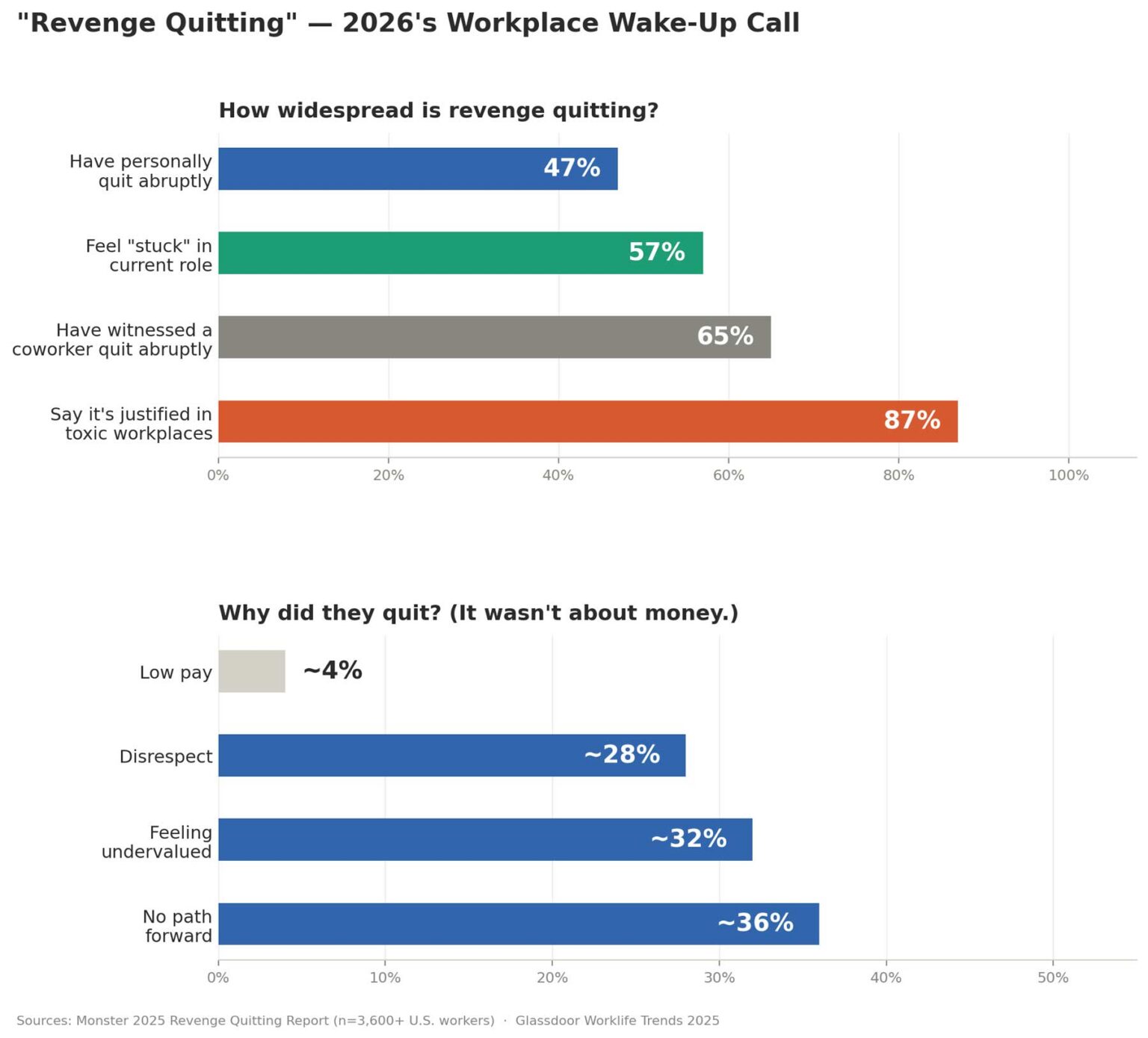
There’s even a name for it now: “revenge quitting.” It’s a 2026 buzzword for employees who resign loudly or at the worst possible moment to send a message after years of feeling ignored. And it is everywhere. In a survey of more than 3,600 U.S. workers, 47% said they have abruptly quit a job to make a point, and 57% have seen a coworker do the same. A striking 87% said revenge quitting is justified when a workplace is toxic. (Monster 2025 Revenge Quitting Report.)
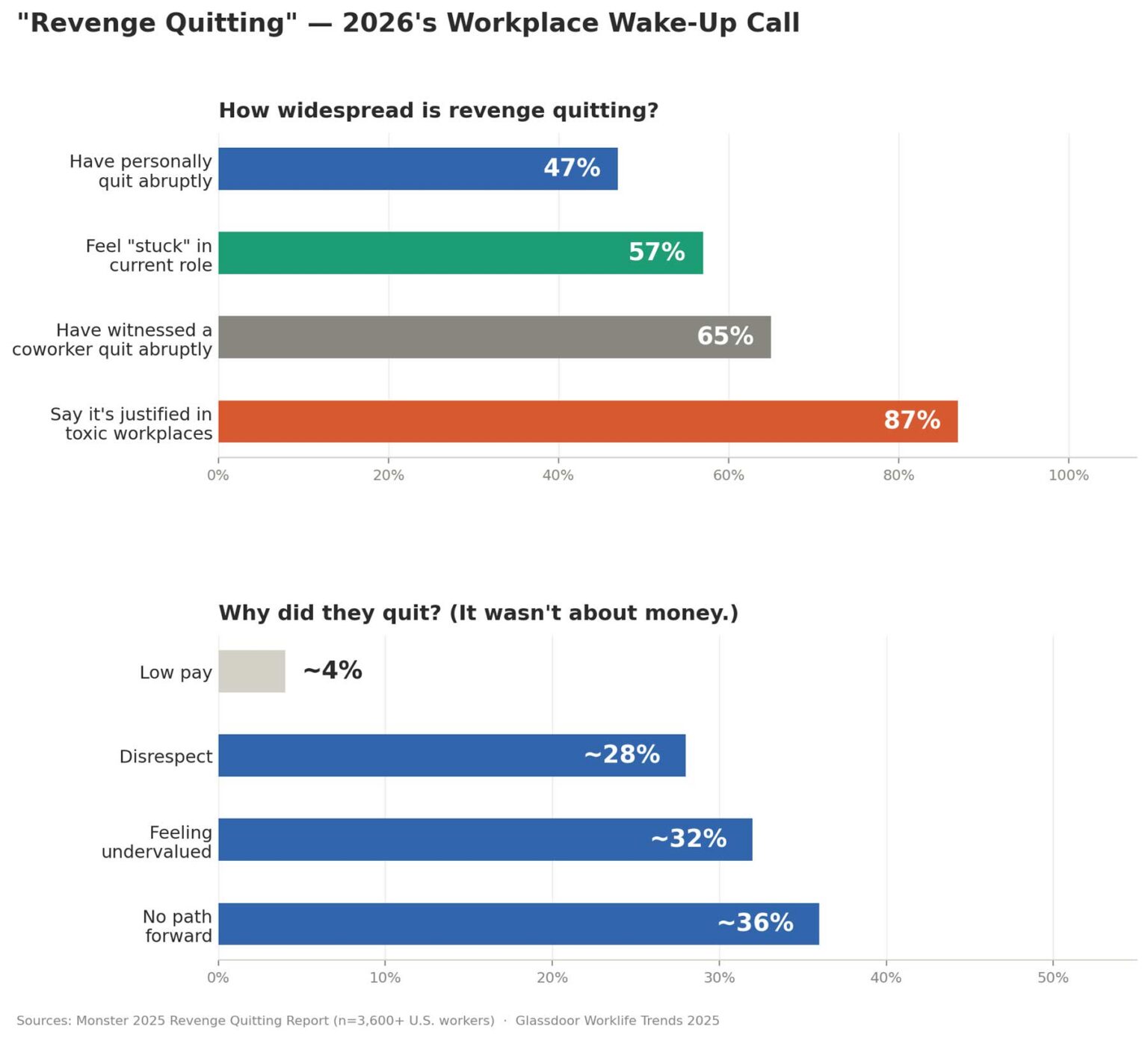
Here’s what stands out: most of those exits weren’t about money. Only about 4% blamed low pay. The bigger reasons were feeling undervalued, disrespected, and stuck with no path forward. (Monster, 2025.) That matches another finding that 65% of professionals say they feel “stuck” in their current roles. (Glassdoor Worklife Trends, 2025.)
So if you’re frustrated, the data backs you up. You’re not being dramatic. You’re just being human.
The catch nobody mentions in the heat of the moment.
 But here’s what’s hard to see when you’re angry. A revenge quit feels powerful for about an hour. After that, you’re facing one of the toughest job markets in years, and you have no plan.
Economists call the 2026 market “low-hire, low-fire.” Companies aren’t laying people off in big waves, but they’re barely hiring either. As of March 2026, for the first time since 2021, there were more people looking for work than there were open jobs. There were about 0.9 openings for every job seeker. (Indeed Hiring Lab, March 2026.) Searches are taking longer, and there’s far less room to bargain for a better title or higher pay.
And remember why people leave in the first place: not for money, but because they feel unseen. That’s the real catch. If you jump into the next job out of anger, there’s a good chance you’ll end up with the same problem somewhere else.
That fear is why so many people freeze instead. In one early-2026 survey, 57% of workers called themselves “job huggers,” staying put not out of love, but out of caution about what might come next. (ResumeBuilder, February 2026.) Revenge quitting and job hugging seem like opposites, but both come from feeling like you don’t have a real choice. Career Ownership is about giving yourself that choice.
There’s a smarter way to leave: the strategic exit.
So what’s the alternative? It is not “grin and bear it.” It is not staying stuck forever, either. It’s something quieter and far more powerful: a strategic exit.
A strategic exit uses the same energy that fuels a revenge quit and channels it into a plan. Instead of burning a bridge for one moment, you build a bridge to something better. Instead of letting your boss write the last chapter, you start writing your own. This isn’t about waiting for permission or the “perfect” moment. It’s about making sure that when you leave, you’re moving toward something, not just away from something.
That’s the idea behind Career Ownership: building something that belongs to you, where your effort grows your own income, lifestyle, wealth, and equity, not someone else’s.
You don’t have to plan it alone.
 You don’t have to figure this out alone, and you shouldn’t have to. That’s where a Career Ownership Coach® comes in. A coach isn’t the hero of your story. You are. The coach is your guide, a calm, steady voice who has helped many frustrated people turn a tough moment into a clear next step.
Through Career Ownership Coaching™, a coach helps you slow down before you do anything you can’t undo. Together, you look at three things most people skip when they’re upset:
- What do you truly want for your Income and Lifestyle? Naming these turns a vague “I have to get out” into a clear target.
- How many months could you cover if you made a move? Knowing your real numbers replaces panic with a plan.
- Before you walk out, you explore ways to build something of your own, quietly and on your own timeline, with the risks explained honestly.
There’s no pressure and no cost to start the conversation. The goal isn’t to talk you into anything. It’s to give you clarity, so your next move is a choice, not just a reaction.
Many people are surprised to learn they can explore all of this while still employed. You don’t have to quit to get clarity, and getting clarity first often turns an eventual exit into something calm and confident instead of chaotic.
And you’d be in good company.
 Considering ownership is no longer a fringe idea. The TES Generational Career Confidence Survey found that 83% of Americans now see business ownership as a real alternative to a traditional job — largely because it offers more control and stability than a paycheck alone. That belief crosses every age group: majorities of Gen Z, Millennials, Gen X, and Boomers agree that ownership builds stronger career confidence than climbing someone else’s ladder. (TES Generational Career Confidence Survey.)
Ownership isn’t about chasing a fantasy. It’s about trading a paycheck someone else controls for income and a lifestyle you help design, where your effort builds your own value instead of protecting someone else’s profit margins.
Here’s the truth.
You can use all your frustration in one loud moment and hope the next paycheck feels different. Or you can invest it in a plan you control, so the next chapter is yours by design. The most satisfying exit isn’t the one everyone talks about for a week. It’s the one that quietly sets you free.
Before you write that resignation, write down what you actually want.
Then let a Career Ownership Coach® help you build the bridge to get there. There’s no cost, no pressure, just a conversation about your future. Your frustration got you this far. Let’s turn it into a plan.
 About Your Career Revolution
Our mission is to help individuals explore self-sufficiency as an alternative career.
We help them define their Income, Lifestyle, Wealth, and Equity goals and provide education on the best ways to achieve them. We don’t sell franchises – we help people achieve their dreams of self-sufficiency through business ownership. The approach is different, the experience is different. And it works.
Order on AMAZON
Learn More About Career Ownership Coaching™

BARK&SPARK No Poo Chews for Dogs - Coprophagia & Stool Eating Deterrent | Probiotics, Digestive Enzymes & Breath Aid Support - Stop Dog Poop Eating - 120 chews
$19.96 (as of October 22, 2026 03:22 GMT +00:00 - More infoProduct prices and availability are accurate as of the date/time indicated and are subject to change. Any price and availability information displayed on [relevant Amazon Site(s), as applicable] at the time of purchase will apply to the purchase of this product.)
Purina Pro Plan Veterinary Supplements FortiFlora Dog Probiotic Supplement | FortiFlora Probiotic Supplement with strain of probiotics promotes intestinal health and can help management of diarrhea
$30.99 (as of October 22, 2026 03:13 GMT +00:00 - More infoProduct prices and availability are accurate as of the date/time indicated and are subject to change. Any price and availability information displayed on [relevant Amazon Site(s), as applicable] at the time of purchase will apply to the purchase of this product.)
Earth Rated Dog Poop Bags on Refill Rolls, 270 Bags, Lavender | Guaranteed Leak Proof and Extra Thick Waste Bag Refill Rolls
$14.99 (as of October 22, 2026 03:13 GMT +00:00 - More infoProduct prices and availability are accurate as of the date/time indicated and are subject to change. Any price and availability information displayed on [relevant Amazon Site(s), as applicable] at the time of purchase will apply to the purchase of this product.)
Tomkas Small Dog Cat Sling Carrier Puppy Purse Travel Wrap Soft Crossbody Pet Bag (Black1, M - Classic Pocket & Classic Strap)
$13.99 (as of October 22, 2026 03:22 GMT +00:00 - More infoProduct prices and availability are accurate as of the date/time indicated and are subject to change. Any price and availability information displayed on [relevant Amazon Site(s), as applicable] at the time of purchase will apply to the purchase of this product.)












Post Comment