
Unlock the Secret Code: How Print-on-Demand APIs Can Turbocharge Your Ecommerce Empire Overnight

Ever start a print-on-demand store thinking, “Piece of cake—just plug in an app, sync a handful of products, and watch orders roll in”? Yeah, me too. For a while, that setup works like a charm—orders just zip through production without breaking a sweat. But then reality sneaks up on you. Suddenly, a customer wants to upload a custom logo, preview it live, or a sports team needs forty personalized shirts all in one basket. That’s when you realize the off-the-shelf integrations aren’t gonna cut it anymore. What now? You dive headfirst into the realm of APIs—and two giants tower over your choices: Printful and Printify. But here’s the kicker—do you build your own custom workflow, or lean on what their platforms offer? The answer isn’t just black or white; it’s about knowing where to build your brand’s magic and where to outsource the heavy lifting. Let’s unpack that journey together. LEARN MORE
Most print-on-demand stores begin with an app. You connect your shop to a provider, sync a few products, and orders flow into production without anyone touching them. For many sellers, that is all they will ever need.
Then something changes. A customer wants to upload a logo and preview it before paying. A sports club wants forty personalised shirts in a single order. Your product needs a flow that no off-the-shelf integration supports. At that point you are looking at a provider’s API, and the question becomes what to build yourself and what to leave to the platform. Two names dominate that conversation: Printful and Printify.
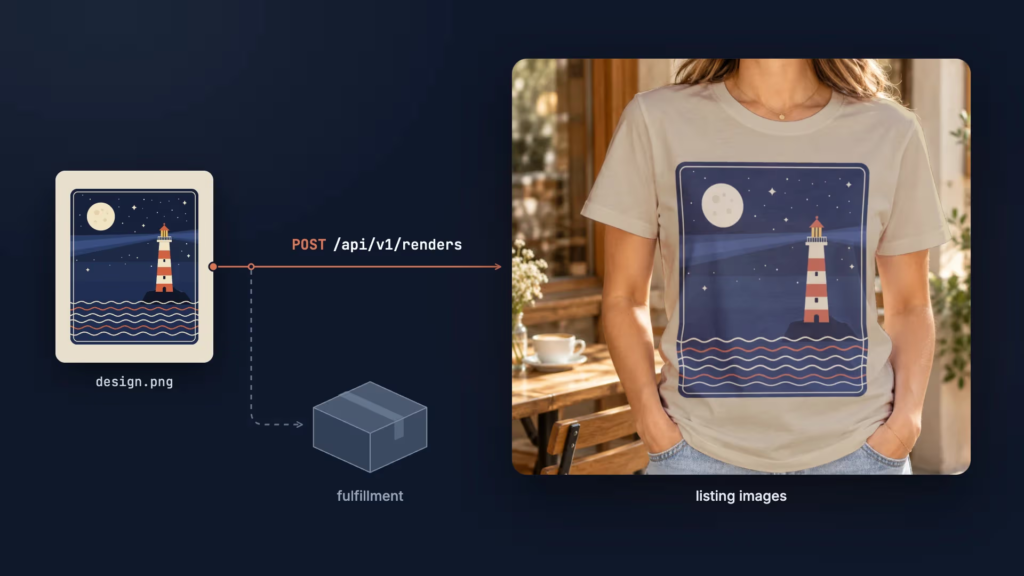
What a print-on-demand API actually does
An API is a set of endpoints your own software can call to do what a dashboard would otherwise do by hand. For a provider such as Printful or Printify, the core capabilities are:
- Catalog: the products, variants, sizes, colours and print areas available to you.
- Order creation: sending recipient details, items and artwork files into production.
- Shipping rates: delivery options and costs for a given basket and destination.
- Status callbacks: notifications as an order moves from received to in production to shipped.
What an API does not give you is a storefront, a checkout, customer accounts or a design experience. Those are yours to supply. Authentication, rate limits and endpoints change over time, so treat each provider’s current documentation as the source of truth before committing to a design.
Buy the hard infrastructure, build the differentiator
Rebuilding fulfilment is a losing project. Printing, quality control, packing, carrier relationships and returns are costly, operationally complex and already solved. Replicating them would cost more than any margin you might save, and it would pull you away from the part customers actually notice.
A useful test: if a customer would never notice it, buy it. If it shapes how they feel about your brand, consider building it. In practice, a custom build pays off in the experience layer.
A product configurator. Customers pick a garment, place artwork, change colours, add text and see a live preview. The configurator is your code. When the customer confirms, your system translates their choices into the variants and print files the API expects.
A team-ordering portal. Clubs, schools and small businesses rarely want one item. They want a shared page where each member picks a size and a name, and one organiser approves everything. A portal collects the individual selections and submits them as one or more orders.
A personalisation flow. Names, dates, messages and uploaded photos need validation, preview and a clean route into the print file. A custom flow can enforce character limits, check image resolution and show exactly what will be printed before payment.
With the API covering catalog, order creation, shipping rates and status callbacks, a developer can focus on that experience while production runs behind it. The shape is right: a thin, well-defined integration at the bottom and your own product thinking on top.
That thin integration still needs honest scoping. Webhooks, failure states and address validation are where these projects usually overrun, because the happy path looks so simple that none of them appear in the first estimate.
Webhooks. Events can arrive late, out of order or more than once. Your endpoint must respond quickly, verify the request is genuine, and handle duplicates so a customer doesn’t receive three “shipped” emails. Make handlers idempotent, and add a periodic status check as a fallback so a missed webhook never leaves an order silently stuck.
Failure states. Orders fail for dull reasons: low-resolution artwork, an out-of-stock variant, a wrong print area, a brief outage. Decide in advance who is notified, what the customer sees, and when a retry is safe. Build a simple internal list of orders needing attention.
Address validation. A mistyped postcode costs a reprint or a lost parcel, and the margin on one item rarely absorbs that. Validate at checkout, handle country-specific formats, and think about how international destinations affect rates and customs information.
Match the workflow to what you sell

The examples above focus on the customer experience, but your product range also shapes the integration. A branded merchandise portal and a personalised wall-art store might both use a print-on-demand API, yet they need different product information, approval steps and artwork checks.
Branded merchandise and business ordering
Consider a business that wants regional teams to order branded shirts, mugs and notebooks through a private portal. Instead of collecting requests by email, the company could let employees choose approved products, upload a department logo and submit their selections for a manager’s approval.
Businesses researching Vistaprint alternatives may begin by comparing product selection, printing costs and order quantities. For a custom ordering portal, there is another question: can the provider support the workflow you need? Check whether the relevant products are available through its API, how artwork must be submitted and whether orders can be held until approval.
Your application would manage access, brand guidelines and spending limits. Once an order is approved, it would send the selected variants, production files and delivery details to the fulfilment provider. That makes the API part of a repeatable purchasing process rather than simply another way to place an order.
Personalised wall art and artist storefronts
A wall-art store presents a different challenge. Customers may want to upload a photograph, compare formats and adjust the crop before buying. Here, the experience depends on showing how an image fits the selected product and checking whether the file meets its print requirements.
For artists exploring Displate alternatives, the decision can extend beyond materials and mounting options to how they want to sell. Running an independent storefront means deciding how artwork is presented, how products are priced and how customers move from browsing to purchase.
A custom API workflow can connect those choices to fulfilment. Your storefront captures the selected format and crop, your software prepares the production file, and the integration submits the order. Before building the preview, confirm the provider’s current product availability, print dimensions and delivery coverage. A convincing mockup is only useful if the finished product matches what the customer approved.

Meet the platforms: Printful and Printify
Printful: production under one roof. The essence of Printful is control and consistency. It produces and ships orders through its own facilities, so quality standards, turnaround and packaging follow one set of rules rather than many. For a custom workflow, that predictability is valuable. Your configurator can rely on a single, consistent product catalog, and branded packaging and inserts can reinforce the experience you are designing. Printful’s tooling around mockups and design placement also suits builders who want to show customers an accurate preview. If your differentiator is a premium, reliable experience, Printful is a natural foundation.
Printify: a network with choice. The essence of Printify is flexibility. It connects merchants to a network of independent print providers, so you can choose who produces each product based on location, price and available options. For a custom workflow, that breadth is the appeal. A wider catalog gives your configurator more to offer, and choosing providers close to your customers can help with delivery times and costs. If your differentiator is range, price positioning or serving several regions, Printify gives you room to optimise.
Neither is universally better. Printful leans toward uniformity, Printify toward options, and many developers design their integration so that either can sit behind it. Check current catalogs, pricing and regional coverage on printful.com and printify.com before you decide, because both evolve.

A workflow that holds up
Whichever platform you choose, the sequence is broadly the same. Sync and cache the catalog on a schedule instead of calling it on every page view. Capture the customer’s design as structured data (product, variant, artwork, placement), not just a flattened image. Quote real shipping rates once you have an address. Confirm payment before anything reaches production. Create the order, using draft mode where available. Then listen for status updates to refresh your records and trigger tracking emails.
A few habits keep the work manageable:
- Start small. Take one product and one region from configurator to delivered parcel, including a deliberately failed order.
- Test safely. Use sandbox or draft orders for the awkward cases.
- Keep a paper trail. Log every request, response and webhook payload against its order.
- Keep the provider swappable. Wrap the API in your own thin layer so you can use Printful, Printify or both without rewriting the shop.
Is a custom build worth it?
Not always. If you sell a standard catalog, a native integration with either platform is cheaper, faster and lower risk. Custom work makes sense when the experience itself is what you are selling: when personalisation, team ordering or a configurator changes your conversion rate, your average order value or the customers you can reach.
If that sounds like your business, start with the platform whose strengths match your differentiator. Printful brings production you can rely on; Printify brings choice you can tune. Either way, they handle the part nobody wants to rebuild, leaving you free to design the part that sets your brand apart.
<!–
–>

Minties Mint Dental Chews for Dogs, Medium 25-50 lbs, 50 count | Vet-recommended mint chew for medium dogs 25-50 lbs; scrubs teeth; helps reduce plaque, tartar & bad breath; 50 count
$25.41 (as of November 10, 2026 03:26 GMT +00:00 - More infoProduct prices and availability are accurate as of the date/time indicated and are subject to change. Any price and availability information displayed on [relevant Amazon Site(s), as applicable] at the time of purchase will apply to the purchase of this product.)
Smart Bark Collar for Large Medium Small Dogs, Rechargeable No-Bark Collar, Stop Barking Collar, 2026 Upgraded Dog Bark Collar with 3 Modes, 7 Sensitivity, Pumpkin Orange
$27.99 (as of November 10, 2026 03:26 GMT +00:00 - More infoProduct prices and availability are accurate as of the date/time indicated and are subject to change. Any price and availability information displayed on [relevant Amazon Site(s), as applicable] at the time of purchase will apply to the purchase of this product.)
Beats Solo 4 - Wireless On-Ear Bluetooth Headphones, Up to 50-Hour Battery Life, Ultra-Lightweight Comfort, Powerful and Balanced Sound, Apple & Android Compatible - Matte Black
$129.95 (as of November 10, 2026 03:26 GMT +00:00 - More infoProduct prices and availability are accurate as of the date/time indicated and are subject to change. Any price and availability information displayed on [relevant Amazon Site(s), as applicable] at the time of purchase will apply to the purchase of this product.)
Amazon Kindle Paperwhite 16GB (newest model), Now thinner and lighter, 7" display, warm light, Graphite
$199.99 (as of November 10, 2026 03:37 GMT +00:00 - More infoProduct prices and availability are accurate as of the date/time indicated and are subject to change. Any price and availability information displayed on [relevant Amazon Site(s), as applicable] at the time of purchase will apply to the purchase of this product.)














Post Comment