
Unlocking Secrets: What Smaller US Banks Are Hiding About Their Private Credit Risk in Q1 2026 Earnings Calls!
Earnings season is upon us again, and this time, my curiosity is piqued by the small but mighty regional banks in the US and their dance with Non-Depository Financial Institutions (NDFIs). Ever wonder if private credit is just a delicate house of cards, teetering on the edge of collapse and threatening to topple the entire financial domino setup? Well, you’re not alone. What’s fascinating—and a bit telling—is that nearly every regional bank’s earnings presentation this quarter features a spotlight on their lending to these elusive NDFIs. But why the sudden transparency about what once lurked in the shadows? And how much risk do these banks actually carry on their books? Think of it as peeling back the layers of a well-constructed puzzle in the financial world, where a bug in one piece might just buzzle the entire picture. Stick with me as we decode the diverse exposures of these banks, the nature of their relationships with NDFIs, and why this matters more than ever. Ready to dive deep into the complex web of lending, risk, and opportunity? Let’s unravel it together. LEARN MORE
img#mv-trellis-img-1::before{padding-top:46.58203125%; }img#mv-trellis-img-1{display:block;}img#mv-trellis-img-2::before{padding-top:59.1796875%; }img#mv-trellis-img-2{display:block;}img#mv-trellis-img-3::before{padding-top:38.4765625%; }img#mv-trellis-img-3{display:block;}img#mv-trellis-img-4::before{padding-top:34.1796875%; }img#mv-trellis-img-4{display:block;}img#mv-trellis-img-5::before{padding-top:61.5234375%; }img#mv-trellis-img-5{display:block;}img#mv-trellis-img-6::before{padding-top:55.6640625%; }img#mv-trellis-img-6{display:block;}img#mv-trellis-img-7::before{padding-top:79.98046875%; }img#mv-trellis-img-7{display:block;}img#mv-trellis-img-8::before{padding-top:97.60147601476%; }img#mv-trellis-img-8{display:block;}img#mv-trellis-img-9::before{padding-top:101.71755725191%; }img#mv-trellis-img-9{display:block;}img#mv-trellis-img-10::before{padding-top:56.240126382306%; }img#mv-trellis-img-10{display:block;}img#mv-trellis-img-11::before{padding-top:24.043715846995%; }img#mv-trellis-img-11{display:block;}
We are early into earnings season and this season I want to peek into how the small regional banks in the US do and what they say about their lending to NDFIs. Some are worried that private credit is a house of cards that would caused a domino effect.
A situation became a contagion if it doesn’t affect one area but a few other areas.
And what we notice is that in this quarter’s earnings presentation almost all these little banks have a slide on their lending to NDFIs!
What is an NDFI?
Before we start, you might be wondering about what is NDFI!
A Non-Depository Financial Institution (NDFI) is any financial company that does NOT take deposits — think private equity funds, direct lending platforms (private credit), mortgage REITs, consumer finance companies, and leasing firms. Banks lend to these entities, and the quality of that lending depends heavily on what the NDFI does with the money.
Since May 2024, US regulators now require banks over $10B to break down NDFI exposure into 5 sub-categories: mortgage credit, business credit (private credit), private equity funds, consumer credit, and “other.”
Much of the worry of private credit is that each private credit fund has lend more to small software companies. When Anthropic starts coming out with all these funky functionality, it kind of affect the terminal value of these small companies.
Based on discounted cash flow, most of the value of these companies is in the terminal stage where they stop growing and it gets cut. More so, we wonder if they can stay viable.
A lot of these lending to NDFI are not to private credit because it could be lending to leasing firms and REITs.
Kyith, why is lending to REITs not a normal loan?
Well there can be loans secured to property, but you can look at some REITs as triple-net leases where its borrowing money, and then trying to earn a long term rental spread with this money that does not belong to you. It looks like a variation of getting deposits and loaning the money out.
The First Batch of Regional Financials Reporting Last Week
I might do this for a few weeks, probably next week because that is a large batch.
This week we have:
- M&T Bank [Disclaimer: Vested with a very tiny part of Crystalys] (MTB)
- First Horizon (FHN)
- Citizens Financial (CFG)
- Truist Financial (TFC)
- Fifth Third (FITB)
- Regions Financial (RF)
- PNC Financial (PNC)
- Ally Financial (ALLY)
Out of this, Ally Financial is the most irrelevant because based on their business private credit is almost zero.
There is an Interactive HTML that comes with this post. You can go to US Regional Banks Q1 2026 Deep Dive to see what is posted here with greater detail.
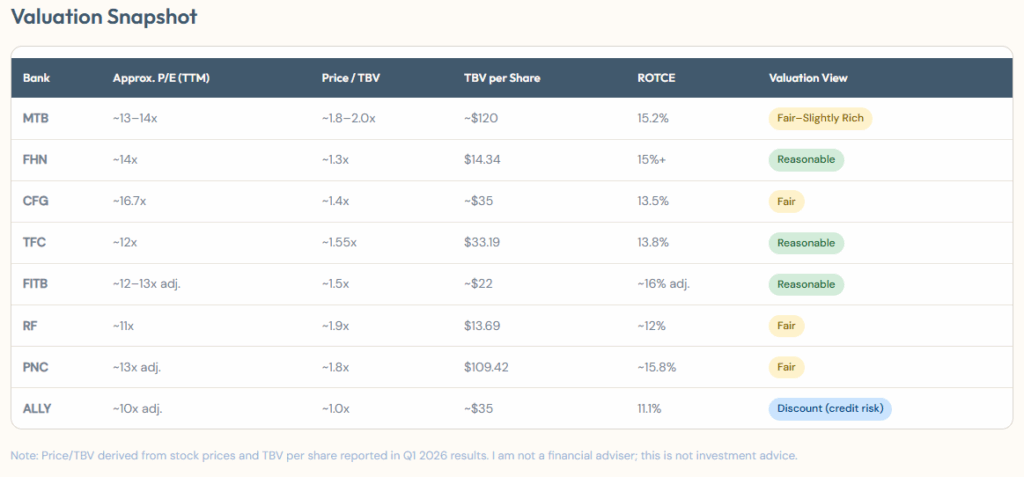
Before we go on, here are how the regional banks look in terms of the metrics:


We kept saying smaller banks but damn these banks are also not too small. Almost all of them are trading above 1 times their tangible book value.
Notice that their ROTCE is also not low. This is because… they also have wealth management in the business.

The value spot might be Truist and Fifth Third. After doing this report, I felt that PNC is a bank that I should watch more.
Different Degree of NDFI Risk
With most things, there are different degree of risk and the table below helps us figure out the terminology used and the different degree of risks:

How Are the 8 Regional Bank’s Exposure to NDFI?

If we look at this PNC and MTB are the ones that have more significant NDFI. The rest of them are very small.
What they Say About their Private Credit and NDFI Exposure in the Transcripts

What we are noticing is that every bank is not waiting to be asked about their exposure and are actively volunteering the information.
MTB, FHN, RF, PNC, FITB used investment-grade credit quality as the shield for their NDFI book.
We have to note that NDFI loans are often rated at platform level (the private credit fund) and not the underlying borrower level. The platform (a private credit fund) may be investment grade while its actual loan portfolio is full of leveraged, below-investment-grade credits. The banks know analysts know this, which is why explanations of collateral structures and borrowing base mechanics were so prominent.
If we rank what they say from the most confident to the least confident:
- PNC – not even on the curve
- FHN – less than 1%, all asset-backed
- FITB – deliberate avoidance
- MTB – smaller than peers, well-controlled
- CFG – disciplined 5% growth, no change planned
- RF – declining balances, mostly REITs
- TFC – structural protections but minimal voluntary disclosure
Fifth Third’s Dividend Finance is the highest risk because this is where their private credit adjacent lending is closer to the credit cycle stress.
M&T Bank – CFO Daryl Bible
The most detailed breakdown of any bank in the cohort. Bible walked through the NDFI book composition explicitly on the call:
“Our NDFI portfolio remains a smaller percentage of total loans compared to our peer group. Three portfolios — fund banking (subscription lines), residential mortgage warehouse lending, and institutional CRE (primarily lending to REITs) — comprise over two-thirds of the NDFI loans and are long-standing and relatively well understood by the market. Business credit intermediaries consist of approximately $700 million of wholesale lender finance, $600 million of…”
Key quote: “no single net charge-off greater than $10 million” — suggesting the NDFI book is performing cleanly. MTB is notably smaller relative to peers in NDFI and chose transparency as a defensive move. Management positioned it as a long-standing, well-understood business rather than an opportunistic recent bet.
Reading between the lines: Bible’s unprompted granular breakdown signals the bank had prepared for pointed analyst questions after the sector spotlight from 2025 failures. The fact that they led with “smaller than peer group” is deliberate reassurance.
First Horizon – CCO Thomas Hung
The clearest “we barely have any of this” statement in the cohort. Chief Credit Officer Thomas Hung, who was brought in specifically to field credit questions, stated directly:
“Private credit exposure is less than 1% of the loan book, and substantially all of that is backed by tangible assets like real estate, inventory, equipment, or accounts receivable.”
Management also noted the ACL is “approximately seven times our average net charge-offs over the last two years” — a very strong coverage statement. The bank’s fixed income capital markets business is explicitly separate from NDFI risk.
Reading between the lines: FHN’s CCO appearing on the call (unusual) and the pre-emptive specificity of the private credit statement suggests analysts were going to ask regardless. Hanging the answer on “tangible assets” is a deliberate signal that they avoid unsecured or second-lien private credit structures.
Citizens Financial Group – CEO Bruce Van Saun
The most interesting dynamic: an analyst directly asked whether Citizens would opportunistically grow NDFI as competitors pull back. CEO Van Saun’s answer was revealing:
“We’ve grown that book in a very disciplined manner, call it 5% a year, being very selective about who we want to bank and the type of vehicles that we bank and making sure we have the right structure. So I don’t really see us veering off of that. That served us well to where we’re positioned today… our baseline assumption is that we kind of keep to that mid-single-digit growth rate.”
Reading between the lines: The analyst question is itself telling — investors are watching which banks might opportunistically grab business from peers perceived to be stressed. Van Saun’s answer is a studied non-answer: not no, not yes, just steady-state discipline. The phrase “even if some people step back and there’s opportunities to do more, we’ll see” suggests the door is ajar but he wasn’t going to say so on a public call.
Truist Financial – CEO William Rogers & CFO Michael Maguire
Truist was notably less specific about NDFI than most peers.
From the Q&A section captured: Truist noted NDFI facilities are structured with “advanced rate limits, borrowing base mechanics, and meaningful equity positions beneath us, all of which are designed to provide significant loss protection in more stressed scenarios.”
Reading between the lines: The absence of proactive NDFI disclosure is notable. Truist is a $565B institution with meaningful non-bank lending, but chose not to offer granular NDFI colour voluntarily. Given the sector-wide analyst scrutiny, this silence will likely invite more pointed questions in Q2.
Fifth Third – CEO Timothy Spence
Fifth Third gave the most ideologically firm rejection of private credit in the cohort. Spence was direct and unusual in framing it as a deliberate strategic choice:
“Private credit and business development company exposures held under 1% by design, due to ‘deliberate’ risk avoidance rather than missed opportunities.”
The transcript also disclosed: “NDFI exposure kept at 7%” of the book (which post-Comerica is now $178B+ in loans, so ~$12–13B total). He also drew a sharp line around tech lending:
“Historically, tech infrastructure build cycles tend to overshoot, and obligors can be less clear than we prefer.” (Software/data centre lending under 1%.)
On Dividend Finance (a consumer NDFI-adjacent book they acquired): Spence acknowledged NCOs are ticking up because the tax bill changed the economics of the solar/home improvement lending product from lending to leasing — creating an unforeseen headwind. He called it “an industry facing significant disruption” and essentially said Dividend Finance is now in run-off mode.
Reading between the lines: Spence is positioning FITB as the bank that said no to the private credit gold rush when peers said yes. This is a strong differentiator statement — but the Dividend Finance admission undermines it slightly, because that was itself an NDFI-style consumer lending bet that went sideways for an unexpected structural reason.
Regions Financial – CFO Anil Chadha
Regions used slightly different terminology — “NDFR-related lending” (Non-Deposit Funding Related) rather than NDFI, which itself tells you they’re thinking about it slightly differently. Chadha’s key statement:
“An area that has not been a meaningful growth driver over the past year is NDFR-related lending. These loans reflect long-standing client relationships with predominantly investment grade credits with nearly half of balances associated with our long-standing REIT business. Private credit exposure remains limited, less than 2% of total loans, largely investment grade, well-enhanced. Existing client paydowns exceeded draws during the quarter.”
The last sentence is important: net NDFI/private credit balances are actually declining, meaning existing clients are repaying faster than Regions is extending new credit. That could mean either (a) disciplined pull-back, or (b) borrowers reducing their leveraged positions in an uncertain macro environment.
Reading between the lines: Regions flagged their REIT exposure as the dominant piece of NDFI — which is a relatively safe sub-category. But “paydowns exceeded draws” is slightly ambiguous: it could signal borrowers are under stress and deleveraging, or simply that Regions is not aggressively pushing this business.
PNC Financial – CEO Bill Demchak & CFO Rob Reilly
PNC gave the most combative and confident NDFI defence in the cohort. Demchak went on offence in his opening remarks, unsolicited:
“While we recognize that there are many market concerns out there — from energy prices to AI to private credit — we are not seeing anything that suggests these issues are broadly impacting our customers or our credit quality in the near term. Specifically regarding the increased attention on banks’ exposure to nondepository financial institutions, the sound bite you ought to walk away with here is that we do not see any loss content in this book and certainly do not see any exposure to a systemic event.”
Then came the most pointed quote of the entire cohort, when analyst Chris McGratty asked where NDFI risk ranks on PNC’s “wall of worry”:
Bill Demchak: “It is not even on the curve. If you go through that whole bucket, the riskiest piece in the whole thing is that little $5 billion slice that is to REITs, leasing, and this and that.”
Reilly added the specifics: NDFI loans 90% investment grade or equivalent; business credit intermediaries 80% composed of asset securitizations; $7 billion in CLOs mainly in AAA senior tranches. Management stated they “expect zero losses going forward.”
Demchak also offered a meta-commentary on the industry confusion: “I cannot speak to what other banks have in this category as the definition seems to capture random things. We are very outsized in our corporate receivables financing relative to others, which is a low-spread business with negligible risk. The bulk of our loans actually have nothing to do with private credit despite the regulatory category in which they reside.”
Reading between the lines: “Zero losses” is an extraordinary claim to make publicly. Demchak knows what he’s doing — it’s a direct response to market fears. The call-out of “corporate receivables financing” (essentially factoring/trade finance) is an important clarification: PNC’s $73B NDFI book is heavily weighted toward boring, secured trade finance rather than risky leveraged lending. This is the bank most willing to defend the NDFI category directly.
The Regional Banks Also Showed Improve Credit Quality, which Indicates the Health of the General Economy
Here is the Net Charge Off:

Net Charge Off are loans the bank wrote off as unrecoverable, net of recoveries, as a % of average loans. Under 0.5% is generally healthy for a broad commercial bank, anything over 1.5% signals significant stress.
The light bars were the quarter last year, the more solid bar is this quarter. You would notice almost all the banks have lower net charge offs except PNC. But PNC end up the lowest.
Here is the Nonperforming Loans (NPL) divide by loans:

NPL are loans where borrowers have stopped paying or are unlikely to repay. Under 1% is healthy for most banks.
Here is the Allowance for Credit Losses (ACL) divide by Loans:

This shows the reserve or cushion set aside for future losses. If this ratio shrinks it means less is provision or overconfidence.
You would notice that their ACL/Loan is about 1.5%. Then you look at the NCO% is 0.5% and less.
If in a normal economy, NCO of 0.5% is reasonable but in recession naturally we would see the NCO is higher. So an ACL/Loan of 1.5% is kind of showing the banks have roughly 3-5 years of “normal” loss absorption with zero additional provisioning.
In the grand scheme of things, this is a lot of provisioning.
For a 2008-style even, it is a 12-18 months of buffer against peak losses before the bank needs to generate substantial new provisions from earnings.
The reason these banks are not considered at risk of insolvency even in a bad scenario is that PPNR (pre-provision profit) is the real shock absorber. MTB earns ~$2.4B in PPNR per year. PNC earns ~$8–9B. Even if NCOs doubled to 1.0%, the additional provision expense — perhaps $500–700M for a mid-size regional — is a hit to earnings, not to survival. The 2008 crisis caused failures primarily at banks that were undercapitalised and over-concentrated in CRE, not at well-diversified commercial banks with strong PPNR. That’s precisely the profile most of this cohort is not replicating today.
PPNR = Revenue { Net interest income + fee income } – Operating Expenses
ACL is like an emergency bucket and every net income, the bank factors in a little more to build up this emergency bucket. If the ACL is enough, then the bank does not takes an earnings hit.
Taking an earnings hit affects the share price but its not a solvency issue.
So you got to look at it in levels.
Kyith, How High can the NCO Be in Recession?
Good question. Currently its less than 0.5% with some like PNC in even lower.
Great Financial Crisis
This is the real fxxk.
The total industry NCO rate was 0.5% in 2006 (same as now!) and it peak at 2.1-2.5% in 2009 to 2010.
That is like 4-5 times multiplier
But the damage is different by loan type:

The Real Estate and property one is a real WTF.
Many financial institutions were probably too concentrated in their loan books and you can see which one matter most. If we look at the 8 banks revenue mix almost all is C&I Commercial (50%), Consumer (30%) and Commercial Real Estate (20%).
Basket this risk is bigger than private credit lor!
Not all Recessions are like GFC
In the Covid recession the NCO rate went from 0.48% pre-pandemic to 0.55% in mid 2020. Massive government stimulus (PPP, moratoriums, direct payments) kept borrowers current.
In the Early 2000s Dot-com/Post 9/11 recession, the NCO rose from 0.50% to 1.1-1.2% at the peak in 2002. This was driven almost entirely by a C&I and telecom/tech credit bust — commercial loans to over-leveraged corporate borrowers. CRE barely moved.
If we look at these recession how does the ACL buffer help?
Mild/COVID-style recession: NCO rises to 0.6–0.8%. The bank burns through about 0.3–0.4 percentage points of the 1.5% ACL buffer per year before provisions rebuild it. No capital threat whatsoever. The buffer is massive relative to losses.
Early 2000s moderate recession: NCO rises to 1.0–1.2%. Bank burns ~0.7–0.8 percentage points of buffer per year before provisions kick in. Still manageable — banks would build provisions from earnings, which at 1.0–1.5% ROA are generating significant pre-provision profit. Painful for earnings, not for solvency.
Epilogue
Hope you find this useful. Hopefully next week I got the energy to do something similar.

Do Like Me on Facebook. I share some tidbits that are not on the blog post there often. You can also choose to subscribe to my content via the email below.
I break down my resources according to these topics:
- All my personal notes about how my philosophy behind my own money and how I manage it.
- Building Your Wealth Foundation – If you know and apply these simple financial concepts, your long term wealth should be pretty well managed. Find out what they are
- Active Investing – For active stock investors. My deeper thoughts from my stock investing experience
- Learning about REITs – My Free “Course” on REIT Investing for Beginners and Seasoned Investors
- Dividend Stock Tracker – Track all the common 4-10% yielding dividend stocks in SG
- Free Stock Portfolio Tracking Google Sheets that many love
- Retirement Planning, Financial Independence and Spending down money – My deep dive into how much you need to achieve these, and the different ways you can be financially free
- Providend – Where I used to work doing research. Fee-Only Advisory. No Commissions. Financial Independence Advisers and Retirement Specialists. No charge for the first meeting to understand how it works
- Havend – Where I currently work. We wish to deliver commission-based insurance advice in a better way.

Kyith is the Owner and Sole Writer behind Investment Moats. Readers tune in to Investment Moats to learn and build stronger, firmer wealth foundations, how to have a Passive investment strategy, know more about investing in REITs and the nuts and bolts of Active Investing.
Readers also follow Kyith to learn how to plan well for Financial Security and Financial Independence.
Kyith worked as an IT operations engineer from 2004 to 2019. Currently, he works as a Senior Solutions Specialist in Fee-only Wealth Advisory Firm Providend. All opinions on Investment Moats are his own and does not represent the views of Providend.
You can view Kyith’s current portfolio here, which uses his Free Google Stock Portfolio Tracker.
His investment broker of choice is Interactive Brokers, which allows him to invest in securities from different exchanges all over the world, at very low commission rates, without custodian fees, near spot currency rates.
You can read more about Kyith here.

WARCAT Automatic Litter Box丨Open Top, Child Lock, Gray&White | 10 sensors + child lock, 10L sealed drawer holds 10 days, no app/WiFi, open-top, works with any clumping litter, bags+mat.
$99.99 (as of October 11, 2026 03:20 GMT +00:00 - More infoProduct prices and availability are accurate as of the date/time indicated and are subject to change. Any price and availability information displayed on [relevant Amazon Site(s), as applicable] at the time of purchase will apply to the purchase of this product.)
Amazon Smart Plug, Works with Alexa, Simple Setup, Endless Possibilities (2-Pack)
$39.98 (as of October 11, 2026 03:20 GMT +00:00 - More infoProduct prices and availability are accurate as of the date/time indicated and are subject to change. Any price and availability information displayed on [relevant Amazon Site(s), as applicable] at the time of purchase will apply to the purchase of this product.)
Sheba Perfect Portions Cuts Wet Cat Food, Multipack, 2.6 oz, 24 ct | Chicken, Salmon & Turkey cuts in gravy, grain-free, protein-rich, no corn/soy, essential vitamins & minerals, twin-pack trays
$27.96 (as of October 11, 2026 03:11 GMT +00:00 - More infoProduct prices and availability are accurate as of the date/time indicated and are subject to change. Any price and availability information displayed on [relevant Amazon Site(s), as applicable] at the time of purchase will apply to the purchase of this product.)
Apple 2026 Mac mini Desktop Computer M6 chip | 12‑core CPU and 12‑core GPU, 16GB Unified Memory, 256GB SSD Storage
$779.99 (as of October 11, 2026 03:30 GMT +00:00 - More infoProduct prices and availability are accurate as of the date/time indicated and are subject to change. Any price and availability information displayed on [relevant Amazon Site(s), as applicable] at the time of purchase will apply to the purchase of this product.)













Post Comment