
Ridley Scott’s The Dog Stars: The Unexpected Twist That Will Flip Everything You Think You Know!
Ever caught yourself humming “Old McDonald Had a Farm” during a moment of pure uncertainty? Ridley Scott sure did — as a four-year-old war baby hiding under the stairs during The Blitz, hoping against hope that the bombs wouldn’t find him. Fast forward decades, and that haunting mix of fear and fragile hope wove itself into his latest cinematic venture, The Dog Stars. This isn’t your typical apocalypse flick stuffed with bleakness and doom; no, Scott’s crafting a story that asks not just how survivors endure, but why they even keep trying when the world as we know it has crumbled. Imagine gripping the controls of a single-engine plane, your loyal dog by your side, with nothing but the endless sky and scattered pockets of humanity left — what keeps you pushing forward? In a landscape etched with loss, fear, and a fair share of violence, Scott finds a thread of hope, a glimmer that maybe, just maybe, life can mean more than mere survival. Intrigued? Trust me, there’s more to this tale than meets the eye. LEARN MORE
 8 min read
Ridley Scott remembers when it seemed like there might not be a tomorrow. All he could do is hope for the best. And sing a song.
The future Gladiator and Alien filmmaker was around four years old when the German Luftwaffe bombarded England during The Blitz of World War II, and he remembers that frightening time vividly. “I was a war baby. So in a funny kind of way, that leaves a mark on your DNA,” he says. “When I was sitting under the stairs, while we were bombed at night by the Nazis, we were singing ‘Old McDonald Had a Farm’ and hoping we never got a direct hit.”
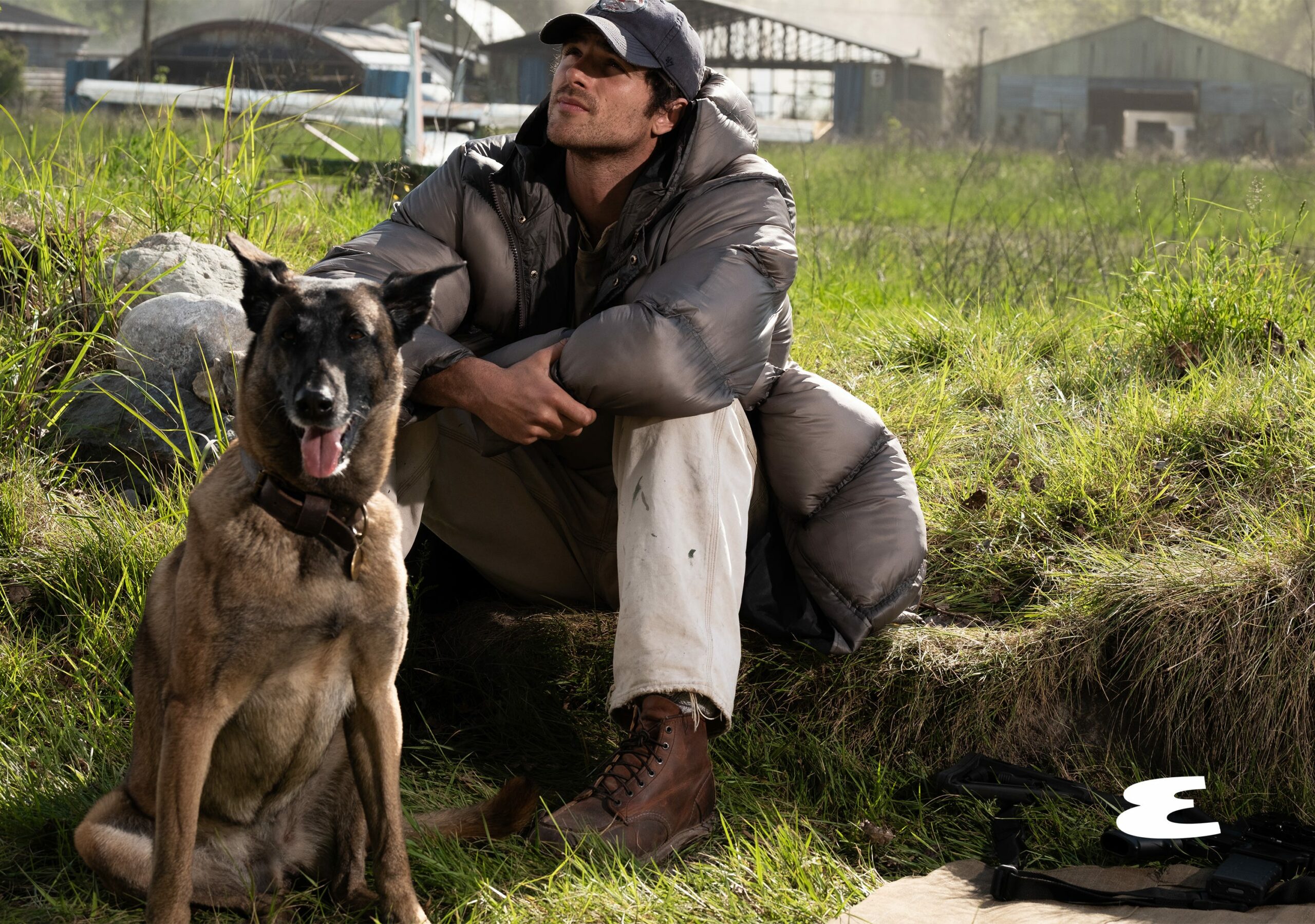
That long-ago memory surfaced as he talked about adapting author Peter Heller’s 2012 post-apocalyptic novel The Dog Stars, starring Jacob Elordi, Margaret Qualley, and Josh Brolin in a story set in the aftermath of global destruction. In this case, it’s not war but a lethal pandemic that has swept most of humanity off the globe. A few stragglers survive, including Elordi’s Hig, a pilot who has a single-engine Cessna he calls The Beast, a loyal blue heeler mutt named Jasper … and not much else. The dog and the plane are Hig’s version of singing “Old McDonald”—small comforts to keep him going when all seems lost.
The Dog Stars, coming to theaters in August, is an unusual end-of-the-world movie in this way. It’s not just about how a handful of people manage to survive, but why they even bother to try. “I think there’ve been rather too many apocalyptic movies,” Scott tells Esquire for this exclusive first look. “And I think I started off with a pretty tough one doing Blade Runner years ago. There was no end to the grimness of Blade Runner. In this, what I’m so pleased that came off was the strong feeling of hope. ‘It’ll be okay.’ If you do the right thing, it calls to mind the expression: God helps those who help themselves.”
God. Fate. Circumstance. Call it what you will. The point that Scott sees in Heller’s story is that life only matters when you’re living for more than yourself. The Macguffin in The Dog Stars, the thing everyone is seeking, is purpose. Where the characters find it, how they lose it, and what they’ll do to recover it is what sets this tale apart. “I think people will be surprised and engaged actually. I would say, hmm … charmed as well,” Scott adds. “Although, there is some violence.”
You can’t have the end of the world without at least a little of that.

Meet Jacob Elordi’s Hig, a pilot who has a single-engine Cessna he calls The Beast. To Hig’s right is Josh Brolin’s Bangley, a gun expert who isn’t big on conversation or sharing about his past.
The Dog Stars‘ title is ambiguous, even for those who read the story. It may refer to the figures that Hig envisions between stars in the night sky. The constellations of antiquity are forgotten or only dimly remembered, so he makes new connections where he can.
“There’s a section, a small fragment of the universe that relates to the dog star, and he explains that one night when he’s lying out with his dog,” Scott explains. There is no end of empty homes now that humanity has died off, but living in one tends to give thieves and killers a target. So, Hig tucks-in out in the wild. “They don’t like to sleep indoors because it’s dangerous. So they sleep outside in a sleeping bag, and he talks to the dog and points out the star that relates to the dog,” Scott says.
People love a pup, and there were several that helped play the crucial role of Jasper. “I had one dog who would chase an attack, one dog that you could roll on the ground with, and one dog that you could actually just be with, who would sit next to him on a plane, pant in delight and look out the window,” Scott says. “So I had three doggy characters that I adored. I absolutely loved them.”
Along with the canine handlers and trainers, the filmmaker found a sort of co-director in Elordi when it came to managing the Jaspers. “Jacob’s a farm boy who is good with animals anyway. He can drive tractors and shit like that. So he knows how to handle the dog,” Scott says. “I have two dogs, and I’m too kind and too sweet, so they don’t behave whatsoever. But Jacob would go, ‘Hey, now down, stop.’ And they’d do everything he said.”
For much of the story, Hig’s only human companion is Brolin’s Bangley, a gun expert who isn’t big on conversation or sharing about his past. In Heller’s novel, Hig assesses his terse neighbor as “a rancher clearly, some sort of soldier along the way.”
What’s clear to Hig is that Bangley knows his way around weapons of war and has gathered an arsenal that keeps their small airport near the Rockies safe from the occasional marauder who wanders across the little homestead. Brolin, who previously worked with Scott on 2007’s American Gangster, plays the implacable watchman as someone who tolerates Hig, and might even like him, but still keeps him at arm’s length.
“I see him as someone who is fiercely protective of the things that he loves, that he loves deeply. The few things he is able to love,” Brolin tells Esquire. Hig isn’t sure about his companion, mostly because it seems like Bangley isn’t sure about him. Brolin says that surly demeanor is how you know he cares.
That manifests as resentment toward Hig for repeatedly leaving their safe space to take his plane aloft. Bangley doesn’t get why he risks it, but Hig insists he must scout for hunting grounds, scavenge needed supplies, and make nice with the scattered communities of infected people that Hig calls “Menonnites.” They exist almost the way leper colonies once did, clusters of people who are dying from disease in slow motion. Benedict Wong, who also previously worked with Scott as the pilot Ravel in Prometheus and the Jet Propulsion Lab chief Bruce Ng in The Martian, plays a farmer in one of these encampments.
“You might say if there was a head Mennonite, it’s Benedict,” Scott says. “Somehow they were lucky in having a valley that can only really be spotted from the air, or by a very rough cart track. That’s how Benedict hid, and how Elordi gradually got to know that they were there. He’d fly over and once saw cattle, and then children. He figures if you’ve got children, that you’re harmless.”
But Bangley doesn’t see the usefulness of such missions of mercy. He has a love-hate relationship with those he selects to safeguard, which so far includes Hig, the dog Jasper, and no one else. “They don’t come across as loved through Bangley. They come across as an irritant that he has to adhere to, because that is where his honor lies. He is about honor. He is all about protection. He is all about integrity,” Brolin says. “He lives his life in the razor sharpness of integrity.”
Scott says he enjoyed drawing laughs out of the “gallows humor relationship” between the odd couple, along with the heavier existential questions looming over it all. “Bangley is an expert in warfare,” the director explains. “As Hig says to him, ‘You love this shit. Bangley, you live for this stuff. But I don’t. I need to find something else.’”
On his occasional scouting missions, circling surrounding regions in The Beast, Hig eventually locates that “something else” he needs. It turns out to be someone else. And her name is Cima.

Margaret Qualley’s Cima (right) spends her time doing subsistence farming and guarding against invaders.
Hig is a pilot with nowhere to go. Qualley’s Cima (pronounced SEE-mah) is a medic with no one to heal. She endures in her own remote fortification in a similar situation as Hig. She spends her time doing subsistence farming and guarding against invaders, only her stoic guardian is her father, Pops, played by Guy Pearce, yet another Scott veteran from Prometheus and Alien: Covenant.
“I was born in Montana and my dad was a rancher, so there was something about it that felt familiar and natural to me,” Qualley tells Esquire. “I was drawn to the purity of the movie. And in Cima specifically, I was really attracted to her hopefulness and her ability to see people for who they are.”
A crucial element was casting someone who emanated the trustworthiness that Cima senses. Asked what he saw in Elordi, Scott replies: “He may get pissed off, but I kept saying, ‘This is Gregory Peck on steroids.’ He’s got an elegance that Peck had, and a presence that Peck had, that not many have. He’s blessed with that.”
Almost everyone else in this life-after-people scenario harbors ill intent, so Cima has only endured this far because Pops was a Navy SEAL. He has used his lethal training to keep other murderous survivors either far away or six feet under, which makes meeting people difficult for the young woman. When she encounters Elordi’s Hig there is an obvious attraction: Last woman on Earth, meet the last man on Earth. Even if they don’t restart humanity, they might bookend it as a last-gasp Adam and Eve.
Scott says the key was not to overthink this relationship. He encouraged improv between the two as the characters figured each other out. “I’m one of those directors who has eight cameras handy. I say, ‘Right, get on the floor. Action!’” he says. “I want to be surprised. We all know what it is. We know what the relationship is. I want to see what they’ve got in them. I’m looking for originality, otherwise you can talk something dead.”
The pair of actors came with their own individual prep and notions of what should happen in this end-times courtship, Qualley says. “Ridley really encourages spontaneity. It just all happened so fast.”
Awkwardness was a key ingredient, she added. “And I think that Jacob and I are both real awkward, so we didn’t have to put any of that on. That part came a little too easy.”
How will they fit in with Bangley? With the Mennonites? Should they stay where they are or go elsewhere? These are questions for the film to answer.
“Hope” is the word she and Scott both keep using to describe The Dog Stars. The Earth isn’t completely lifeless, after all. People are gone, but nature persists. Perhaps something good between the people who remain can too.

“He may get pissed off, but I kept saying, ‘This is Gregory Peck on steroids,’” Scott says of Elordi. “He’s got an elegance that Peck had, and a presence that Peck had, that not many have. He’s blessed with that.”
This is where Scott’s own history comes back into play. After surviving The Blitz, he was about nine years old when World War II ended and his engineer father was dispatched to Hamburg, Germany, to help the enemies who once tried to level their home rebuild their own.
“My dad was taken into Germany with the Americans on the Marshall Plan,” says Scott, who was stunned by the destruction he witnessed. “We really bloody creamed it. It’s like we dropped several hydrogen bombs there. It was still destroyed when I got there, 18 months after armistice. So even as a child, I remember the shocking sight of a city that’s flattened.”
Today, Hamburg is a vibrant city at the end of the Elbe river, leading to the Baltic Sea, instead of the wasteland he remembers. The Dog Stars is about a similar idea: What is lost can be found again. Adversaries can become allies. Maybe something good can emerge again. Small mercies and such.
That’s where the hope of The Dog Stars can be found. Alongside hope comes faith, based on the spiritual way the filmmaker connects the dots of Heller’s story. “There will always be survivors. At least, I hope so,” Scott says. “And if you believe in God-given decisions, He makes sure that there are survivors with a specific plan to rebuild and start again.”
GHOST Energy Drink, Zero Sugars, 12-Pack, A&W Root Beer, 16oz | Energy & Focus Pre Workout Drink, No Artificial Colors, Gluten-Free, Vegan - 200MG Natural Caffeine, L-Carnitine, Taurine
$29.99 (as of October 11, 2026 03:09 GMT +00:00 - More infoProduct prices and availability are accurate as of the date/time indicated and are subject to change. Any price and availability information displayed on [relevant Amazon Site(s), as applicable] at the time of purchase will apply to the purchase of this product.)
Hint Flavored Water Zero Sugar 0 Calories - Best Sellers Variety (12 pack) | Crisp, refreshing water, fruit flavors. 0 calories, 0 sugar, 0 sweeteners. Hydration for wellness. Gluten-free, Kosher, Vegan
$13.46 (as of October 11, 2026 03:09 GMT +00:00 - More infoProduct prices and availability are accurate as of the date/time indicated and are subject to change. Any price and availability information displayed on [relevant Amazon Site(s), as applicable] at the time of purchase will apply to the purchase of this product.)
Amazon Smart Plug, Works with Alexa, Simple Setup, Endless Possibilities (2-Pack)
$39.98 (as of October 11, 2026 03:20 GMT +00:00 - More infoProduct prices and availability are accurate as of the date/time indicated and are subject to change. Any price and availability information displayed on [relevant Amazon Site(s), as applicable] at the time of purchase will apply to the purchase of this product.)
Banana Bunch (4-5 Count)
(as of October 11, 2026 03:09 GMT +00:00 - More infoProduct prices and availability are accurate as of the date/time indicated and are subject to change. Any price and availability information displayed on [relevant Amazon Site(s), as applicable] at the time of purchase will apply to the purchase of this product.)











Post Comment